


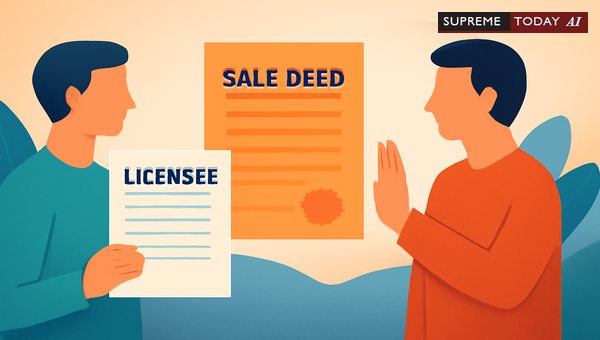
Can a Licensee Challenge the Sale Deed of the Property They Are Licensed to Use?
Imagine you're using a property under a agreement—perhaps a shop, residence, or commercial space. The owner decides to sell it, and you wonder: Can a licensee challenge the sale deed of the property he is licensed to use? This is a common concern for licensees in India, where the line between temporary use rights and can blur legal battles.
In this post, we break down the legal position, drawing from key judgments and principles. Note: This is general information based on precedents and not specific legal advice. Consult a qualified lawyer for your situation.
The Nature of a : Personal Right, Not
A is fundamentally a to use property, not a transfer of interest or . Unlike a , which creates a , a is and does not confer . This distinction is crucial when considering challenges to a sale deed.
Legal documents emphasize this limitation. For instance, 2003 0 Supreme(P&H) 1370 states: > The is exclusively for the Right to use of the Premises and may not in any way be treated as any sale, Agreement to sell, , transfer, etc. and Save as otherwise provided in this Agreement, no right, or interest in the Premises shall pass to the Licensee by virtue of these presents.
It further clarifies: > The licensee shall not make any structural additions or alterations in the Premises, and if any addition or alterations are permitted then the Licensee shall ensure that upon vacating the Premises, the Licensee shall remove all such fittings and alterations and restore the Premises in its original condition. 2003 0 Supreme(P&H) 1370
Similarly, 2015 0 Supreme(Del) 4149 notes: > As submitted above, the Licensee does not get any interest in the licensed property but only gets a permission to use the licensed property in a particular manner. 2015 0 Supreme(Del) 4149
These provisions underscore that licensees lack the (standing) to interfere with the owner's right to sell.
Main Legal Finding: Generally, No Challenge Possible
A licensee generally cannot challenge the validity of a sale deed, provided the has been validly terminated and no proprietary interest exists beyond the . Courts consistently hold that once terminated, the licensee's rights evaporate, leaving no basis to contest the sale. 2018 0 Supreme(Del) 3202 2023 4 Supreme 376
Key points include:- A creates a to use the property, not .- Post-termination, no proprietary rights remain to challenge sale deeds.- Rights are non-transferable and . 2021 0 Supreme(Guj) 97 2013 0 Supreme(Del) 1405
Impact of Termination
Termination is pivotal. Once lawfully ended, the licensee's possession ceases, and they cannot claim ongoing rights. 1984 0 Supreme(Pat) 277 affirms: > The of the plaintiffs on the suit property was proved from the revenue records... The defendant's status on the suit property was held to be that of a licensee, and he could not have acquired any right or in the property once the stood terminated. 1984 0 Supreme(Pat) 277
2023 4 Supreme 376 adds: > Entry of defendant-appellant over part of suit property subsequently is simply as a licensee of plaintiff-respondent... He does not continue to occupy it in capacity of owner. 2023 4 Supreme 376
2018 0 Supreme(P&H) 4543 reinforces: > There is no vested right of any type to remain in possession of the property of respondent No. A licence stands terminated the moment the licensor conveys a notice of termination of a licence. The petitioner, herein, is residing in the house of respondent No. 1 on the basis of concession given by his father in the property owned by him. He, as a licensee, is only permitted to enjoy the possession of the property licensed but without creating any interest in the property. 2018 0 Supreme(P&H) 4543
Judicial Precedents: Licensees Lack Standing
Courts have repeatedly sided against licensees. In 1999 3 Supreme 485, the Court held that a licensee cannot challenge a sale deed due to lacking proprietary interest. 1999 3 Supreme 485
2005 0 Supreme(Guj) 353 observes that revenue entries based on valid sale deeds cannot be challenged by licensees without independent rights. 2005 0 Supreme(Guj) 353
Other precedents echo this. A licensee's challenge requires proving , , or —not mere occupancy. 2023 0 Supreme(Ker) 688 2023 0 Supreme(Del) 4884
For example, in petrol pump cases like Bharat Petroleum (referenced in 2024 Supreme(Online)(Del) 32681 2024 Supreme(Online)(Del) 32682), the Court examined termination for use in selling petroleum products, affirming legal possession remains with the owner. 2024 Supreme(Online)(Del) 32681
Exceptions: When a Challenge Might Succeed
Exceptions exist if the licensee holds , such as a or . Mere post-termination does not suffice.
Additionally, challenges may arise on grounds like in the sale or . 2023 0 Supreme(Ker) 688 notes licensees must seek injunctions if the sale affects rights, but not directly contest validity without strong evidence.
stresses: > can be executed by a seller if he has to the property.
In liquor scenarios, use is restricted, and termination follows non-compliance. 2024 Supreme(Online)(Del) 32493
Additional Insights from Related Cases
agreements often limit use, prohibiting subletting or alterations without consent.
Deepak S. Kavadiya VS Addl. Divisional Commissioner Konkan Division -
discusses demands post-notice, including sale deed execution for licensed premises used residentially. 2024 Supreme(Online)(Del) 32683 ties into circle rates for undervalued sales, but reinforces licensee limitations.Courts distinguish licenses from leases under . 2015 0 Supreme(Del) 4149 Burden of proof lies on the licensee to show more than .
Bullet-point analysis from sources:- Licensees cannot challenge merely on use; need proof. 2023 0 Supreme(Ker) 688- Sale deeds require registration; licenses do not transfer . 2023 0 Supreme(Del) 4884- Temporary rights mean no claim. 2023 Supreme(Online)(DEL) 7084
Practical Recommendations
- For Licensees: Document any proprietary claims clearly. Opt for leases if protection against sales is needed.
- For Licensors: Terminate licenses formally before sales to avoid disputes.
- General Advice: Verify agreements; consider circle rates for stamp duty in sales. 2024 Supreme(Online)(Del) 32681
Parties should prioritize enforceable rights over mere licenses.
Key Takeaways and Conclusion
In summary:- Licenses grant temporary use, not . 2003 0 Supreme(P&H) 1370- Post-termination, no standing to challenge sale deeds. 2018 0 Supreme(Del) 3202- Exceptions require independent interests or proof.- Law distinguishes licenses clearly from leases/.
A licensee, absent proprietary interest, typically cannot challenge the sale deed—especially after valid termination. This protects owners' alienation rights while limiting permissive users. For tailored guidance, seek professional legal counsel.
References
- 2003 0 Supreme(P&H) 1370 - as personal right.
- 2018 0 Supreme(Del) 3202 - No challenge post-termination.
- 2023 4 Supreme 376 - Licensee not owner.
- 1984 0 Supreme(Pat) 277 - Rights cease on termination.
- 1999 3 Supreme 485 - Lacks proprietary interest.
- 2005 0 Supreme(Guj) 353 - Valid sales unchallenged.
- 2023 0 Supreme(Ker) 688 - -based challenges only.















