Searching Case Laws & Precedent on Legal Query..!
Scanned Judgements…!



Searching Case Laws & Precedent on Legal Query..!
Scanned Judgements…!
Limitation Period for Recovery of Money by Government - The general limitation period for suits involving government money varies based on the nature of the claim. For claims not specified elsewhere, Article 113 of the Limitation Act provides a period of 3 years from the date the cause of action arises. However, certain claims, such as those related to government dues like electricity or promissory notes, may have different limitation periods, typically 3 years from the date of the agreement or execution (e.g., Articles 35 and 54). In some cases, the limitation period can extend up to 30 years, especially under Article 112, which applies to suits by private persons but may be relevant to government claims depending on context 2024 0 Supreme(Guj) 662, 2024 0 Supreme(Kar) 377, 2025 0 Supreme(Telangana) 39, 2023 0 Supreme(Del) 5052.
Acknowledgment and Payment - Under Section 19 of the Limitation Act, acknowledgment of debt or payment made before the expiry of the limitation period can extend the time for recovery. For government claims, proof of payment or acknowledgment is crucial to avoid the bar of limitation 2023 Supreme(Online)(Mad) 101591.
Government's Negligence and Delay - There is concern over the lethargy or negligence of government officials in timely filing suits or pursuing recovery, which can result in the loss of public money and property. It is emphasized that the limitation law applies equally to government and private parties, and delays can hinder the recovery process 2024 0 Supreme(Ker) 101.
Special Circumstances and Court Decisions - Certain statutes like the Electricity Act or specific directives (e.g., Supreme Court orders) may modify limitation periods or their computation, especially in cases involving public schemes or accounts. Courts have also highlighted the importance of correctly calculating limitation periods, excluding certain days, and adhering to prescribed timeframes to prevent unjust dismissals of valid claims 2023 0 Supreme(Jhk) 379, 2025 0 Supreme(Telangana) 39.
Specific Examples - Claims based on promissory notes or loans generally have a 3-year limitation from the date of the instrument or grant of loan. For instance, suits based on promissory notes are typically barred after 3 years from the date of execution unless acknowledgment or payment extends this period. Similarly, recovery suits against government companies or guarantors have specific timeframes, often around 3 years from the date the amount became payable 2024 0 Supreme(Ker) 101, 2024 0 Supreme(SC) 438, 2024 0 Supreme(All) 455.
Analysis and Conclusion:The limitation period for the government to recover money is primarily governed by the Limitation Act, with most claims falling within 3 years from the cause of action or relevant date (such as the date of the agreement, execution, or acknowledgment). Certain claims, like those under specific statutes or involving government property, may have longer periods, up to 30 years. Acknowledgments, payments, or specific legal provisions can extend these periods. Proper computation of limitation, adherence to procedural requirements, and timely action are crucial for effective recovery of government funds. Negligence or delays by officials can jeopardize recovery, but the law applies equally to government and private entities 2024 0 Supreme(Guj) 662, 2023 Supreme(Online)(Mad) 101591, 2024 0 Supreme(Ker) 101.
References:- 2024 0 Supreme(Guj) 662- 2023 Supreme(Online)(Mad) 101591- 2024 0 Supreme(Ker) 101- 2024 0 Supreme(SC) 438- 2024 0 Supreme(Kar) 377- 2023 0 Supreme(Del) 5052- 2025 0 Supreme(Telangana) 39- 2023 0 Supreme(Cal) 1131- 2023 0 Supreme(Jhk) 379- 2024 0 Supreme(All) 455
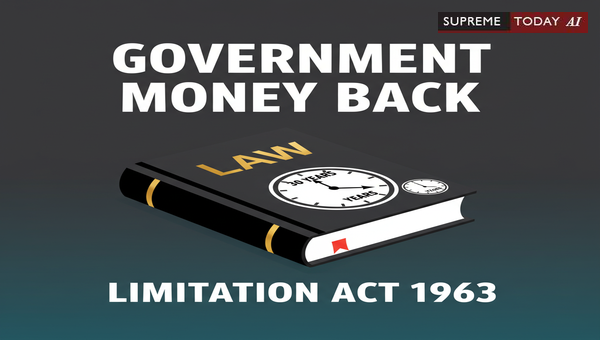
When it comes to recovering money owed to the government, time is of the essence—but how much time exactly? The question to Recover Money by Government is a common concern for public authorities, businesses, and individuals dealing with government dues, contracts, or refunds. Governed primarily by the in India, these periods can vary significantly based on the claim's nature, preventing while balancing .
This blog post breaks down the key rules, exceptions, and strategies, drawing from statutory provisions and case insights. Whether you're a government official pursuing dues or a private party facing recovery actions, understanding these timelines is crucial to avoid dismissals on limitation grounds. Note: This is general information; consult a legal professional for advice tailored to your situation.
The sets time limits for filing suits to recover money, with special provisions for government claims. Generally, private parties have 3 years for most money recovery suits, but the government enjoys extended periods in certain scenarios to protect public funds 2023 0 Supreme(Ker) 184.
Under , the State Government (or Central Government) has a generous 30 years from when the amount became due to enforce any claim for money not otherwise provided for in the Act. This applies to broad government suits against individuals or entities, far exceeding the standard 3-year period for private claims. As noted, The State Government has a period of 30 years to recover amounts due 2023 0 Supreme(Ker) 184.
This extended timeline reflects the in recovering government dues, such as taxes, loans, or property-related payments. However, it's not unlimited—courts scrutinize if the claim falls squarely under or a more specific provision 2024 0 Supreme(Guj) 662.
Not all government recoveries qualify for 30 years. Many claims revert to shorter periods:
Additionally, claims like promissory notes or loans often carry 3 years from execution or when payable () 2024 0 Supreme(Ker) 101, 2024 0 Supreme(SC) 438.
For secured debts, provides 12 years to enforce payment from when the money becomes due. The period of limitation is twelve years to enforce payment of money secured when the money sued for becomes due under of the 2018 0 Supreme(Ori) 788, 2019 0 Supreme(Ori) 125. This may apply to government-backed securities or mortgages.
Interest claims under are limited to 3 years from when interest accrues, separate from principal recovery 2017 0 Supreme(Pat) 818. For unspecified claims, offers 3 years from the 2024 0 Supreme(Guj) 662.
Time isn't always rigid. allows written acknowledgments of liability to restart the clock from the acknowledgment date 2020 0 Supreme(Ori) 96. Similarly, extends periods via part-payments before expiry 2023 Supreme(Online)(Mad) 101591.
COVID-19 brought temporary relief: In computing the period of for filing any Suit... the period from to shall be excluded 2023 0 Supreme(Cal) 1131. Courts emphasize proper computation, excluding holidays or specific days 2023 0 Supreme(Jhk) 379.
N
on-payment of pension is a recurring cause... the father of the petitioners was not entitled for the arrears of pension prior to 3 years of his claim 2019 0 Supreme(MP) 310.T
here is concern over the lethargy or negligence of government officials in timely filing suits... which can result in the loss of public money 2024 0 Supreme(Ker) 101.Courts won't enjoin statutory recoveries unless time-barred, stressing timely action 2019 0 Supreme(Ori) 125.
To navigate these rules effectively:- Assess Claim Type: Determine if (30 years) or a 3/12-year provision applies.- Document Acknowledgments: Secure written admissions or payments to extend timelines.- Act Promptly: Avoid ; compute periods accurately, excluding extensions.- Seek Counsel: Complex cases involving coercion, mistakes, or statutes need expert review.
In summary, while the government typically has 30 years under for general money recovery claims, specific scenarios like public funds, mistakes, or contracts limit it to 3 years (Articles 24, 113), with 12 years for secured debts (). Acknowledgments under Sections 18-19, statutory tweaks, and case law add layers, but negligence risks public losses.
Key Takeaways:- Prioritize early filing to safeguard claims.- Limitation applies uniformly—government isn't exempt.- Always verify with primary documents and professionals.
This framework ensures efficient public fund recovery while upholding fairness. For personalized guidance, consult a lawyer. References include 2023 0 Supreme(Ker) 184 1994 0 Supreme(MP) 234 2023 0 Supreme(Chh) 129 2020 0 Supreme(Ori) 96 2024 0 Supreme(Guj) 662 2023 Supreme(Online)(Mad) 101591 2024 0 Supreme(Ker) 101 2023 0 Supreme(Cal) 1131 2019 0 Supreme(Ori) 125 2019 0 Supreme(MP) 310 2018 0 Supreme(Ori) 788 2017 0 Supreme(Pat) 818 2015 0 Supreme(Pat) 270 2023 0 Supreme(Jhk) 379 2024 0 Supreme(SC) 438.
#LimitationAct #GovtMoneyRecovery #LegalGuide


For money payable to the plaintiff for money paid for the defendant. ... Any suit for which no period of limitation is provided elsewhere in this Schedule. ... It is therefore submitted that the suit of the plaintiff is well within the period of limitation as per Article 113 of the Act. The decision was taken on 8/4/1993 and the suit was filed on 6/4/1996 and hence the suit is we....

Unless the payment is made by the Defendant towards the liability before the expiration of the period of limitation, there cannot be an acknowledgement in terms of S.19 of the Act to save the period of limitation. ... the cause of action arose for recovery of money. ... The Plaintiff is a Government Company. The Defendant is also a Company registered under the Companies Act, 1956. The Pl....

Therefore, the appropriate Governments are hereby requested to consider enactment of an exhaustive legislation to deal with this menace to avoid losing government property and money/ public property and money due to the lethargy on the part of the officials, without much delay, adverting to the interest ... A preposterous proposition is sought to be propounded that if there is some merit in the case, the period of delay is....

The period of limitation if any was 3 years from 31.07.2004, when the amount stood and payable by Respondent No. 3 Company (in Liqn.). The period to recovery from either the Company or the Guarantors who stood surety for the said amount expired in the year 2007. ... It would be ironic if an Act for speedy recovery is held as enabling a creditor who has delayed recovery beyond the period of limitation to r....

as regards a suit for recovery of money the period of limitation of three years has to be calculated from the date of the agreement. ... While coming to the said conclusion, the trial court held that the limitation period for the recovery of money would commence from the date of the agreement. ... The period of limitation is to be calculated in terms o....

Article 19 of the Schedule to the Limitation Act prescribes the period for money payable for money lent as under: Description of suitPeriod of limitationBalbir Rajput (supra), another learned Single Judge of this Court reiterated that each transaction of loan being independent from one another, as per Article 19 of the Schedule to the Limitation Act, the limit....

While computing the period of limitation, as per Section 12 (1) of the LIMITATION ACT , for any suit, appeal or application, the day from which such period is to be reckoned shall be excluded. ... and came to an erroneous conclusion that the suit was filed within the limitation period of three years. ... ACT and observed that the said Section does not specify as to how the peri....

period of limitation embedded in the statute to file appeals or applications. ... It was clearly stated that in computing the period of Limitation period for filing any Suit, Appeal, Application or proceeding, the period from 15.03.2020 to 28.02.2022 shall be excluded. ... CBI, Kolkata, the self Contained Note was forwarded to the Department of personnel and Training, Governmen....

schemes during the period 1991 to 2002. ... It is the further specific case of the State Government that the petitioner being a Government Servant is responsible for giving accounts of public money and any advance taken should either be spent on execution of the schemes or return the monies to the public exchequer. ... The learned counsel appearing for the State would submit that the specific case of the State Go....

Learned AGAI submits that the complaint having been filed within one month from the date when the cause of action arose, the same was within the prescribed period of limitation, and, therefore, the orders passed by the courts below cannot be faulted on the question of limitation. ... period. ... (i) cheque is presented to the bank within a period of six months from the date on which it is drawn or within....

In view of the same, Article 62 of the Limitation Act shall apply. The period of limitation is twelve years to enforce payment of money secured. Further, a statutory authority cannot be injuncted by way of permanent injunction to discharge the statutory function. So calculated, it cannot be said that the Corporation has issued notice under Sec.29 of the S.F.C Act to recover a time barred debt.

Thus if it is held that non-payment of pension is a recurring cause and every month would give rise to fresh cause of action, then it is clear that the father of the petitioners was not entitled for the arrears of pension prior to 3 years of his claim. Thus it is held that because of delay and latches, the case of the father of the petitioners for payment of pension from 1984 to 2005 cannot be considered. However, for recovery of money, the period of limitation under the Limitation A....

The period of limitation is twelve years to enforce payment of money secured when the money sued for becomes due under Article 62 of the Limitation Act, 1963. The instant case is governed under Article 62 of the Limitation Act.

The aforesaid provision goes to show that if only claim of interest is made, then Article 25 of the schedule of Limitation Act, 1963 comes into play. The Tribunal refused to pay the interest on principal dues amount beyond the period of three years after taking note of Article 25 of the schedule of Limitation Act, 1963. Article 25 of the schedule of Limitation Act, 1963 says that for money payable for the interest upon money due from the defendant to the plaintiff, period of limitati....
If the mistake was known in these cases on or shortly after January 17, 1956 the delay in making these applications should be considered unreasonable. The period of limitation prescribed for recovery of money paid by mistake under the Limitation Act is three years from the date when the mistake is known. If, on the other hand, as Mr. Andley seems to argue, the mistake was discovered much later, this would be a controversial fact which cannot conveniently be decided in writ pr....


An indispensable Tool for Legal Professionals, Endorsed by Various High Court and Judicial Officers
Please visit our Training & Support
Center or Contact Us for assistance

Scan Me!
India’s Legal research and Law Firm App, Download now!


For Daily Legal Updates, Join us on :



 Back to top


