


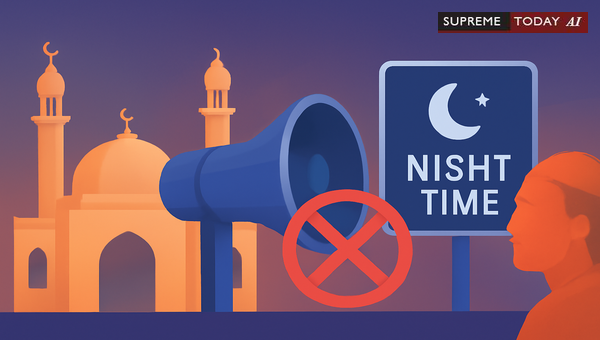
Loudspeaker Rules at Religious Places in India
In a diverse country like India, religious practices are deeply ingrained in daily life. Temples, mosques, gurudwaras, and churches often use loudspeakers for prayers, azaan, bhajans, and announcements. But what happens when the sound disturbs neighbors, students, or patients? The question of loud speaker usage at religious places arises frequently, sparking debates on religious freedom versus public peace.
This blog explores the legal framework governing loudspeaker use at religious sites, drawing from key court judgments and regulations. While religious rights are protected under Articles 25 and 26 of the Constitution, they are not absolute and must align with public health and order. Here's a comprehensive guide to the rules, restrictions, and best practices.
Regulatory Framework:
The cornerstone of regulation is the , notified under the . These rules strictly control loudspeaker and public address systems to curb noise pollution.
Key mandates include:- Prior Written Permission: No loudspeaker or public address system can be used without written permission from the competent authority. As stated, a loud speaker or a public address system shall not be used except after obtaining written permission from the authority 2023 0 Supreme(Mad) 1587 2019 0 Supreme(P&H) 1554.- Noise Level Standards: Usage must adhere to prescribed ambient noise standards, varying by zone (residential, silence, industrial).- Timing Restrictions: Prohibited during night hours (10 p.m. to 6 a.m.) in most areas 2019 0 Supreme(P&H) 1554.
Courts have reinforced these, directing religious institutions like temples, mosques, and gurudwaras to comply even during daytime 2019 0 Supreme(P&H) 1554.
Night Hours and Sensitive Area Restrictions
Night-time use is heavily restricted to protect sleep and health:- General Ban: Loudspeakers are barred from 10 p.m. to 6 a.m. in residential and silence zones (near hospitals, schools, courts) 2019 0 Supreme(P&H) 1554 2024 0 Supreme(P&H) 1186.- Limited Exceptions: During cultural or religious festivals, permission may allow use up to midnight, but limited to 15 days per year, with noise not exceeding 10 dB(A) above ambient levels 2019 0 Supreme(P&H) 1554.
Near sensitive areas:- Prohibited during examinations, near educational institutions, or hospitals 2019 0 Supreme(P&H) 1554 2024 0 Supreme(P&H) 1186.- In one case, courts directed no microphone/loudspeaker use on temples or mosques beyond permissible decibels, banning extension speakers outside premises: Both temples and mosque would be allowed to use microphone/loudspeaker within permissible limit of decibels i.e. at low noise levels within the prescribed decibels limit—Temple or mosque management would not be allowed to use amplifiers and any extension speaker outside the premises 2013 0 Supreme(All) 1492.
Permission Process and Enforcement
Religious places must apply for written permission, specifying duration, volume, and purpose. Authorities monitor compliance, with directives for regular inspections 2019 0 Supreme(P&H) 1554 2024 0 Supreme(P&H) 1186.
Enforcement is strict:- Police and district magistrates oversee, with personal responsibility on officials.- Violations attract penalties under , including fines and seizures.
A ruling declared parts of state law for conflicting with central rules, emphasizing: the entire subject regarding the use of loudspeakers and public address system and sound producing instruments is now regulated by 2015 0 Supreme(MP) 14.
Balancing Religious Freedom and Public Rights
Article 25 guarantees freedom of religion, but subject to public order, health, and morality. Courts clarify no absolute right to noise: and muchless force the to suffer the same. That, 2015 0 Supreme(MP) 14.
In a COVID-19 PIL, the allowed azaan by human voice from minarets but banned amplifiers: Azan may be an but recitation of Azan through loudspeakers or other sound amplifying devices cannot be said to be an integral part of religion 2020 0 Supreme(All) 596. This highlights that while core practices are protected, amplified noise isn't.
Other cases echo this:- Religious meetings at residences dismissed if violating rules 2023 0 Supreme(Mad) 1587.- Protests with loudspeakers regulated to avoid resident inconvenience 2018 0 Supreme(SC) 732.
Exceptions and Permissible Uses
Limited leeway exists:- Festivals: Up to 15 days/year, low volume, short night extensions 2019 0 Supreme(P&H) 1554.- Closed Premises: Allowed in auditoriums, halls per norms 2019 0 Supreme(P&H) 1554.- Low-Volume Use: Within decibel limits, no outdoor extensions 2013 0 Supreme(All) 1492.
Penalties for Violations
Breaches invite:- Fines and imprisonment under .- Equipment confiscation.- Strict action during lockdowns or exams 2020 0 Supreme(All) 596
ABDUL KAYYUM vs SRI NEERAJ GUTPA PRIN. SECY. HOME LKO. AND 3 OTHERS
.Authorities must act on complaints, ensuring effective implementation of laws to prevent infringement of rights 2023 0 Supreme(Mad) 1587.
Recommendations for Compliance
To avoid issues:- Always seek prior permission.- Use volume limiters and direct sound inward.- Schedule outside night/sensitive hours.- Promote awareness: Religious leaders and public can collaborate for harmony.
Authorities should ramp up monitoring during festivals and exams 2019 0 Supreme(P&H) 1554.
Key Takeaways
- Permission is Mandatory: No exceptions without written approval 2019 0 Supreme(P&H) 1554.
- Respect Timings and Limits: Night bans and zone rules are non-negotiable 2024 0 Supreme(P&H) 1186.
- Balance is Key: Faith thrives in peace, not at the cost of others' rights.
This overview is based on judicial precedents and rules like Noise Pollution Rules, 2000. Laws may evolve, and local variations apply. This is general information, not legal advice—consult a lawyer for specific cases.
References:- 2019 0 Supreme(P&H) 1554, 2024 0 Supreme(P&H) 1186, 2023 0 Supreme(Mad) 1587, 2013 0 Supreme(All) 1492, 2020 0 Supreme(All) 596, 2015 0 Supreme(MP) 14, 2018 0 Supreme(SC) 732.
#NoisePollutionRules #ReligiousLoudspeakers #IndiaLaw












