Searching Case Laws & Precedent on Legal Query.....!
Analysing the retrieved Case Laws
Scanned Judgements…!



Searching Case Laws & Precedent on Legal Query.....!
Analysing the retrieved Case Laws
Scanned Judgements…!
Cognizable and Non-Bailable Offence under Tamilnadu Prohibition of Ragging Act - The Madras High Court has held that offences under the Tamilnadu Prohibition of Ragging Act are cognizable and non-bailable in certain cases, particularly when the offence involves serious ragging incidents that warrant immediate police intervention and investigation without prior Magistrate approval. This is aligned with the Supreme Court's stance that ragging, being a serious human rights violation and a form of systemic abuse, should be treated as a cognizable and non-bailable offence to ensure effective deterrence and enforcement. ["2015 Supreme(Online)(Chh) 125"]
Main Points and Insights:
The law's intent is to make ragging a punishable offence that can be investigated and prosecuted without the accused's consent, thus reinforcing the severity of the offence and the need for immediate intervention ["2015 Supreme(Online)(Chh) 125"].
Analysis and Conclusion:
References:- ["2015 Supreme(Online)(Chh) 125"]
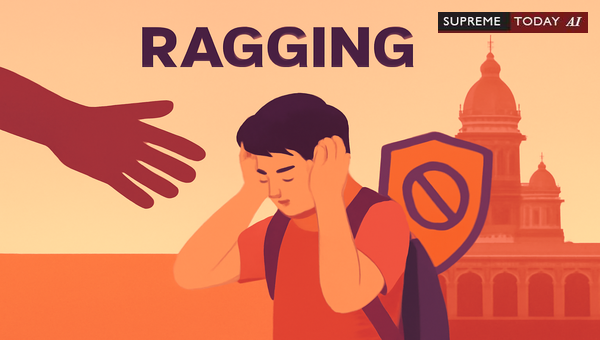
Ragging in educational institutions remains a persistent menace in India, often leading to physical harm, psychological trauma, and even tragic outcomes like suicides. While many states have enacted anti-ragging laws, the classification of these offences—whether (allowing police to arrest without warrant) or , or —plays a crucial role in enforcement. A pivotal question arises: In what case did the hold that the offence under the Tamil Nadu Prohibition of Ragging Act is and ?
This ruling marks a significant step towards stricter deterrence. In this post, we delve into the landmark decision, its legal reasoning, contrasts with other jurisdictions, and practical implications.
The explicitly held that offences under the are and . This determination empowers police to act swiftly without a warrant and restricts bail, underscoring the gravity of ragging. 2015 0 Supreme(Mad) 2770
The judgment clearly articulates: The , in its judgment, clearly stated that the offences under the are and . This classification stems from an interpretation of the Act's provisions alongside the , particularly Schedule entries on offence categorization. 2015 0 Supreme(Mad) 2770
The Court emphasized ragging's serious nature, involving acts of violence, harassment, and humiliation, which have grave consequences on students and the reputation of educational institutions. Legislative intent supports immediate police intervention and stringent punishment, justifying and status. 2015 0 Supreme(Mad) 2770
Drawing from guidelines and the Act itself, the Court aligned its view with broader anti-ragging frameworks. It noted that ragging demands effective enforcement, treating it as a grave crime rather than a minor infraction. This interpretation ensures deterrence, as status prevents easy release, allowing thorough investigations. 2001 5 Supreme 782 2015 0 Supreme(Mad) 2770
The ruling reinforces that while not all ragging-related offences automatically fall under this category, those specifically under the Tamil Nadu Act do, per the Court's analysis.
Not all Indian states classify ragging identically, highlighting regional variations in legislative will. For instance, Kerala's Prohibition of Ragging Act presents a stark contrast.
In Kerala, offences under , are and . The expressed frustration: It passes my comprehension as to why ragging continues to be a non and offence. 2007 0 Supreme(Ker) 634
Another Kerala case quashed proceedings because police registered a case without magistrate orders for a offence: As an offence under section 4 of Kerala Prohibition of Ragging Act is only a non offence, on receipt of a complaint... the officer in charge of the police station is not competent to register the case. 2010 0 Supreme(Ker) 660
Similarly, in Maharashtra, a court quashed charges linked to ragging but allowed proceedings under the , noting insufficient evidence for graver IPC sections. 2025 0 Supreme(Bom) 1429
makes ragging and , akin to Tamil Nadu: ragging has been made offence by the legislature. Yet, enforcement challenges persist, as seen in a bail rejection due to ragging's human rights abuse nature. 2014 0 Supreme(Chh) 277
These comparisons illustrate Tamil Nadu's progressive stance, potentially influencing other states amid calls for uniform stringent laws.
Police can investigate and arrest without warrants, streamlining responses. Courts must recognize status, denying routine bail to deter perpetrators. 2015 0 Supreme(Mad) 2770
This ruling signals judicial resolve against ragging's systematized form of human rights abuse. By elevating it to /, it addresses criticisms of lax laws in states like Kerala, where status hampers prevention. 2014 0 Supreme(Chh) 277 2007 0 Supreme(Ker) 634
However, exceptions apply: The ruling is Act-specific and contextual, not universally extending to all ragging instances. 2015 0 Supreme(Mad) 2770
| Aspect | Tamil Nadu Ruling | Kerala Contrast ||--------|-------------------|-----------------|| ? | Yes 2015 0 Supreme(Mad) 2770 | No 2007 0 Supreme(Ker) 634 || ? | No 2015 0 Supreme(Mad) 2770 | Yes 2010 0 Supreme(Ker) 660 || Police Power | Arrest without warrant | Needs magistrate order || Deterrence Level | High | Low |
The 's decision in the referenced case strengthens anti-ragging enforcement in Tamil Nadu, prioritizing student safety. While transformative, effective implementation requires collective action.
Disclaimer: This article provides general information based on public judgments and is not legal advice. Laws may evolve, and specifics vary by case. Consult a qualified lawyer for personalized guidance.
#AntiRagging #MadrasHighCourt #RaggingLaws


The police officers found that certainly the offence of ragging punishable under Section 4 of the Kerala Prohibition of Ragging Act, 1998 was committed. But those offences are non-cognizable and bailable going by the schedule to the Code of Criminal Procedure. ... It passes my comprehension as to why ragging continues to be a non cognizable and bailable offence ....

Indian Explosives Ltd. this Court has held that when prima facie no case is made out against the accused, then the High Court ought to have exercised the jurisdiction under Section 482 CrPC and quashed the complaint. 47. ... (4) Where, the allegations in the FIR do not constitute a cognizable offence but constitute only a non-cognizable offence, no investigation is permitted by a police officer without an order of....

Kerala Prohibition of Ragging Act, 1998 as well as Sections 126 (2) and 296(b) of the Bharatiya Nyaya Sanhita, 2023 , alone were incorporated all of which were bailable offences. ... State of Kerala and Another [2024 KHC OnLine 6451], the Supreme Court has observed that while considering an application for anticipatory bail, the Court has to bear in mind that the offence under the SC/ST Act is committed when the alleged offending act#HL_EN....
As an offence under section 4 of Kerala Prohibition of Ragging Act is only a non cognizable offence, on receipt of a complaint of the commission of an offence under Section 4 of the Act, the officer in charge of the police station is not competent to register the case. ... the case registered for the offence under section 4 of the Act alone, in law the investiga....

Section 14 of the Bail Act reads as follows, 14. (1) Notwithstanding anything to the contrary in the preceding provisions of this Act, whenever a person suspected or accused of being concerned in committing or having committed a bailable or non-bailable ... Institutions Act No. 20 of 1998 by the relevant High Court. ... of Ragging and Other Forms of Violence in Educational Institutions Act No. 20 of 1998. ... The ....
Section 14 of the Bail Act reads as follows, 14. (1) Notwithstanding anything to the contrary in the preceding provisions of this Act, whenever a person suspected or accused of being concerned in committing or having committed a bailable or non-bailable ... The petitioner who is the father of the suspect has filed the bail application before the High Court of the Western Province Holden in Gampaha as bail can only be granted for a suspect remanded in terms of the #HL....
Section 14 of the Bail Act reads as follows, 14. (1) Notwithstanding anything to the contrary in the preceding provisions of this Act, whenever a person suspected or accused of being concerned in committing or having committed a bailable or non-bailable ... Institutions Act No. 20 of 1998 by the relevant High Court. ... of Ragging and Other Forms of Violence in Educational Institutions Act No. 20 of 1998. ... The ....

Some of the States have acted by enacting legislations and making ragging as defined therein a cognizable and punishable offence. However, we feel ragging cannot be cured merely by making it a cognizable criminal offence. ... Council of Principals of College in Kerala and Others, AIR 2009 SC 2223 the Supreme Court has expressed great concern regarding ragging in educational institution and by noticing the directions issued in case o....
is a systematized form of human rights abuse and it is also a form of systematic and sustained physical and mental abuse of fresh students of college by seniors and has taken shape of human right violation though the ragging has been made cognizable non-bailable offence by the legislature, and despite ... Some of the States have acted by enacting legislations and making ragging as defined therein a cognizable and punishable offence. However, we feel ....

With reference to the provisions that explicitly classify offences into bailable and non-bailable, as well as cognizable and non-cognizable under sub-Sections (4) to (7) of Section 104 of the Customs Act, the Supreme Court emphasised in clear and explicit terms that, “the reasons to believe” must reflect ... , 1962 (“the Customs Act”), were non-bailable. ... Thirdly, given the framework of the Cus....
Therefore, the legal position is well settled that an offence under Section 63 of the Copyright Act is non bailable and cognizable. In paragraph 7 of the above judgment, the Apex Court held that offence under Section 63 of the Copyright Act is a cognizable and non-bailable offence, while setting aside the finding entered into by the High Court holding the view that the same is a non cognizable and bailable offence.

Consequently, we answer the question raised, holding that the offence under Section 68A of the Copy right Act is a non-bailable offence.” 11. The above decision rendered by the High Court of Gauhati in respect of bailable or non bailable offence for the offence punishable under Section 68A of Copy Rights Act and it held that the offence punishable under Section 68A is non bailable offence and entertained the Anticipatory bail petition. Whereas the High Court of Andhra Pradesh held in the petition under Section 482 of Cr.P.C. reported in the case of Amarnath Vyas @ Vijay Pra....

Offence Cognizable or Non- Bailable or Non- By what Court Cognizable Bailable triable If punishment with Cognizable Non-bailable Court of Session death, imprisonment for life, or imprisonment for more than 7 years, If punishable with Cognizable Non-bailable Magistrate of the first imprisonment for 3 class years and upwards but not more than 7 years. If punishable with Non-cognizable Bailable Any Magistrate imprisonment for less than 3 years or with fine only. "II - CLASSIFICATION OF OFFENCES AGAINST OTHER LAWS

If punishable with death, imprisonment for life, or Imprisonment for more than 7 years cognizable Non-bailable Court of session Offence Cognizable or non-cognizable" Bailable or Non-bailable by what Court triable If punishable with imprisonment for 3 years and upwards but not more than 7 years.

The State of Tamil Nadu has an enactment for the prohibition of ragging in educational institutions. It is known as The Tamilnadu Prohibition of Ragging Act, 1997. I do not know whether the Union Territory of Puducherry has such an enactment. The Act defines ragging to mean "display of noisy, disorderly conduct, doing any act which causes or is likely to cause physical or psychological harm or raise apprehension or fear or shame or embarrassment to a student in any educational institution and includes teasing, abusing or playing practical jokes on, or causing hurt to such s....


An indispensable Tool for Legal Professionals, Endorsed by Various High Court and Judicial Officers
Please visit our Training & Support
Center or Contact Us for assistance

Scan Me!
India’s Legal research and Law Firm App, Download now!


For Daily Legal Updates, Join us on :



 Back to top


