SupremeToday Landscape Ad
AI Thinking

AI Thinking...

Searching Case Laws & Precedent on Legal Query.....!

Scanned Judgements…!

Checking relevance for President Of India VS In The Matter Of: Cauvery Water Disputes Tribunal...

1991 0 Supreme(SC) 655 : The interim order passed by the Tribunal on June 25, 1991, was held to be a report and decision within the meaning of Section 5(2) of the State Water Disputes Act, 1956, and was required to be published under Section 6 of the Act to be effective and binding on the parties. The order was made effective from July 1, 1991, and included specific directives for water release, time-tables, adjustments, and restrictions, indicating that it was intended to be implemented immediately and not merged into a final order. The order was declared to remain operative until final adjudication of the dispute, confirming that interim orders take effect from their date of passing and are not merged into the final order.Checking relevance for Empire Industries LTD. VS Union of India...

Checking relevance for Hindustan Lever VS Ashok Vishnu Kate...

Checking relevance for EMPIRE INDUSTRIES LTD. VS UNION OF INDIA: REAL HONEST TEXTILES...

Checking relevance for Sec. , U. P. S. C. VS S. Krishna Chaitanya...

Checking relevance for Abhimanyoo Ram VS State of UP...

Checking relevance for North Bengal University VS Dilip Kumar Sarkar...

Checking relevance for Baljidner Singh VS Gurjit Kaur...

2023 0 Supreme(P&H) 3375 : Interim maintenance orders merge into final orders and cease to exist upon the passing of the final order, but this merger does not nullify the interim relief granted prior to the final order. The interim relief remains enforceable from the date of the interim order, and the final order takes effect from the date of filing of the main petition, not from the date of the final order. The principle of merger does not negate the interim relief already granted, as confirmed in the Puneet Chopra case.Checking relevance for Vanshraj Sharma VS State Of U. P. Thru Prin. Secy. Forest Govt. Of Up Lko. ...

Checking relevance for Dhoot Developers Pvt. Ltd. VS B. K. Verma...

2021 0 Supreme(P&H) 990 : An interim order merges in the final order passed in the proceedings and ceases to operate after the final disposal of the writ petition. The interim order is binding only until the final order is passed and does not continue to operate thereafter, even if not challenged in an appeal. The court held that the interim order dated 20.03.2020 ceased to operate after the final disposal of the writ petition, as it had merged in the final order. This principle was supported by the Supreme Court''''s decision in State of W.B. v. Banibrata Ghosh, (2009) 3 SCC 250, which clarified that an interim order does not decide the fate of the parties finally and merges with the final order, making the non-filing of an appeal against the interim order irrelevant.Checking relevance for Novozymes South Asia Pvt Ltd VS Joint Commissioner Of State Goods And Services Tax...

Checking relevance for Sourabh Kumar VS State of U. P. ...

Checking relevance for Sourabh Kumar VS State of U. P. ...

Checking relevance for WINDING UP INDIA WIND POWER LTD V/s SIDDHANATHA INFRASTRUCTURE DEVELOPMENT COMPANY PVT LTD...

Checking relevance for Tarapore And Company VS Tractors Export, Moscow...

Checking relevance for Shiv Shankar VS Board Of Directors, U. P. S. R. T. C. ...

Checking relevance for Super Cassettes Industries Ltd. VS Music Broadcast Pvt. Ltd. ...

Checking relevance for MADHUSUDAN VEGETABLE PRODUCTS COMPANY LIMITED VS RUPA CHEMICALS,vapi...

Checking relevance for Zila Parishad, Budaun VS Brahma Rishi Sharma...

Checking relevance for State Of M. P. VS J. S. Bansal...

Checking relevance for Ramujagir Samarth Mishra VS Divisional Controller, M. S. R. T. C. Corporation, Kaulkhed Road, Akola...

2014 0 Supreme(Bom) 1530 : Interim order when passed may be availed at interim stage. As it is subject to final decision, it is bound to merge in the final order and in such event, when final order is passed, the final order alone is enforceable.Checking relevance for Mile Stone Soft. Tech. Pvt. Ltd. VS Nidhi Chhibber...

Checking relevance for Rajinder Kumar Malhotra VS Paresh Biharilal Vyas...

Checking relevance for Sunil Kumar VS State of Kerala represented by Public Prosecutor...

Checking relevance for KARSANJI CHATRAJI HADIYOL VS JASUBEN RAMSINGJI PARMAR...

Checking relevance for ASHOK KUMAR BAJPAI VS RANJANA BAJPAI...


AI Overview

AI Overview...

Analysis and Conclusion:

The provided sources collectively establish that interim orders or awards are effective only until the issuance of the final order or award. Once the final order is passed, the interim order merges into it and ceases to have independent effect from that date. This merging principle applies to arbitral awards, injunctions, and other interim reliefs, ensuring that the final decision supersedes any prior interim measures. Therefore, the interim order Always Merged in Final Order and Shall Take Effect from that Date of Passing of the Interim Order only is consistent with legal doctrine, but practically, the effect is considered from the date of the final order, rendering the interim order's effect subordinate or eclipsed thereafter.

When Interim Orders Merge with Final Judgments: Understanding Legal Continuity Rules

Do Interim Orders Merge with Final Orders Automatically?

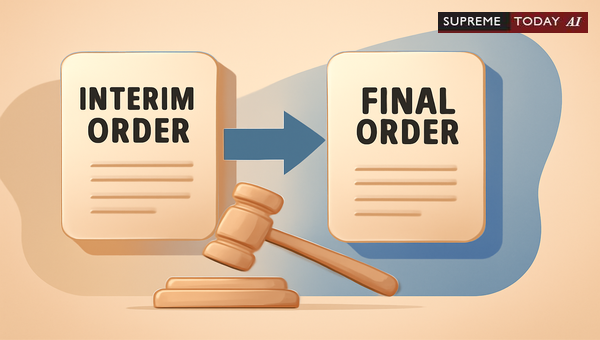
In the realm of litigation, interim orders serve as crucial lifelines, preserving the status quo or preventing irreparable harm while a case awaits final adjudication. But what happens when the court finally delivers its judgment? A common question arises: Interim Order Merges with Final Order—does this happen automatically simply upon the passage of the final order? This blog post delves into this nuanced legal principle, drawing from key judicial precedents to provide clarity for litigants, lawyers, and legal enthusiasts.

Understanding the interplay between interim and final orders is vital, as misconceptions can lead to enforcement challenges or unnecessary appeals. We'll examine the general rule, exceptions, court discretion, and practical recommendations, supported by authoritative sources. Note: This article offers general information based on judicial trends and is not a substitute for professional legal advice tailored to your specific situation.

The Nature of Interim Orders and Their Relationship to Final Orders

Interim orders are provisional measures granted during the pendency of proceedings. They are designed to maintain the status quo or avert immediate prejudice until the court reaches a final decision. Typically, these orders—such as stays, injunctions, or temporary relief—are not meant to endure indefinitely.

The principle that interim orders generally merge into final orders is well-established in Indian jurisprudence. However, this merger is not automatic merely by the passage of the final order. Instead, interim orders cease to operate upon the final order unless explicitly continued or preserved by the court2014 0 Supreme(Bom) 1530. As one judgment succinctly states: Interim order when passed may be availed at interim stage. As it is subject to final decision, it is bound to merge in the final order and in such event, when final order is passed, the final order alone is enforceable 2014 0 Supreme(Bom) 1530.

This merger implies that the interim order loses its independent enforceability, subsumed within the final adjudication. The effect is not date-dependent solely on the passing of the final order; rather, it hinges on the specific circumstances and the court’s direction2021 0 Supreme(P&H) 990.

Key Judicial Clarifications on Merger

Courts have consistently emphasized that the continuity of interim orders post-final judgment requires explicit judicial intervention. In a pivotal ruling, it was clarified that interim orders operate only until final adjudication unless expressly continued or preserved2021 0 Supreme(P&H) 990. The court's reasoning underscores that the operative effect of an interim order is limited to the duration of the proceedings and does not persist post-final order unless specifically continued or extended2021 0 Supreme(P&H) 990.

Supporting this, several decisions illustrate explicit merger language. For instance: Interim order(s) passed earlier shall stand merged with this final judgment and order2019 0 Supreme(Megh) 189. Similarly, Interim order (s) operating in these proceedings shall stand merged with this final order2014 0 Supreme(Gau) 59 2014 0 Supreme(Gau) 69. These phrases highlight how courts intentionally signal merger to eliminate ambiguity.

In arbitration contexts, the doctrine applies analogously: interim awards or orders merge with the final award and cease to have independent effect from the date of the final award2025 Supreme(Online)(Mad) 48372 2025 Supreme(Online)(Mad) 43207. The same holds for civil injunctions, where interim relief merges into the final judgment upon its issuance, restoring parties to their pre-interim positions unless otherwise directed 2025 Supreme(Online)(AP) 962.

Doctrine of Merger: Effect and Timing

The doctrine of merger does not postpone effects or create perpetual rights. For example, in tenancy disputes, it was held that the doctrine of merger does not have the effect of postponing the date of termination of tenancy merely because the decree of eviction stands merged2024 0 Supreme(Bom) 75

Brijbhushan Chandrabali Shukla VS Mahendra Yadav, s/o Lavjari S. Yadav - Current Civil Cases

. This reinforces that merger aligns the interim order's fate with the final one, without retroactive or extended independent operation.

Moreover, sources note that upon merger, interim orders take effect only up to the date of the final order, emphasizing their provisional nature 2025 Supreme(Online)(AP) 962 2024 0 Supreme(AP) 1502. Courts aim to place parties in the same situation in which it would have been if the interim order would not have been passed in case of adverse final outcomes 2024 Supreme(Online)(MP) 19305.

Exceptions, Limitations, and Court Discretion

While the default is cessation upon final order, courts retain discretion to preserve interim relief. Parties must explicitly request continuance, as silence implies merger. For instance, interim orders merge and cease to have independent effect absent such directions 2021 0 Supreme(P&H) 990.

Exceptions arise in public interest or complex matters:- Explicit Continuance: Courts may direct persistence, e.g., in labor or construction cases 2014 0 Supreme(Bom) 1530.- Nature of Order: Some interim measures, like stays pending appeal, may survive if specified 2024 2 Supreme 651.- Arbitral Contexts: Interim awards eclipse upon final award unless challenged separately 2025 Supreme(Online)(Mad) 48372.

Limitations include no automatic nullification pre-merger and the need for clear judicial language to avoid disputes 2025 Supreme(Online)(Manipur) 93.

Practical Implications and Recommendations

For practitioners and parties:- Seek Explicit Directions: Always request the court to specify if interim relief continues post-final order.- Review Final Orders Thoroughly: Examine for merger clauses like Interim order, if any, is merged in the final order2012 0 Supreme(All) 2987 2011 0 Supreme(All) 1052.- Avoid Assumptions: Merger is not automatic; reliance on passage alone risks unenforceability 2021 0 Supreme(P&H) 990.- Compensation Risks: Losing parties may claim restitution if interim orders caused prejudice 2024 Supreme(Online)(MP) 19305.

Courts are encouraged to clearly specify outcomes to prevent ambiguity, ensuring procedural fairness.

Conclusion and Key Takeaways

In summary, interim orders do not automatically merge into final orders simply by their passage; they cease unless explicitly preserved, governed by court directions and case specifics. This principle, rooted in efficiency and finality, applies across civil, labor, and arbitration proceedings 2014 0 Supreme(Bom) 1530 2021 0 Supreme(P&H) 990.

Key Takeaways:- Interim orders are provisional and merge by default.- Explicit court language determines continuance.- Review judgments meticulously for merger provisions.- Consult legal experts for case-specific strategies.

By grasping these nuances, you can navigate litigation more effectively. Stay informed on evolving jurisprudence, and remember: while general trends guide, individual cases vary.

Word count: 1028. References are illustrative of judicial trends; full texts should be consulted.

#InterimOrders, #LegalMerger, #CourtJudgments
Chat Download
Chat Print
Chat R ALL
Landmark
Strategy
Argument
Risk
Chat Voice Bottom Icon
Chat Sent Bottom Icon
SupremeToday Portrait Ad
logo-black

An indispensable Tool for Legal Professionals, Endorsed by Various High Court and Judicial Officers

Please visit our Training & Support
Center or Contact Us for assistance

qr

Scan Me!

India’s Legal research and Law Firm App, Download now!

For Daily Legal Updates, Join us on :

whatsapp-icon Back to top