


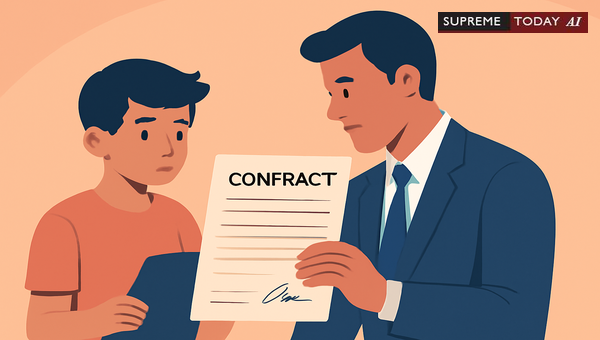
Can Minors Enter Contracts in India? A Comprehensive Legal Guide
In the realm of contract law, one of the most frequently asked questions is: Whether a Minor can Enter into a Contract. This issue is particularly relevant in India, where protecting vulnerable individuals, especially minors (persons under years of age), is a cornerstone of the legal system. Whether you're a parent, business owner, or educator, understanding the rules surrounding minors and contracts can prevent costly mistakes and legal disputes.
This blog post dives deep into Indian contract law principles, exceptions, key judicial findings, and practical recommendations. We'll draw from established legal precedents and statutes to provide clarity. Please note: This is general information only and not specific legal advice. Consult a qualified lawyer for your situation.
Legal Principle: Minors' Incapacity to Contract
Under Indian law, primarily governed by the ), a minor is generally considered . This means any agreement entered into by a minor is typically
. Upon attaining majority (age ), the minor can choose to (reject) or (accept) the contract
.
This protective stance ensures minors are shielded from exploitation, as they may lack the maturity to fully comprehend contractual obligations. Courts have consistently upheld this, emphasizing that minors cannot be bound by contracts in the same way as adults.
For instance, in employment contexts, courts have ruled: There can be no quarrel that the appointment of a person is a contract between him and the employer and a minor cannot have the capacity to enter into such a contract.2009 0 Supreme(Pat) 673. This highlights how even seemingly beneficial arrangements, like jobs, fall under this rule if the individual is a minor.
Key Exceptions to the Rule
While the general rule is strict, Indian law recognizes certain exceptions where minors can be held accountable or contracts can be enforceable:
1. Contracts for Necessaries
Minors can be liable for , such as food, clothing, shelter, and education, provided these are essential for their well-being. The rationale is to prevent minors from evading responsibility for basic needs supplied in good faith. Suppliers of necessaries can recover a reasonable price, but not under the original contract terms— applies instead.
2. Contracts by Guardians
A guardian (parent or legal guardian) can enter into contracts , but only if they benefit the minor's estate
. Such contracts must be scrutinized for the minor's advantage. Even with guardian consent, the minor retains the right to void the contract upon majority.
Other sources reinforce this: Contracts entered without court approval are and voidable, while (with court permission) may be binding unless repudiated
. If it was an contract of the Plaintiff as a minor whether he ratified it after attaining the age of majority...
Ratification and Rescission After Majority
A pivotal aspect is what happens post-majority. A minor can a contract upon turning , making it binding as if entered into as an adult
. A contract upon ratification by a minor after attaining majority becomes as binding upon him as if it had been executed after his majority.
.
Conversely, they can it before the limitation period lapses. Issues of prescription (time limits) and evidence of ratification are often litigated
. assisted contract whether the Plaintiff took steps to it after attaining the age of majority before the prescriptive period lapsed; If it was an contract...
Judicial Insights from Key Cases
Indian courts have addressed minors' contracts in diverse scenarios:
Education and Grace Marks: In cases involving minor students, like RAEESA FATHIMA T.R. (aged ), courts consider capacity indirectly through representation by guardians 2024 Supreme(Online)(KER) 56873 2024 Supreme(Online)(KER) 11263. PETITIONER: RAEESA FATHIMA T.R.,(MINIOR) AGED YEARS D/O RAFEEQ...2024 Supreme(Online)(KER) 56873
Property and Sales: Ordering parties to enter formal agreements isn't enforcing a new contract if terms were pre-agreed
. To order the respondent to enter into a formal sale and purchase agreement would not be ordering her to enter into a contract.
Marriage Contracts: Similar to general contracts, minors lack capacity for enforceable marriage agreements unless ratified or under specific laws
. The capacity to enter into a contract to marry must be determined according to the law in regard to capacity to enter into contracts generally.
Public Policy and Government Contracts: No fundamental right exists to force government entry into contracts, especially with minors 1996 0 Supreme(AP) 1079. No person has any fundamental right to insist that the Government must enter into contract with him merely because his tender is lowest.1996 0 Supreme(AP) 1079
These cases illustrate the judiciary's nuanced approach, balancing protection with practicality.
Broader Contexts: Fraud, Good Faith, and Public Policy
Contracts require and capacity. Fraud or misrepresentation can void agreements, particularly with minors
. Contracts against public policy or under duress are unenforceable
FEENANDO v. FEBNANDO.
.In hire-purchase or regulatory scenarios, boards may refuse contracts with minors 1993 0 Supreme(Guj) 272. No opinion is hereby expressed in case where there is any provision in the Regulations enabling the Board to enter into a contract with a minor...1993 0 Supreme(Guj) 272
Key Findings and Practical Recommendations
Key Findings:
- The Indian legal system generally protects minors from binding contracts
.
- Minors can void contracts even with guardian consent.
- Exceptions exist for necessaries and beneficial guardian contracts
.
- Ratification post-majority can enforce prior agreements.
Recommendations:
- Verify age and capacity before any dealings with minors.
- Use guardians for representation and ensure benefit to the minor.
- Document everything; seek court approval for significant contracts.
- Consult legal counsel to draft enforceable agreements.
- Businesses: Implement age verification policies to avoid voidable claims.
Conclusion and Key Takeaways
In summary, while a minor cannot generally enter into a valid contract in India, exceptions for necessaries and guardians provide flexibility. Upon majority, ratification or repudiation decides enforceability. This framework prioritizes minors' welfare while allowing practical transactions.
Key Takeaways:- Contracts with minors are voidable
.- Focus on necessaries and guardian benefits.- Always explicitly post-majority.- Prioritize legal advice for compliance.
Stay informed on evolving case law, as courts continue refining these principles. Share your thoughts below—have you faced a minor contract issue?
(Word count: 1028. Sources cited are for illustrative purposes; full judgments available via legal databases.)
#MinorsContracts, #IndianContractLaw, #LegalGuideIndia















