


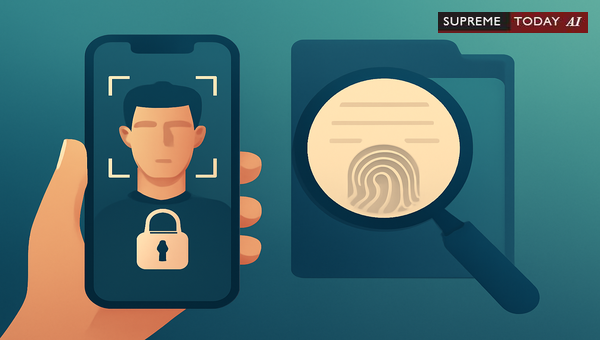
Face Unlock on Phone: Under ?
In today's digital age, smartphones hold a treasure trove of personal data—from messages and photos to financial records and location history. But what happens when demands access to your locked device? Specifically, does opening a mobile phone through face recognition fall under , triggering protections against under of the Indian Constitution?
This question arises frequently in criminal investigations, where unlocking a phone can reveal critical evidence. Generally, courts have ruled that providing biometric access, like face recognition, does not constitute . Instead, it's treated as a physical or scientific process, similar to fingerprinting. This blog post dives deep into the legal reasoning, key precedents, and nuances, drawing from judicial findings to help you navigate this complex area.
Understanding Under
of the Constitution of India protects an accused person from being compelled to be a witness against themselves. But what exactly is ?
- Testimonial evidence involves communication or expression from the accused's consciousness, such as answering questions or providing a password that reveals knowledge.
- , like blood samples, fingerprints, or biometrics, does not invoke this privilege because it doesn't require the accused to communicate facts.
The distinction is crucial: The courts have consistently distinguished between (which involves communication or expression of the accused’s consciousness) and physical or biological evidence. Courts emphasize that biometric processes are non-testimonial. For instance, The privilege against does not extend to physical or scientific examinations, including biometric identifications. 1979 0 Supreme(SC) 401
Does Face Recognition Unlock Count as Testimonial?
No, unlocking a phone via face recognition typically does not amount to . Here's why:
Biometrics as Physical Evidence
Face recognition is akin to providing a biological specimen. Providing biometric data such as face recognition is akin to producing a physical or biological specimen, not testimonial evidence. 2022 0 Supreme(Ker) 254 Courts compare it to fingerprinting, shoe imprints, or blood samples:
Providing of password, passcode or biometrics is akin to finger printing and/or taking imprints of the shoes, soles and or taking sample of the clothes, biological samples, chemical samples, etc, same cannot amount to forced testimony on part of the accused. 2022 0 Supreme(Ker) 254
A direction to provide a password, passcode, biometrics would not amount to . It is only in the nature of a direction to produce a document. 2022 0 Supreme(Ker) 254
In one case, a directed an IT engineer (petitioner) to cooperate in unlocking his mobile phone. The higher court upheld this, stating: The contention of the Petitioner that the mobile phone contains his personal information which is protected under cannot be accepted, the order of the directing the Petitioner to cooperate in unlocking the mobile phone does not violate the and does not amount to . 2021 0 Supreme(Kar) 2
Mere Access vs. Testimony
Simply granting access doesn't make the accused a witness:
Mere providing of an access of to smartphone or e-mail account would not amount to being a witness, the information that is accessed by the Investigating officer on the smartphone and or the e-mail account being only access; to the data and/or documents, it is for the Investigating officer to prove and establish the same in a Court of law by following the applicable Rules of evidence. 2022 0 Supreme(Ker) 254
This aligns with broader jurisprudence: The examination of the body or collection of physical evidence, such as blood samples or fingerprinting, does not violate the privilege against , provided the process is not testimonial in nature. 1978 0 Supreme(SC) 136 1979 0 Supreme(SC) 401
Judicial Precedents Reinforcing the Ruling
Indian courts have consistently upheld this view:
Biometric Identification Precedents: Biometric identification, such as face recognition, is akin to fingerprinting or blood sampling, which are not testimonial acts. 2022 0 Supreme(Ker) 254 The process is not designed to elicit knowledge or communication from the accused but to establish identity or access. 1978 0 Supreme(SC) 136
Related Cases on Device Unlocks: In a case involving an investigation, seizure of a mobile phone and its visuals was noted, but no testimonial issue arose from access alone. 2022 Supreme(Online)(Ker) 78640 Similarly, directions for police custody or unlocking have been upheld as part of routine investigation, not violating . 2004 0 Supreme(Mad) 1522
Polygraph and Privacy Contexts: Courts distinguish invasive tests. For example, involuntary polygraph tests are barred without consent, per , but biometric unlocks are treated differently as non-communicative. 2021 0 Supreme(Kar) 2
Internationally, U.S. cases highlight debates on compelled phone unlocks (e.g., ), but Indian law leans toward classifying biometrics as non-testimonial. 2025 Supreme(US)(cadc) 96
Exceptions and Limitations
While generally permissible, there are caveats:
Coercion or Duress: If face recognition involves force that compels testimony (e.g., combined with interrogation), it may infringe . Processes must be non-coercive and purely physical/scientific.
Privacy Rights: () may intersect, but courts balance it against investigation needs. Unlock directions don't automatically violate privacy if justified. 2021 0 Supreme(Kar) 2
Refusal Consequences: Refusing biometrics might lead to adverse inferences, but not direct compulsion to testify. In vigilance inquiries, no arises from witness statements alone. 2018 0 Supreme(Ker) 569
should document voluntary compliance, and courts assess for fairness.
Practical Recommendations for Investigations and Accused
For : Treat face unlocks as physical evidence. Obtain court orders and ensure non-coercive execution. 2022 0 Supreme(Ker) 254
For Individuals: Cooperate if directed, but challenge coercive methods. Consult counsel if privacy concerns arise.
Courts' Role: Scrutinize for testimonial elements: The process must be non-coercive and purely physical/scientific; otherwise, it might amount to .
Key Takeaways
- Face recognition unlocks are physical evidence, not testimonial, preserving protections.
- Supported by precedents classifying biometrics like fingerprints. 1978 0 Supreme(SC) 136 2022 0 Supreme(Ker) 254 1979 0 Supreme(SC) 401
- Exceptions apply if coercion elicits communication.
Disclaimer: This post provides general information based on judicial trends and is not legal advice. Laws evolve, and outcomes depend on specific facts. Consult a qualified lawyer for personalized guidance.
In summary, opening a mobile phone through face recognition generally does not violate privileges, empowering efficient investigations while safeguarding constitutional rights.
#Article203 #TestimonialCompulsion #BiometricEvidence















