Searching Case Laws & Precedent on Legal Query.....!
Analysing the retrieved Case Laws
Scanned Judgements…!



Searching Case Laws & Precedent on Legal Query.....!
Analysing the retrieved Case Laws
Scanned Judgements…!
In cases involving land disputes or rights, courts have directed authorities to update records correctly and follow prescribed procedures, especially when land details are not accurately reflected or when appointments are challenged ["2025 Supreme(Online)(Tel) 67918"].
Analysis and Conclusion:
References:- ["2005 0 Supreme(Jhk) 524"]- ["2025 Supreme(Online)(Tel) 39457"]- ["2025 Supreme(Online)(Tel) 66004"]- ["2025 Supreme(Online)(Tel) 28635"]- ["DWARKADHEESH SWARNKAR vs STATE OF RAJASTHAN - Rajasthan"]- ["2018 0 Supreme(Raj) 12"]- ["2025 Supreme(Online)(Tel) 67918"]- ["DWARKADHEESH SWARNKAR vs STATE OF RAJASTHAN - Rajasthan"]- ["1990 0 Supreme(Raj) 799"]- ["2025 Supreme(Online)(Mad) 53037"]- ["2012 0 Supreme(Jhk) 1762"]- ["2006 0 Supreme(All) 191"]- ["DWARKADHEESH SWARNKAR vs STATE OF RAJASTHAN - Rajasthan"]- ["DWARKADHEESH SWARNKAR vs STATE OF RAJASTHAN - Rajasthan"]- ["2021 0 Supreme(Chh) 72"]- ["2024 Supreme(Online)(Chh) 16184"]- ["2023 Supreme(Online)(Tel) 21949"]- ["2025 Supreme(Online)(Tel) 67918"]
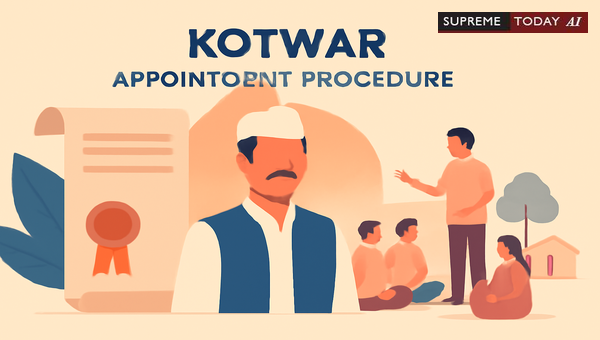
In rural India, the role of a Kotwar—a traditional village-level —is crucial for land records, revenue collection, and local administration. But what happens when it comes to the appointment of a Kotwar bhu rajswa sahita kotwar ki niyukti (with )? This question often arises in Madhya Pradesh, where disputes over improper procedures can lead to legal challenges. If you're a villager, revenue official, or legal practitioner seeking clarity, this post breaks down the , key procedures, and judicial insights.
Typically, appointments must follow strict rules to ensure merit, transparency, and fairness. Deviations can result in courts setting aside such appointments. Let's dive into the details governed primarily by the .
The appointment of a Kotwar falls under , along with the rules framed thereunder, particularly . These provisions outline a structured process to select suitable candidates as . 2010 0 Supreme(MP) 872
Key include the Collector, Sub-Divisional Officer (SDO), Assistant Collector, Tehsildar, or Naib Tehsildar, depending on their empowerment. However, a critical prerequisite is the recommendation from the Gram Sabha. Without this, no valid appointment can be made. 2010 0 Supreme(MP) 872
The process emphasizes:- Qualifications: Candidates must meet prescribed eligibility criteria.- Proposals: Must originate from the Gram Sabha through proper channels.- Transparency: Informal suggestions or unauthenticated letters do not qualify. 2010 0 Supreme(MP) 872
In similar government appointment scenarios, courts have stressed that essential qualifications must be possessed at the time of application or recommendation. For instance, in teacher recruitment cases under Jharkhand rules, failure to meet educational standards at the relevant stage led to dismissal of claims. 2013 0 Supreme(Jhk) 1322 This principle aligns with Kotwar appointments, where procedural lapses invalidate selections.
The appointment is a requiring adherence to rules. Proposals must be duly authenticated and passed by the Gram Sabha. Courts have repeatedly held that bypassing this renders appointments invalid. 2010 0 Supreme(MP) 872
For example, in a key case, a challenge was dismissed because the proposal lacked proper Gram Sabha authentication. The court ruled: proposals must be made through proper channels and in accordance with rules, and informal suggestions or unauthenticated letters do not suffice. 2021 0 Supreme(MP) 31
Additionally, broader on public appointments underscore the need for strict procedure. In compassionate appointment matters, authorities must consider relaxation provisions if applicable, but only after applying their mind—much like ensuring Gram Sabha input here. Rejection without due process was remitted for reconsideration. 2012 0 Supreme(Jhk) 1178
Any violation allows courts to set aside the appointment and direct a fresh process. 2010 0 Supreme(MP) 872
permits preference to near relatives of former Kotwars, but only when other qualifications are equal. This is not an automatic right or overriding factor. Merit prevails otherwise. 2021 0 Supreme(MP) 31
The court in one dispute clarified: Preference to near relatives of ex-Kotwars is only permissible when other qualifications are equal, and not as a matter of right. 2021 0 Supreme(MP) 31 Kinship alone cannot trump competence.
This mirrors general service rules where relaxations (e.g., age or qualifications) are discretionary and conditional. In primary teacher appointments, even trained candidates were scrutinized for eligibility at advertisement time. 2008 0 Supreme(Jhk) 539
Kotwars hold the status of or , entitling them to upon valid appointment. Courts have affirmed this while insisting on lawful processes. 2010 0 Supreme(MP) 872
In cases of procedural breaches:- Appointments based on unauthorized proposals were quashed.- Fresh selections were ordered per rules. 2010 0 Supreme(MP) 872
Related rulings on terminations and transfers highlight that service conditions must align with statutes. Unauthorized transfers of employees led to salary stoppages, emphasizing institutional-specific rules. 2008 0 Supreme(All) 141 Similarly, for Kotwars, deviations invite .
One source notes regular Bhu-Rajswa entitlements in disputes involving predecessors, reinforcing the benefit's attachment to valid tenure.
While the framework is robust, common pitfalls include:- Informal Proposals: Invalid without Gram Sabha backing. 2010 0 Supreme(MP) 872- Overriding Preferences: Relatives' claims fail if unqualified.- Lack of Transparency: Subject to challenge.
In contractual or provisional appointments, convictions or procedural gaps justify termination, even pending appeals—paralleling how invalid Kotwar selections are nullified. 2025 Supreme(Online)(CAT) 11165
To avoid disputes:- Villagers/Gram Sabha: Ensure resolutions are formal and highlight qualified candidates.- Revenue Officers: Verify Gram Sabha proposals and balance merit with preferences.- Aspiring Kotwars: Confirm eligibility upfront; relatives should not rely solely on kinship.- Challenge Illegally: Petition courts for quashing non-compliant appointments.
Authorities should document every step, as judicial scrutiny demands it.
The appointment of a Kotwar bhu rajswa sahita in Madhya Pradesh demands strict adherence to , and Rules 3-4. Gram Sabha recommendations, qualifications, and procedural integrity are non-negotiable, with preferences as tie-breakers only. Courts consistently uphold these to maintain fairness. 2010 0 Supreme(MP) 872 2021 0 Supreme(MP) 31
Key Takeaways:- Gram Sabha proposal is mandatory.- Merit over relatives unless equal.- Invalid processes lead to quashing.- Transparent adherence prevents litigation.
This post provides general information based on statutes and precedents. It is not legal advice. Consult a qualified lawyer for specific cases.
References:1. 2021 0 Supreme(MP) 31 – On Rule 4, qualifications, and procedure.2. 2010 0 Supreme(MP) 872 – Detailed rules, Gram Sabha role, and precedents.
#KotwarNiyukti #MPLandRevenue #GramSabha


Ro-4-284 ke vetanman me niyukti ki jati hai. Ise nayee niyukti samjhi jayegi. Yen niyukti bilkul asthai hai aur bina karan bataye kisi bhi samay inki seva samapt kar di ja sakti hai." ... (Emphasis given) ... 6. ... The extract as appears in the Service Book reads as under : ... "Nideshak, Bhu-abhilekh tatha parimap Bihar Patna ke Patrank 17-161/ 75-15 di. 17.10.77 ke nideshanusar Shri Muzaffar Hussain, sevamukt DPM ko punah dinak 27.10.77 se DPM ke pad par vetanman 205.3.226 Da.

But presently in the BHU BHARATI website the above said land details are not showing. A copy of BHU BHARATI website details are here with enclosed with this letter. ... That they established Petitioner No.1- Trust and constructed Sri Ashta Lakshmi Sahita Lakshminarayana Temple in part of the said land and balance land is kept for use infront of temple. That entire land is under the temple and temple is being managed by Petitioner No.1-Trust.

But presently in the BHU BHARATI website the above said land details are not showing. A copy of BHU BHARATI website details are here with enclosed with this letter. ... That they established Petitioner No.1- Trust and constructed Sri Ashta Lakshmi Sahita Lakshminarayana Temple in part of the said land and balance land is kept for use infront of temple. That entire land is under the temple and temple is being managed by Petitioner No.1-Trust.
But presently in the BHU BHARATI website the above said land details are not showing. A copy of BHU BHARATI website details are here with enclosed with this letter. ... That they established Petitioner No.1- Trust and constructed Sri Ashta Lakshmi Sahita Lakshminarayana Temple in part of the said land and balance land is kept for use infront of temple. That entire land is under the temple and temple is being managed by Petitioner No.1-Trust.

petitioners and the predecessors of the respondents, is regular Bhu-Rajswa

The petitioner and the deceased Sahita were married 14 years ago. Sahita ended her own and her two children's lives by jumping into a water tank on 02.10.2016. ... Needless to say that benefit of presumption is not available to the prosecution in the case at hand as the marriage of the petitioner and the deceased Sahita took place more than 14 years ago. ... In the statement of Birda Ram, who was examined by the trial court on 27.11.2017, the highest allegation regarding any cruel act of the accused with the deceased before the fateful in....

During the course of hearing, it is also brought to the notice of this Court that all the applications received in Bhu Bharathi Portal were transferred to competent authorities as specified in Bhu Buarathi Rules, but the said fact is not mentioned in the impugned order. ... Thus, the impugned order is contrary to the procedure laid down under the Bhu Bharati Act, 2025 and without application of mind by 3rd respondent. ... He has also directed to carry out necessary changes in Bhu Bharati Portal in respect of the subject....

The petitioner and the deceased Sahita were married 14 years ago. ... Sahita ended her own and her presumption is not available to the prosecution in the case at hand deceased before the fateful incident is in reference to the call made by Sahita

A-131/Niyukti/2015-16 dated 06.05.2015 & provisionally appointed person is working on the post since 15.05.2015 till date. ... A-131/Niyukti/2008 dated 04.06.2008 & after completion of prerequisite training, he took the charge of the post on 11.06.2008. ... Then, she was taken to BHU Hospital, where she was admitted and while going to Medical checkup, consequently she died as her natural death. 3.2 Thereafter, the applicant was convicted in case crime No. 269 of 2008 in ST No. 49/2009 (State Vs.
In this reply, it has submitted that the petitioner has failed in Charak Sahita and Koumar Bhartya in the second attempt and there is no provision for revaluation of answer books of the candidate who has failed in second attempt. ... This time he again failed in Charak Sahita and Koumar Bhratiya. This time again, the petitioner submitted an application for revaluation and deposited the requisite fees on 19.10.1990. He submitted a detailed representation on 24.11.1990 for revaluation of his answer books. ... He was declared failed in practical examination o....

PRASHIKSHAN KE BAD SAFAL UMMIDWARON KI NIYUKTI MATRIK (GHA) JIS PANCHANG VARSH ME VIGYAPAN NIKALA JAYEGA, US VARSH KE PAHLI JULY KO UMMIDWAR KI AYU SARKAR DWARA NIRDHARIT NYUNTAM EVAM ADHIKTAM AYU SIMA KE ANTARGAT HOGI, KINTU IS NIYAMAVALI KO PRAVRIT HONE KE BAD MATRA PRATHAM NIYUKTI VARSH ME PURV PRASHIKSHIT UMMIDWARON KE LIYE SARKARI SEVA ME PRAVESH KE LIYE NIRDHARIT ADHIKTAM AYU SIMA KI SHART KI RAJYA SARKAR DWARA SHANT KIYA JA SAKEGI.” PRASHIKSHAN KE VEYAVASTHA RAJAYA SARKAR DWARA KARAYI JAYEGI. PRASHIKSHIT VETANMAN SE MATRA TIN VARSHO KE AVADHI KE LIYE RAJYA SARKAR DWA....
“vase mamlon me jisme kisi mahila ki chaturthvargiya pad par niyukti ka prastav ho, niyukti padadhikari niyukti ki sharton ko shithil karne ke liye saksham honge par yah Shithilikaran samiti ki anushansa par ki jayegi. Clause6 of the circular is being reproduced herein as under: Mahila ummidwar ke liye cycle chalane ki yogyata ki shart Kshant kar di jayegi tatha shakshanik yogyata ki shart bhi is shart par shilthil ki ja sakegi ki likhnepadne ke jaise samanya gyan ki awasyakta sambandhit mahila ummidwar dwara niyukti ke do varshon ke andar hasil kar liya jayega.”
(GHA) JIS PANCHANG VARSH ME VIGYAPAN NIKALA JAYEGA, US VARSH KI PAHLI JULY KO UMMIDWAR KI AYU SARKAR DWARA NIRDHARIT NYUNTAM EVAM ADHIKTAM AYU SIMA KE ANTARGAT HOGI, KINTU IS NIYAMAVALI KO PRAVRIT HONE KE BAD MATRA PRATHAM NIYUKTI VARSH ME PURV PRASHIKSHIT UMMIDWARON KE LIYE SARKARI SEVA ME PRAVESH KE LIYE NIRDHARIT ADHIKTAM AYU SIMA KI SHART KI RAJYA SARKAR DWARA SHANT KIYA JA SAKEGI. PRASHIKSHAN KE BAD SAFAL UMMIDWARON KI NIYUKTI MATRIK PRASHIKSHIT VETANMAN SE MATRA TIN VARSHO KI AVADHI KE LIYE RAJYA SARKAR DWARA SUBIDHA KE ADHAR PAR KI JA SAKEGI. PRASHIKSHAN KI VEYAVASTH....

Sri Ram Niwas Singh Ke Lipik Ki Niyukti Bhi Uprokt Tithi Se Manya Ki Jayegi." Ukta Sthanantaran Prastav Grismavkash Ke Paschat Vidyalay Khulne Ki Tithi Se Prabhavi Mana Jayega, Tatha Sri Indrapal Singh Ke Sevain Sthanantarit Vidyalaya Me Uprokt Adhyay Ke Viniyam 59, 60 Tatha 61 Se Shasit Hogi.
"(4) Is Patra Me Ankit Vishayon Ke Adhyapanarth Parishad Dwara Nirdharit Nyuntam Yogyataon Se Vibhushit Adhyapikaon Ki Niyukti Niyamanusar Ki Jaye Tatha Aprashikshit Adhyapikaon Ke Sthan Par Prashikshit Evam Yogya Adhyapikaon Ki Niyukti Ki Jaye. (6) Naveen Kachhayen Sanchalit Karne Samast Vyaya Sansthadhikari Svayameva Vahan Karen" (5) Niyamanusar Ek Yogya Pradhanacharya Ki Niyukti Ki Jaye.


An indispensable Tool for Legal Professionals, Endorsed by Various High Court and Judicial Officers
Please visit our Training & Support
Center or Contact Us for assistance

Scan Me!
India’s Legal research and Law Firm App, Download now!


For Daily Legal Updates, Join us on :



 Back to top


