


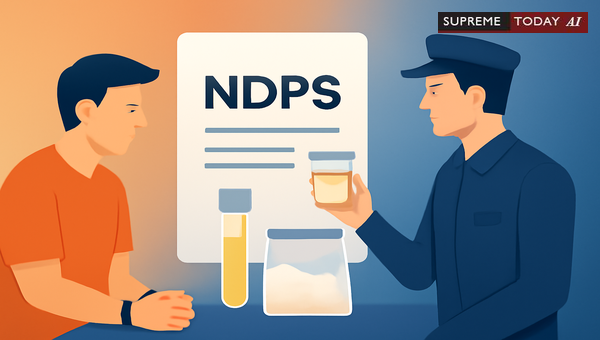
NDPS Act: Can Investigative Officers Take Urine Samples from Accused?
In the high-stakes world of narcotics enforcement in India, the , sets strict rules for searches, seizures, and evidence collection. A common question arises: Can an investigative officer take urine samples from the accused in NDPS cases? While no direct precedent explicitly addresses urine samples, judicial interpretations of sample collection procedures under the Act provide critical insights. Typically, such actions require stringent to protect and ensure evidence integrity. This post analyzes the legal framework, accused protections, and court rulings that suggest investigative officers cannot unilaterally collect biological samples like urine without following mandatory safeguards.
Legal Framework Under NDPS Act for Sample Collection
The NDPS Act outlines precise procedures for handling evidence, primarily focused on seized contraband but extending principles to any sampling that impacts the accused.
Key Provisions
- Section 42: Allows officers to search and seize without a warrant based on reasonable belief of an offense. However, this does not extend to unchecked personal or biological sampling. 2018 0 Supreme(All) 1645
- Section 50: Mandates informing the accused of their right to be searched before a Gazetted Officer or Magistrate. Courts have ruled that no formal proforma is needed, but the accused must be aware of this option. 2018 0 Supreme(All) 1645
- Section 52A: Crucially requires samples of seized narcotics to be drawn and certified in the presence of a Magistrate. This ensures authenticity and prevents . 2023 0 Supreme(Raj) 2056 2024 0 Supreme(AP) 1000
For urine samples, which could test for psychotropic substances, these principles apply analogously. Investigative officers cannot bypass or accused consent, as procedural lapses raise doubts. 2024 0 Supreme(Raj) 1632
Rights of the Accused:- Right to be informed of search grounds and Section 50 options.- Presence during any sampling to maintain transparency.- Challenge evidence if procedures are violated, potentially leading to . 2023 0 Supreme(P&H) 1602
Judicial Interpretations on Sample Collection Procedures
Courts emphasize strict adherence, often quashing convictions for .
Presence of Magistrate Essential
The in stressed that samples must follow ; deviations create . 2023 0 Supreme(Raj) 2056 Samples should be drawn in accordance with , and deviations create about the evidence's integrity. 2023 0 Supreme(Raj) 2056
High Courts echo this: Samples ideally drawn before a Magistrate to prevent . 2024 0 Supreme(AP) 1000 In one case, the held magistrate certification as primary evidence, with delays violating requirements. 2024 0 Supreme(Raj) 1632
Timely Processing and
- Samples must reach forensic labs within ; longer delays suggest mishandling. 2024 0 Supreme(Raj) 1632 Delays beyond this period raising doubts about or mishandling. 2024 0 Supreme(Raj) 1632
- Proper seals, signatures, and documentation are mandatory. Missing elements undermine cases. 2023 0 Supreme(P&H) 1602
Applying to urine samples, failure to involve a Magistrate or document could render results inadmissible, as courts prioritize procedural correctness.
Leads to Acquittals
In , the reiterated Section 50 and 52A adherence, including informing the accused and representative sampling before a Magistrate. 2018 0 Supreme(All) 1645
Insights from Additional Case Law on Procedural Lapses
Recent judgments reinforce that investigative officers must not ignore safeguards, even if directory.
- In a case under Sections 18, 52, 52A, with Section 50 led to : with procedural safeguards outlined in NDPS Act raises reasonable doubts regarding the validity of the seizure. 2023 0 Supreme(P&H) 2891
- Improper sampling vitiated conviction: Violation of Sec. 42 of the NDPS Act and as the investigating officer did not lift the samples in a proper manner. 2023 0 Supreme(AP) 1260
- Section 52A violations prejudiced rights: Violation of these procedures can lead to prejudice against the accused and affect the admissibility of evidence. 2024 0 Supreme(Ker) 1414
One ruling noted total with Sections 50, 52A, and 57: Prosecution case suffers from material procedural irregularity and there is total . 2023 0 Supreme(Gau) 941
Even for contraband, samples must be drawn under : Samples have to be drawn in front of the Magistrate.
N. Uganchand Kumawat VS Inspector of Police
These precedents suggest urine collection—intrusive and personal—demands similar rigor, typically beyond an IO's solo authority.
Why Investigative Officers Cannot Unilaterally Take Urine Samples
While NDPS focuses on contraband, urine tests implicate personal search (Section 50) and evidence certification (Section 52A). Courts view biological sampling as requiring:- or magistrate presence.- Independent witnesses.- Secure custody to rule out . 2020 0 Supreme(J&K) 268 Duty of the Investigating Officer to ensure that after the recovery of contraband is made and the samples are taken, the samples are kept in proper custody so as to negate any chance of . 2020 0 Supreme(J&K) 268
Non-adherence invites , as in ganja cases where irregular lifting granted benefit of doubt. 2023 0 Supreme(AP) 1260
Re-sampling trends highlight caution: NDPS does not permit routine re-testing, underscoring initial procedure's importance. 2021 0 Supreme(Telangana) 172 The NDPS Act itself does not permit re-sampling or re-testing of samples. 2021 0 Supreme(Telangana) 172
Practical Implications for Accused and Officers
- For Accused: Challenge urine evidence if no magistrate involvement or delays. Courts may dilute prosecution cases. 2024 0 Supreme(Ker) 1414
- For Officers: Follow protocols to avoid acquittals. Section 52 is directory but cannot be ignored. 2023 0 Supreme(P&H) 2891
Key Takeaways
- No direct precedent bans IO urine collection outright, but principles under Sections 50 and 52A generally prohibit it without magistrate oversight.
- Procedural violations—lacking presence, signatures, or timely forwarding—lead to and acquittals. 2024 0 Supreme(Raj) 1632
- Uphold for fair trials; courts quash for lapses. 2023 0 Supreme(Gau) 941
Disclaimer: This analysis is for informational purposes and reflects general judicial trends. It is not legal advice. Consult a qualified lawyer for case-specific guidance.
Sources:2018 0 Supreme(All) 1645 2024 0 Supreme(AP) 1000 2023 0 Supreme(Raj) 2056 2024 0 Supreme(Raj) 1632 2023 0 Supreme(P&H) 1602 2023 0 Supreme(P&H) 2891 2023 0 Supreme(AP) 1260 2024 0 Supreme(Ker) 1414 2023 0 Supreme(Gau) 941
N. Uganchand Kumawat VS Inspector of Police
2021 0 Supreme(Telangana) 172 2020 0 Supreme(J&K) 268 #NDPSAct, #AccusedRights, #DrugLawsIndia















