SupremeToday Landscape Ad

AI Overview

AI Overview...

  • Scope of High Court's Power under Article 227 - The High Court's jurisdiction under Article 227 is supervisory, not appellate. It cannot reappreciate or reweigh evidence or facts, but only ensure that inferior courts or tribunals have acted within their jurisdiction and followed proper procedures. This jurisdiction is limited to correcting procedural errors and ensuring legality, without substituting its own decision on facts. 2022 0 Supreme(HP) 712, 2022 0 Supreme(HP) 799,

    Sher Mohammad vs Municipal Corporation of Delhi (SDMC) - Delhi

    , 2022 0 Supreme(All) 1639
  • Remedy for Property Damages Due to Construction - When neighboring construction causes damage, remedies typically involve civil suits for injunction, damages, or specific performance. The courts emphasize that claims for damages or damages for property infringement should be pursued through civil suits, not through public law remedies under Article 226 or 227. In cases of unauthorized construction, authorities like MCD may demolish illegal structures, but disputes over damages or property rights are to be resolved via civil litigation.

    Tejpal Singh vs Surinder Kumar Dewan - Delhi

    , 2024 0 Supreme(P&H) 856, 2025 Supreme(Online)(Mad) 22037, 2023 0 Supreme(Cal) 324
  • Limitations on High Court Interference in Construction Disputes - The High Court, exercising supervisory jurisdiction under Article 227, should not interfere in detailed factual disputes or substitute its judgment for that of the subordinate courts. It is only appropriate to intervene if there is a clear procedural irregularity or jurisdictional error. The courts have consistently held that Article 227 is not meant to act as a court of first appeal or to re-evaluate evidence regarding construction or property disputes. 2022 0 Supreme(HP) 799,

    Sher Mohammad vs Municipal Corporation of Delhi (SDMC) - Delhi

    , 2022 0 Supreme(All) 1639, 2023 0 Supreme(Mad) 2178
  • Civil Remedies for Construction-Related Damages - Disputes arising from construction damages, unauthorized building, or breach of property rights are to be addressed through civil suits for damages, injunctions, or specific performance. The courts have clarified that damages for property infringement require detailed factual investigation and are not suitable for resolution under public law remedies like Article 226. 2022 0 Supreme(All) 1639, 2025 Supreme(Online)(Mad) 22037, 2023 0 Supreme(Cal) 324

Analysis and Conclusion:The main legal principle is that High Courts, under Article 227, have a supervisory role limited to procedural oversight and cannot act as appellate courts or reweigh evidence in property or construction disputes. Remedies for damages caused by neighboring construction are primarily civil, through suits for damages or injunctions, rather than public law proceedings. When property damage occurs due to unauthorized construction, the appropriate course is civil litigation, and courts should avoid unwarranted interference under Article 227 unless procedural irregularities are evident.

Addressing Neighbor Construction Damage Through Civil Suits Instead of Article 227 Petitions

Neighbor Construction Damage: Article 227 High Court Remedy?

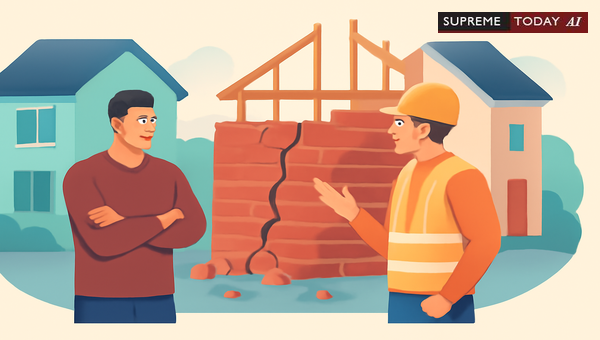
Imagine waking up to cracks in your home's walls, all because your neighbor started a major construction project next door. Your property has suffered damages, and you're wondering: Due to the construction in the neighbor, our property got damages—remedy under 227 before High Court? This is a common dilemma for homeowners in India facing such disputes. While it might seem appealing to rush to the High Court under Article 227 of the Constitution, the legal landscape typically points to more direct civil remedies. This post breaks down the options, principles, and limitations, drawing from judicial precedents to guide you.

Disclaimer: This article provides general information based on legal principles and is not a substitute for professional legal advice. Consult a qualified lawyer for your specific situation.

Understanding Property Damage from Neighbor's Construction

Neighbor disputes over construction are frequent in densely populated areas, especially in urban India. When a neighbor's building work leads to structural cracks, water seepage, or other harms to your property, you may seek compensation or preventive measures. However, the path isn't always through the High Court's supervisory powers.

Courts emphasize that such issues often stem from tortious acts (wrongful negligence) or breaches of building regulations. The primary question is whether actual damage has occurred or if it's merely anticipated. As noted in judicial observations, damages for loss in anticipation are not generally awarded unless actual loss or injury has materialized

Rajinder Singh Chimni vs Jagmohan Dilwari - Delhi (2018)

2018 0 Supreme(Del) 2796.

Primary Remedies: Civil Suits for Damages or Injunction

The cornerstone remedy in India for property damage due to a neighbor's construction is filing a civil suit under the Code of Civil Procedure (CPC), 1908. Here's how it works:

1. Suit for Damages

  • Claim compensation for actual losses, such as repair costs, diminished property value, or other quantifiable harms.
  • Requires evidence like engineering reports, photos, and expert testimony proving causation (i.e., neighbor's construction directly caused the damage)

    Rajinder Singh Chimni vs Jagmohan Dilwari - Delhi (2018)

    .

2. Suit for Injunction (Preventive Relief)

  • If damage is ongoing or threatened, seek a permanent or mandatory injunction to halt construction, order rectification, or demand demolition of unsafe parts.
  • Particularly useful for anticipatory relief: If the damage or threat is in anticipation, the appropriate relief is to seek an injunction to prevent the construction or rectify the threat, rather than damages, especially when no actual loss has yet occurred

    Rajinder Singh Chimni vs Jagmohan Dilwari - Delhi (2018)

    2018 0 Supreme(Del) 2796.
  • Courts grant this if the construction violates sanctioned plans, building bylaws, or poses a perpetual threat to your property

    Rajinder Singh Chimni vs Jagmohan Dilwari - Delhi (2018)

    .

Statutory Remedies for Unauthorized Construction

  • Approach local authorities (e.g., municipal corporations like MCD or BBMP) for demolition of illegal structures under building acts.
  • In cases involving construction violations, remedies may include demolition or rectification orders, as damages for anticipated loss are generally not granted unless actual harm has occurred

    Rajinder Singh Chimni vs Jagmohan Dilwari - Delhi (2018)

    .

Civil courts are best equipped for factual investigations, weighing evidence on negligence, foreseeability, and quantum of damages—areas unsuitable for higher courts' summary jurisdiction

Tejpal Singh vs Surinder Kumar Dewan - Delhi

2024 0 Supreme(P&H) 856.

The Limited Role of Article 227: High Court's Supervisory Jurisdiction

Article 227 empowers High Courts with superintendence over all courts and tribunals within their territory. But it's not a cure-all for property disputes.

Key Limitations

  • Supervisory, Not Appellate: The High Court cannot re-appreciate facts, reweigh evidence, or act as a first appellate court. The High Court's jurisdiction under Article 227 is supervisory, not appellate. It cannot reappreciate or reweigh evidence or facts, but only ensure that inferior courts or tribunals have acted within their jurisdiction and followed proper procedures 2022 0 Supreme(HP) 712 2022 0 Supreme(HP) 799

    Sher Mohammad vs Municipal Corporation of Delhi (SDMC) - Delhi

    .
  • Invoke Article 227 only for gross jurisdictional errors, procedural irregularities, or manifest illegality in subordinate court proceedings—not to directly claim damages or challenge factual findings 2021 0 Supreme(P&H) 1619 2022 0 Supreme(HP) 782 2020 0 Supreme(Bom) 835.
  • Under Indian law, especially in the context of High Court supervision under Article 227, the Court's role is supervisory, not appellate or reappreciative of facts, and cannot be used to directly seek damages or interfere with factual findings unless there is a gross illegality or perversity 2021 0 Supreme(P&H) 1619.

When Article 227 Might Apply

  • If a trial court dismisses your suit erroneously (e.g., without hearing evidence), petition under Article 227 for correction—but expect scrutiny. The High Court under Article 227 of the Constitution of India has got the power to strike off frivolous and vexatious suits 2019 0 Supreme(Mad) 38.
  • Combined with Article 226 (writs), it's for public law remedies, not private tort disputes like neighbor construction damages

    SRI.S.M. NARAYANA SA vs THE COMMISSIONER - Karnataka

    2012 0 Supreme(Ker) 256.

High Courts restrain interference in construction disputes: The High Court, exercising supervisory jurisdiction under Article 227, should not interfere in detailed factual disputes or substitute its judgment for that of the subordinate courts 2022 0 Supreme(HP) 799

Sher Mohammad vs Municipal Corporation of Delhi (SDMC) - Delhi

.

Judicial Precedents Shaping These Principles

Indian courts have clarified boundaries through key rulings:

  • No Damages for Anticipated Harm: Unless actual injury materializes, injunctions prevail over damages claims

    Rajinder Singh Chimni vs Jagmohan Dilwari - Delhi (2018)

    2018 0 Supreme(Del) 2796 2022 0 Supreme(HP) 782.
  • Civil Route Preferred: Disputes arising from construction damages, unauthorized building, or breach of property rights are to be addressed through civil suits for damages, injunctions, or specific performance 2022 0 Supreme(All) 1639 2025 Supreme(Online)(Mad) 22037.
  • Supervisory Restraint: In Pyda Venkatanarayana v. Thota Ramaswami, Article 227 was held to be entirely distinct and different from Article 226 and that Article 227 confers upon High Court a power of supervision over all judicial matters 2008 0 Supreme(Mad) 835.
  • If construction is sanctioned and deviations rectified, relief is harder without proven threat

    Rajinder Singh Chimni vs Jagmohan Dilwari - Delhi (2018)

    .

These precedents underscore: Article 227 isn't for bypassing civil courts in factual-heavy cases.

Practical Steps and Recommendations

Facing this issue? Follow these steps:1. Document Everything: Photos, videos, timelines, neighbor notices.2. Engage Experts: Structural engineers for damage reports.3. Serve Legal Notice: Demand cessation/rectification via lawyer.4. File Civil Suit: In the appropriate civil court (based on valuation/jurisdiction).5. Local Authorities: Complain for bylaw violations.6. High Court Last Resort: Only post-civil proceedings, for supervisory relief.

It is advisable to gather expert evidence proving the threat or damage, and then approach the civil court for appropriate relief

Rajinder Singh Chimni vs Jagmohan Dilwari - Delhi (2018)

.

Conclusion and Key Takeaways

For property damage from a neighbor's construction, initiate a civil suit for damages or injunction—that's the robust, evidence-based path. Article 227 offers High Court oversight but is no substitute for trial court adjudication of facts. Damages require proven harm; threats warrant injunctions or demolitions.

Key Takeaways:- Civil suits under CPC are primary; Article 227 is supervisory only 2021 0 Supreme(P&H) 1619.- No anticipatory damages without actual loss

Rajinder Singh Chimni vs Jagmohan Dilwari - Delhi (2018)

.- Gather evidence; seek expert advice early.- High Court interference is rare absent gross errors 2022 0 Supreme(HP) 799.

Protect your property rights wisely—start with civil remedies for the best shot at justice. If in doubt, consult a local advocate versed in property law.

#NeighborConstructionDamage #Article227 #PropertyLawIndia
Chat Download
Chat Print
Chat R ALL
Landmark
Strategy
Argument
Risk
Chat Voice Bottom Icon
Chat Sent Bottom Icon
SupremeToday Portrait Ad
logo-black

An indispensable Tool for Legal Professionals, Endorsed by Various High Court and Judicial Officers

Please visit our Training & Support
Center or Contact Us for assistance

qr

Scan Me!

India’s Legal research and Law Firm App, Download now!

For Daily Legal Updates, Join us on :

whatsapp-icon Back to top