


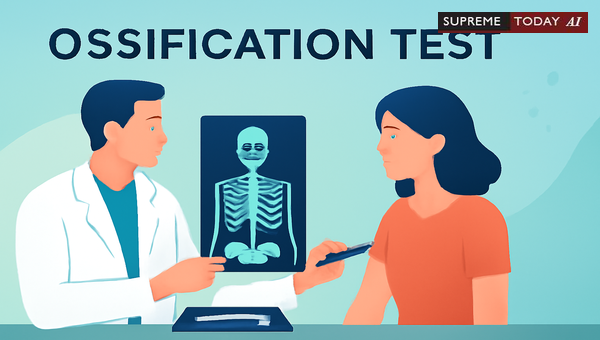
Doctor: Must Be Examined as Witness?
In legal proceedings involving , such as POCSO cases or abduction trials, the plays a crucial role. This scientific method uses X-rays to assess bone fusion and estimate age. However, a common question arises: Doctor who Examine is Not Examine as Witness—meaning, can a doctor's report alone serve as , or must they appear in court?
This blog post explores this vital legal principle under Indian law, drawing from statutes, case law, and judicial precedents. We'll break down why the mere submission of an report is insufficient without the doctor's oral testimony and . Note: This is general information, not specific legal advice. Consult a qualified lawyer for your case.
The Core Legal Principle: Expert Testimony Requires Court Examination
Under Indian law, particularly the , opinions of experts are relevant for court opinions on science, art, or other specialized matters (). However, the main legal finding is clear: the examination of a doctor conducting an is not sufficient to establish expert testimony unless the doctor is examined as a witness in court. The mere report or opinion without oral testimony and does not constitute 1999 8 Supreme 401.
Key Requirements for Expert Witnesses
- An must be examined in court to give their opinion 1999 8 Supreme 401.
- The report submitted by an expert does not automatically go into evidence; the expert must face 1999 8 Supreme 401.
- The doctor conducting the is not automatically an unless examined in court.
The law views as advisory, with credibility hinging on the reasons, data, and opportunity for scrutiny 1999 8 Supreme 401. Without this, courts cannot reliably assess the opinion's basis.
Case Law Insights: Reports Alone Are Inadmissible
Judicial precedents reinforce this. In a key ruling, the court stated: The report submitted by an expert does not go in evidence automatically. He is to be examined as a witness in Court and has to face .2009 6 Supreme 535. This applies directly to medical experts in ossification tests.
Other cases echo this:- The disbelieved an X-ray report because the doctor who conducted the was not examined, overturning reliance on medical evidence 2015 6 Supreme 705.- Prosecution failed to examine the doctor, who merely identified signatures; the report's was ignored without discussion 2015 0 Supreme(Del) 4006.- Even without an , denying of the doctor undermined the case 2018 0 Supreme(P&H) 1003.- In abduction matters, ossification age (16-17 years) wasn't conclusive due to a ±2-year margin, needing opportunity 2025 Supreme(Online)(Raj) 14862.
These rulings highlight procedural lapses weakening evidence when doctors aren't called.
Limitations of Ossification Tests in Court
The estimates age via bone X-rays but has inherent limits:- Not conclusive: Individual variability allows a margin of two years either way2025 Supreme(Online)(Raj) 14862, 2024 0 Supreme(Kar) 680.- Advisory only: Even if conducted, the medical officer's evidence is of and nothing binding2014 0 Supreme(Guj) 891.- Not sole criterion: Courts urge corroboration with birth certificates or school records. Test results are supportive, not definitive, especially sans expert testimony 2024 0 Supreme(Gau) 1561, 2023 0 Supreme(Gau) 604.
Procedural Issues Commonly Seen
- Non-exhibition of reports or absence of radiologist diminishes value 2024 0 Supreme(Gau) 1561,
-
. - may accept reports initially, but appellate courts reject them without doctor examination 2015 6 Supreme 705.
Courts recognize ossification as a useful tool but stress proper procedures for evidentiary weight 2024 0 Supreme(All) 1043.
Implications for Legal Practice
For prosecutions or defenses relying on age:- Summon the doctor: Ensure the ossification-conducting doctor is examined to admit the report.- Request : Parties must demand this to challenge credibility.- Corroborate evidence: Pair tests with documents; avoid sole reliance.
Exceptions: Courts may consider reports if the expert testifies, but never automatically. Scientific reports aren't prohibited, but expert presence is key 1999 8 Supreme 401.
Recommendations for Litigants and Lawyers
To strengthen cases:1. Proactively summon experts: File applications to examine ossification doctors.2. Prepare for : Highlight test margins (±2 years) and variability.3. Gather alternatives: Use birth certificates, MLRs, or school records first.4. Avoid procedural pitfalls: Exhibit reports properly and ensure doctor availability.
In POCSO or similar trials, these steps prevent acquittals due to evidentiary gaps 2018 0 Supreme(P&H) 1003.
Conclusion and Key Takeaways
The principle is straightforward: a doctor who conducts an must be examined as a witness for their opinion to qualify as . Reports alone, without oral testimony and , fall short under the Indian Evidence Act and precedents like 2009 6 Supreme 535 1999 8 Supreme 401.
Key Takeaways:- Ossification tests are valuable but inconclusive ( applies).- Expert credibility demands court scrutiny.- Always corroborate with multiple proofs.- Proper procedure is as critical as science.
In summary: The doctor who examines ossification tests must be examined as a witness in court for their opinion to be admissible as . Their report alone does not suffice unless they face .
Stay informed on evolving case law. For tailored advice, contact a legal professional.
References:1. 1999 8 Supreme 401: Indian Evidence Act, .2. 2009 6 Supreme 535: Expert reports inadmissible without examination.3. 2015 6 Supreme 705, 2015 0 Supreme(Del) 4006, 2018 0 Supreme(P&H) 1003, 2025 Supreme(Online)(Raj) 14862, 2014 0 Supreme(Guj) 891, and others as cited.
#OssificationTest, #ExpertWitness, #IndianEvidenceAct















