


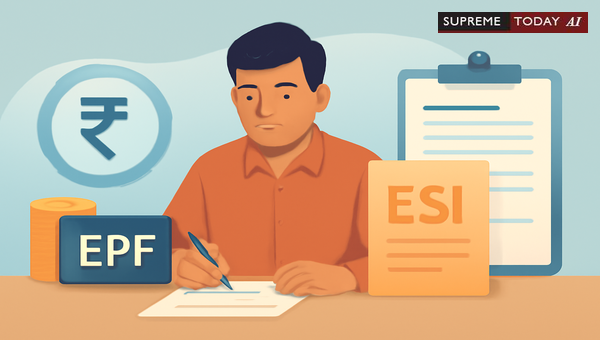
Casual Employee Working Maximum of 3 Hours Per Day and 3 Days Per Week: Entitled to ?
In today's gig economy and flexible workforce landscape, many workers take up casual or part-time roles. But what happens when a casual employee works just 3 hours per day and 3 days per week? Are they entitled to like those under the or ? This is a common question for employers, HR professionals, and workers alike.
This blog post dives deep into Indian labor law to address: Casual Employee Working Maximum of 3 Hours Per Day and 3 Days Per Week is he Entitled for Statutory Contribution? We'll explore definitions, key statutes, case insights, and practical implications. Note: This is general information based on legal provisions and not specific legal advice. Consult a lawyer for your situation.
Understanding in India
involves short-term, irregular work without a permanent contract. These workers often fill temporary needs but lack the protections of regular employees. Under Indian law, the distinction is crucial for benefits like social security contributions.
The explicitly notes that casual employees engaged for very short durations, such as a day or two, are not intended to be covered under its benefits scheme. 1973 0 Supreme(Mad) 48 This aligns with the Act's goal of supporting employees with continuous or substantial service, like sickness, maternity, and injury benefits.
Similarly, other sources highlight that casual or part-time workers must typically work full hours (8 hours per day) and meet minimum engagement periods, such as 240 days per year, to qualify for statutory benefits. 2025 Supreme(Online)(CAT) 5170 2024 Supreme(Online)(CAT) 225 2024 Supreme(Online)(CAT) 8316
: ESI Act Breakdown
Coverage and Eligibility
The ESI Act applies to factories and establishments with 10+ employees (20+ in some states). However, all employees in covered setups are theoretically liable for contributions under , shared equally by employer and employee. 1973 0 Supreme(Mad) 48
But there's a catch for casual workers:- To qualify for sickness benefits (), an employee needs contributions for at least 30 weeks in a contribution period.- Casual employees working minimal hours, like 3 hours/day and 3 days/week, rarely meet this. Such limited engagement (about 9 hours/week) falls short of .
The Act clarifies: casual employees for a very short duration, such as a day or two are not covered. 1973 0 Supreme(Mad) 48 For someone at 3 hours/day x 3 days/week (~36 hours/month), this doesn't constitute substantial service.
EPF and Other Schemes
EPF eligibility under the , also ties to establishments with 20+ employees and wages below a threshold. Casual/part-time workers below 8 hours/day or 240 days/year are generally excluded. Sources confirm: workers must be engaged for full hours and minimum periods. 2025 Supreme(Online)(CAT) 5170 2024 Supreme(Online)(CAT) 8316
One source notes part-time employees working 3-6 hours/week might receive higher pay than full-timers in some cases, but this doesn't extend statutory entitlements without meeting criteria. 2014 0 Supreme(Raj) 1436
Insights from Case Law and Other References
Judicial interpretations reinforce exclusions for transient workers:- exceeding 480 days is key for , , and benefits under the . Casual workers don't qualify. 2025 0 Supreme(Mad) 4722- In comparisons, even contract workers with differing hours/responsibilities aren't equated to regulars. 2022 0 Supreme(Mad) 3356
Other examples:- A worker paid for six hours/day Monday-Friday and three hours Saturday was termed temporary, not eligible for full benefits. 2014 0 Supreme(Raj) 180- Shift patterns maintaining 45 hours/week (e.g., 5 or 6 days) are standard; reduced schedules like 3 days/week don't align.
2007 0 Supreme(Mad) 408- Enhancements from 3 to 7-8 hours/day triggered considerations, but initial low hours didn't. 2024 Supreme(Online)(CAT) 13596
Key Analysis from Sources:- Less than 8 hours/day and 240 days/year: Not entitled to EPF/ESI. 2025 Supreme(Online)(CAT) 5170 2024 Supreme(Online)(CAT) 225- Regular but reduced hours (6-7 hours): Sometimes eligible if near-full month engagement. But 3 hours x 3 days is too minimal. 2024 Supreme(Online)(CAT) 947 2024 Supreme(Online)(CAT) 948- Part-time helpers at 6-7 hours often paid proportionately, no unless thresholds met. 2024 0 Supreme(AP) 911 2024 0 Supreme(AP) 593
Practical Implications for Employers and Employees
For Employers
- No obligation for on casual workers with very short durations. Assess engagement: if under , exemptions apply.
- Document nature (casual vs. regular) to avoid disputes.
For Employees
- Limited hours mean limited entitlements. To access benefits, seek roles meeting minimums (e.g., 8 hours/day, regular days).
- Exceptions possible if work becomes continuous, but policy favors ongoing relationships. 2025 0 Supreme(Mad) 4722
Pros and Cons Bullet List:- Pros of Casual Status: Flexibility, no deductions.- Cons: No ESI/EPF, fewer protections.- Threshold Tip: Aim for 240+ days/year at full hours for eligibility.
Legal Rationale and Policy Goals
Laws like ESI and Industrial Disputes Act target stable employment. Transient casual work doesn't fit, preserving resources for those with ongoing commitments. 1973 0 Supreme(Mad) 48 Case law stresses for permanency. 2025 0 Supreme(Mad) 4722
Even in part-time scenarios, like 19 years on regular post but low hours, conversions are rare without full criteria. 2014 0 Supreme(Raj) 1436
Key Takeaways
| Aspect | Casual (3 hrs/day, 3 days/wk) | Full-Time Regular ||--------|-------------------------------|-------------------|| ESI Coverage | Generally No1973 0 Supreme(Mad) 48 | Yes || EPF Eligibility | Typically No (under 240 days/8 hrs) 2025 Supreme(Online)(CAT) 5170 | Yes || | Insufficient for permanency 2025 0 Supreme(Mad) 4722 | 480+ days qualifies |
In summary, a casual employee working a maximum of 3 hours per day and 3 days per week is generally not entitled to under ESI/EPF. This holds due to minimal hours/days not meeting legal thresholds for coverage.
Final Advice: Employment laws evolve; check applicability via official portals or experts. For tailored guidance, reach out to labor authorities.
Word count: ~1050. References compiled below for transparency.
References
- 1973 0 Supreme(Mad) 48: ESI Act on casual coverage.
- 2025 0 Supreme(Mad) 4722: case law.
- 2024 Supreme(Online)(CAT) 13596, 2022 0 Supreme(Mad) 3356, 2014 0 Supreme(Raj) 1436, 2014 0 Supreme(Raj) 180,
, 2007 0 Supreme(Mad) 408, 2025 Supreme(Online)(CAT) 5170, etc., as cited.












