


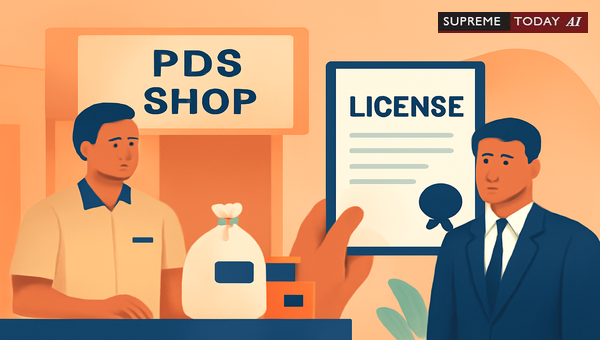
Is a PDS Shop Dealer a ? Legal Guide
Introduction
In India's (PDS), fair price shops play a crucial role in distributing essential commodities like rice, wheat, and kerosene to eligible beneficiaries. But a common question arises: Is a PDS shop dealer a ? This query often stems from confusion over the legal status of these dealers—whether they are government employees or merely licensed private operators. Understanding this distinction is vital for dealers facing regulatory actions, legal proceedings, or questions about accountability.
This blog post breaks down the legal framework, judicial clarifications, and criteria for status. Drawing from key cases and control orders, we'll clarify that PDS shop dealers are typically licensees, not public servants. Note: This is general information based on legal precedents and should not be taken as specific legal advice. Consult a qualified lawyer for your situation.
Legal Framework: Licensing vs. Public Employment
Mandatory Licensing Under Control Orders
To operate a PDS shop, an individual must first secure a license under relevant orders like the Unification Order or state-specific Targeted PDS Control Orders. As noted, Before a person can be appointed as a dealer under the PDS, they must first obtain a license under the Unification Order 2004 0 Supreme(Pat) 731. This license authorizes trading in food-stuffs or essential commodities but does not confer status.
For instance, in Bihar, granting a PDS license must comply with , avoiding conflicts like family members holding multiple licenses: of a PDS License to private respondent No. 7 to run the PDS shop in the same Ward is clear violation of Rule 11(i) 2025 Supreme(Online)(Pat) 657. Here, the dealer is treated as a private , not a government official.
Appointment as a Dealer: Contractual, Not Statutory Employment
Even with a license, appointment as a PDS dealer is discretionary. The appointment of a dealer under the PDS is at the discretion of the government or relevant authorities. The issuance of a license alone does not automatically entitle a person to be appointed as a fair price shopkeeper or dealer 2004 0 Supreme(Pat) 731. This appointment is governed by a outlining terms, not an employment contract under public service rules.
Sources confirm this: the petitioner is a licence dealer, who is running a PDS shop 2021 0 Supreme(Pat) 521 2021 0 Supreme(Pat) 522. Dealers are authorized agents, subject to inspections and show-cause notices for irregularities, but without employee protections.
Judicial Clarifications: The Akhtar Ali Case and Beyond
Ruling in Akhtar Ali
The in Akhtar Ali provided key insights: The , in the case of Akhtar Ali, clarified that a person dealing in food-stuffs must obtain a license but does not acquire the right to be appointed as a fair price shopkeeper as a matter of right 2004 0 Supreme(Pat) 731. Appointment is discretionary, and termination follows contractual procedures, distinct from .
This ruling underscores that PDS dealers lack the inherent status of public servants. Their role is administrative and contractual, not constitutional.
Additional Case Insights
Courts consistently view dealers as licensees:- In one matter, a petitioner appointed as a Fair Price Shop Dealer since faced challenges, but the focus was on licensing, not public employment: Learned counsel for the petitioner submits that the petitioner has been appointed as Fair Price Shop Dealer for F.P. Shop No.35028 2024 0 Supreme(Telangana) 514.- Transfers on compassionate grounds treat licenses as personal, not official positions: It is not disputed that the petitioner’s father-in-law was a under the as a dealer to run a PDS shop 2013 0 Supreme(Pat) 1120.
Further, The fair price shop dealer performs a vital public function. The grant of contract of fair price shop dealership is an act of distribution of State largesse 2018 0 Supreme(All) 1396. While vital, this is a contractual public function, not employment.
Criteria for Status
Under Indian law, public servants are defined in as those holding office by constitutional or statutory provisions, performing public duties with salary and official designation.
| Criterion | Explanation for PDS Dealers | Reference ||----------|-----------------------------|-----------|| Legal Appointment | Must be statutory/constitutional; PDS is discretionary contract. | 2004 0 Supreme(Pat) 731 || Official Functions | Contractual distribution, not mandated public duties. | 2004 0 Supreme(Pat) 731 || Salary & Designation | Commission-based, no government salary. | General principles || Licensing Nature | Permission to trade, revocable independently. | 2004 0 Supreme(Pat) 731 |
PDS dealers generally fail these tests unless explicitly designated as government employees—a rare exception.
Multiple sources affirm: PDS dealers are not classified as a government servant or in the traditional sense. They are licensed licensees operating under specific control orders with references like 2024 0 Supreme(AP) 1265 2024 0 Supreme(Pat) 1239.
Role, Responsibilities, and Legal Risks
PDS dealers distribute to cardholders under the , but as agents: rights of card holders under the Act are brought to eligible persons to a fruition through the medium of the fair price shop dealer 2018 0 Supreme(All) 1396.
They face scrutiny for irregularities:- Inspections lead to show-cause notices: A show cause notice dated was issued... requiring the petitioner to submit her clarification / reply 2021 0 Supreme(Pat) 521.- Criminal cases require proper complaints under , not automatic due to status.
Disciplinary actions involve license suspension/cancellation per control orders, not service rules.
Conclusion and Key Takeaways
No, a PDS shop dealer is typically not a . They are licensed private operators under contractual arrangements, as clarified in Akhtar Ali2004 0 Supreme(Pat) 731 and supported by cases like those in 2021 0 Supreme(Pat) 521 2024 0 Supreme(Telangana) 514. This status affects procedures for termination, complaints, and liabilities—governed by licensing laws, not public service regulations.
Key Takeaways:- Obtain and maintain licenses under PDS Control Orders.- Appointments are discretionary; expect contractual terms.- Vital public role, but private accountability.- For disputes, follow statutory procedures for license protection.
Stay compliant to avoid cancellations. For personalized advice, contact a legal expert familiar with PDS regulations.
References:- 2004 0 Supreme(Pat) 731 (Akhtar Ali case)- 2025 Supreme(Online)(Pat) 657, 2024 0 Supreme(Telangana) 514, 2021 0 Supreme(Pat) 521, 2021 0 Supreme(Pat) 522, 2018 0 Supreme(All) 1396, 2013 0 Supreme(Pat) 1120- Additional: 2024 0 Supreme(AP) 1265, 2024 0 Supreme(Pat) 1239
#PDSDDealer #PublicServant #LegalInsights












