


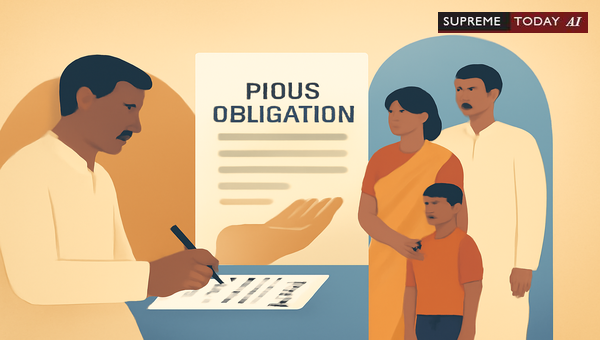
Understanding the and Sale Deed Execution in Hindu Law
In the intricate world of Hindu family law, the stands as a cornerstone, binding sons to repay their father's . But does this extend to an obligation to execute a sale deed for family property? This question often arises in disputes over ancestral lands and joint family assets, where fathers alienate property to settle debts, leaving sons questioning their legal duties.
This blog delves into the includes , drawing from judicial precedents and legal principles. We'll explore its scope, conditions, limitations, and real-world applications. Note: This is general information based on case law and not specific legal advice. Consult a qualified lawyer for your situation.
What is the ?
Under the , the doctrine imposes a religious and legal duty on sons (and grandsons) to discharge their father's debts from their share in the joint family property, known as . This obligation is pious because it stems from ancient Hindu texts, emphasizing filial duty.
Key principle: Sons must repay debts incurred by the father provided those debts are not tainted with immorality or illegality1958 0 Supreme(SC) 117. Courts have clarified that this can extend to family property transactions, including executing sale deeds to facilitate repayment 1999 9 Supreme 103 2021 0 Supreme(Mad) 3181.
As one source notes: - Recognized as a religious duty under Hindu Law (Mitakshara School), binding sons to discharge their father’s debts to the extent of their interest in . This obligation can influence property transactions, including sale deeds, especially when debts are involved 2022 Supreme(Online)(Kar) 38096.
When Does Pious Obligation Require Executing a Sale Deed?
The doctrine comes into play when a father has already entered a sale agreement for joint property to pay off . Sons may be compelled to execute the sale deed if:
- The debts are legitimate, for or welfare 1973 0 Supreme(Ker) 183.
- The sale is to discharge such debts, making the alienation binding on sons 1990 0 Supreme(Kar) 353.
For instance, courts uphold that when a father incurs debts for family purposes, the sons are bound to fulfill this obligation, which may include executing necessary documents like sale deeds 2021 0 Supreme(Mad) 3181 1973 0 Supreme(Ker) 183.
However, execution isn't automatic. The obligation to execute a sale deed arises when the conditions of the sale agreement are met, particularly the payment of the . If the buyer fails to pay, the seller (or heirs) isn't bound 2023 0 Supreme(Mad) 2379 1999 9 Supreme 103. One case emphasized: The execution of a sale deed is contingent upon the satisfaction of specific contractual obligations, including the payment of the balance within the stipulated time 2023 0 Supreme(Mad) 1029.
From additional precedents: - The doctrine can impose a duty on heirs or administrators to execute sale deeds to discharge family debts or fulfill pious obligations 2025 Supreme(Online)(Mad) 67665 2021 0 Supreme(Bom) 780.
Real-World Example from Case Law
In a notable ruling, daughters were held to have an obligation post-2005 amendments but couldn't challenge sales for legitimate loans: Hence, the daughters who have an obligation to discharge the loan cannot challenge the sale of properties... The Lower Appellate Court held that the cannot be applied
. This highlights evolving applications.
Limitations and Exceptions to the Doctrine
Not all debts trigger this obligation. Key exceptions include:
- : Sons aren't bound if debts involve vice, like gambling 1958 0 Supreme(SC) 117 1960 0 Supreme(Ker) 152.
- : Daughters-in-law can't be forced to discharge barred debts of fathers-in-law 1974 0 Supreme(Ori) 117.
- Non-Family Benefit: Sales not benefiting the family are void against non-parties: The sale is neither for the benefit of plaintiffs nor for the benefit of family. The plaintiffs are not parties to the sale deed and therefore, the sale deed... is void 2023 0 Supreme(Mad) 1158.
- Contractual Failures: Vendors aren't obligated if buyers default: Hence, defendants were not under obligation to execute the sale deed 2012 0 Supreme(Kar) 1089. Conversely, if buyers fulfill duties, execution is mandated: In such circumstances, the defendant No. 1 is under obligation to execute the sale deed 2007 0 Supreme(Kar) 559 2007 0 Supreme(Kar) 562.
Post-2005 Hindu Succession Act amendments, the doctrine's scope narrowed, especially for daughters, but sons' liability persists in many cases
.
Gift deeds fall outside: Gift deeds executed out of love and affection are generally not considered valid under the unless they serve a religious or pious purpose 2024 Supreme(Online)(AP) 13575 2024 0 Supreme(AP) 568.
Judicial Precedents Shaping the Doctrine
Indian courts have consistently reinforced these principles:
- Legitimate Debt Requirement: Fathers' alienations for bind sons if for legal necessity 1973 0 Supreme(Ker) 183 1990 0 Supreme(Kar) 353.
- Impact: Pending suits affect deeds: Therefore, the sale deed was subject to decision of dispute in view of the
.
- Heirs' Management Role: The is cast more on the son 2013 0 Supreme(Mad) 815.
- Procedural Compliance: Sales under court orders need draft filings; otherwise, challengeable 2025 0 Supreme(Mad) 4665.
Sale deeds executed in pursuance of the debtor’s obligation or are often upheld, provided they are executed by authorized persons 2024 0 Supreme(P&H) 187 2025 Supreme(Online)(Mad) 67665.
Practical Implications for Families and Buyers
For families:- Verify debt legitimacy before alienation.- Document necessity to bind coparceners.
For buyers:- Fulfill payment timelines to enforce execution.- Check for pending litigations ().
One case affirmed: No title or interest passed... The sale deed was executed when the obligation to execute the sale deed... was subsisting. The defendants are therefore bound 2003 0 Supreme(Ker) 609.
Conclusion and Key Takeaways
The indeed encompasses an obligation to execute sale deeds in Hindu law, but only for legitimate, non-immoral debts tied to family needs. Sons' duties are pivotal, though limited by contracts, amendments, and exceptions. Courts prioritize procedural fairness and equity.
Key Takeaways:- Ensure debts are antecedent and justifiable 1990 0 Supreme(Kar) 353.- Meet sale contract terms before demanding execution 2023 0 Supreme(Mad) 1029.- Doctrine primarily binds sons, not all heirs uniformly 1974 0 Supreme(Ori) 117.- Always check for immorality or procedural lapses.
References: 2021 0 Supreme(Mad) 3181 2023 0 Supreme(Mad) 2379 2023 0 Supreme(Mad) 1029 1958 0 Supreme(SC) 117 1974 0 Supreme(Ori) 117 1973 0 Supreme(Ker) 183 1990 0 Supreme(Kar) 353
2023 0 Supreme(Mad) 1158
2013 0 Supreme(Mad) 815 2012 0 Supreme(Kar) 1089 2007 0 Supreme(Kar) 559 2007 0 Supreme(Kar) 562 2003 0 Supreme(Ker) 6092022 Supreme(Online)(Kar) 38096 2025 Supreme(Online)(Mad) 67665 2021 0 Supreme(Bom) 780 2024 0 Supreme(P&H) 187 2025 0 Supreme(Mad) 4665 2024 Supreme(Online)(AP) 13575 2024 0 Supreme(AP) 568
Word count: 1028. For personalized guidance, seek professional legal counsel.
#PiousObligation, #HinduLaw, #SaleDeed












