


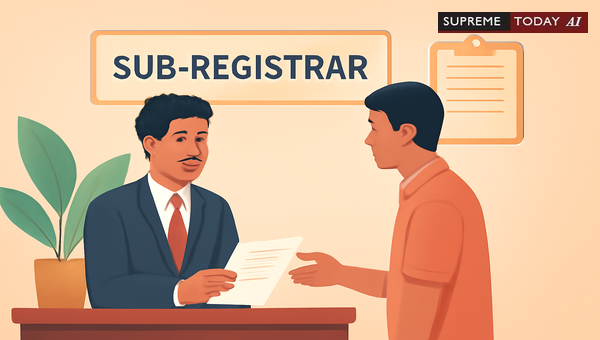
Can Plaintiff Question on Document Presentation?
In property disputes, tensions often arise during document registration. Imagine you're a plaintiff challenging a defendant's actions in court, and you want to probe how documents were presented to the . A common query is: Please help plaintiff for asking questions regarding presenting documents by sub on the application of defendant. This question touches on critical aspects of the , 1908, balancing procedural checks with substantive limits.
This blog post breaks down the legal boundaries, drawing from key judgments and provisions. While this provides general insights, consult a qualified lawyer for advice tailored to your case.
The Role of in Document Registration
The or 's primary function is administrative. They verify and the , not the document's contents or underlying transaction validity. As established in legal precedents, The or ’s role is primarily administrative and limited to verifying and the authority of the presenter 2022 6 Supreme 291 2016 0 Supreme(SC) 871.
Under of the , the presenter must be , often via a . Failure here can lead to refusal, but the inquiry stops at procedure. For instance, in , the court emphasized: the ’s jurisdiction only comes into force if and when a document is presented in accordance with law. If the presentation is made by an unauthorized person, the can refuse registration but cannot go beyond procedural verification to question the of the document 2022 6 Supreme 291.
Permissible Questions for the Plaintiff
Plaintiffs may question the presentation process, but only on procedural grounds. Legally allowable inquiries include:
- Was the presenter authorized under the law?
- Did they hold a valid , properly authenticated? 2022 6 Supreme 291
- Did the presentation meet statutory requirements, like or ? 2016 0 Supreme(SC) 871
Cases like and affirm: the registration process involves verifying the authority of the presenter, and questions about whether the person was are permissible 2022 6 Supreme 291.
In practice, plaintiffs can demand records showing:- .- before the .- Compliance with .
This scope empowers plaintiffs to highlight irregularities without overstepping into .
Limitations: What Cannot Be Questioned
The line is clear: Sub-Registrars cannot probe:
- or legality of the transaction.
- Authenticity of signatures or contents beyond procedure.
- Lawfulness of the underlying deal, absent procedural flaws. 2022 6 Supreme 291
Veena Singh reinforces: the ’s role is limited to procedural verification and that are to be resolved in civil courts 2024 6 Supreme 129. Fraud or collusion claims? Those belong in civil courts, not registration offices. Mere suspicion isn't enough; evidence is required 2022 6 Supreme 291.
Insights from Related Cases
Other judgments echo these principles, providing context on presentation challenges. In one case, the appellant demonstrated readiness by presenting himself in the office of Sub , Narnaul on and submitting documents, underscoring the need for personal or authorized presence 2014 0 Supreme(P&H) 843.
Similarly, a plaintiff went to the 's office with funds ready but the defendant failed to appear, highlighting procedural readiness as key under the 2016 0 Supreme(P&H) 1451. The plaintiff must demonstrate to perform the contract 2016 0 Supreme(P&H) 1451.
In another instance involving (tenants), the issued notice upon document presentation, alerting the plaintiff to potential unauthorized alienation 2020 0 Supreme(Mad) 1016. This shows how notices can trigger plaintiff inquiries into authority.
A suit for failed because the plaintiff didn't prove readiness at the 's office with balance consideration 2020 0 Supreme(All) 589. These cases illustrate that while presentation authority is verifiable, broader claims need court adjudication.
Even in mortgage-related disputes, courts direct release of title deeds post-presentation formalities, but only after verifying procedural steps like NOC and society approvals 2019 0 Supreme(Bom) 912.
Practical Recommendations for Plaintiffs
To effectively question presentation:
- Frame narrowly: Focus on authorization, e.g., Was the duly executed and authenticated? 2022 6 Supreme 291
- Gather evidence: Support claims with documents; conjecture won't suffice.
- Avoid overreach: Steer clear of content validity to prevent dismissal.
- Escalate if needed: For fraud, file civil/criminal suits separately 2022 6 Supreme 291.
In writ contexts, challenges to inaction on prohibited properties have led to guidelines for lists and websites, but procedural presentation remains foundational 2015 0 Supreme(AP) 799.
Key Takeaways
- Yes, but limited: Plaintiffs can question procedural authority in document presentation by Sub-Registrars 2022 6 Supreme 291 2016 0 Supreme(SC) 871.
- No substantive dives: Transaction legality is for courts.
- Act strategically: Use evidence-based, procedure-focused queries.
Property registration disputes demand precision. While Sub-Registrars ensure smooth admin, plaintiffs hold leverage on authority checks. For personalized guidance, reach out to a legal expert—general principles here don't substitute specific advice.
References:1. 2022 6 Supreme 291: Limits to procedural authority.2. 2016 0 Supreme(SC) 871: Administrative role clarification.3. Additional cases as cited.
#SubRegistrar #RegistrationAct #PropertyLaw















