


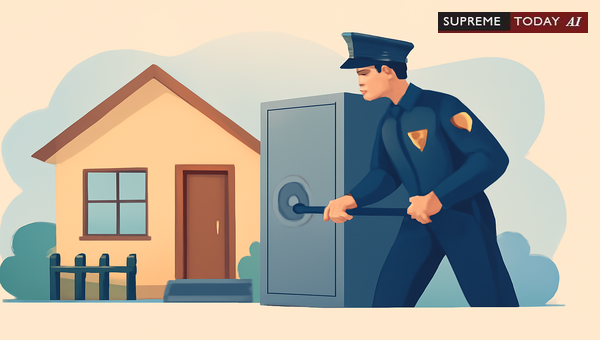
Can Police Break Open Lockers in House Searches?
In the heat of a house search, tensions can run high when authorities encounter locked lockers or almirahs. A common question arises: During a house search, whether the officer can break open the locker inside the house? This issue touches on fundamental rights to privacy versus the state's power to investigate crimes. Understanding the legal boundaries is crucial for homeowners, business owners, and anyone facing such scenarios.
This blog post delves into the legal framework, key precedents, conditions, and procedures governing such actions under Indian law. We'll draw from statutory provisions like the and specific acts, supported by judicial insights. Note: This is general information and not specific legal advice. Consult a qualified lawyer for your situation.
Legal Framework for Breaking Open Lockers
Indian law empowers authorized officers to conduct searches and seizures, but with safeguards. Under , an officer executing a search can break open any outer or inner door—or even a locker—if access is refused and it's necessary for the search. This provision states that the officer has the authority to break open any outer or inner door to gain entry into premises or receptacles like lockers
.
Additionally, specific statutes grant broader powers. For instance, under of relevant acts (such as narcotics or anti-corruption laws), officers authorized by the Director can break open locks of doors, boxes, lockers, safes, almirahs, or other receptacles if they believe contraband or evidence is concealed inside 2023 0 Supreme(Mad) 2050. Similarly, (likely referring to arms or explosives legislation) allows officers to break open the lock of any door, almirah, safe, box, cupboard, drawer etc. during searches 2014 0 Supreme(J&K) 108.
These powers ensure investigations aren't thwarted by locked spaces, but they must be exercised judiciously.
Case Precedents Upholding Authority to Break Open Lockers
Judicial decisions reinforce this authority, particularly when occupants fail to cooperate. In one notable case, during a search, a locker was discovered that occupants hadn't disclosed. Without the key, the authorized officer arranged to break it open, revealing a significant amount of currency 1998 0 Supreme(Cal) 500. This precedent highlights that non-disclosure justifies such action.
Another instance involved a vigilance search at a residence where a computer hard disk and locker key were seized, with the inventory prepared in the presence of witnesses 2012 0 Supreme(Mad) 2562. Courts have also addressed bank lockers, but the principle extends to house searches: relevance must be established, as seen in cases where jewels in a locker were scrutinized, though the final report lacked details on the search inside locker No.14 2023 Supreme(Online)(MAD) 19542 2023 Supreme(Online)(MAD) 26439.
In a CrPC context, officers have broken open doors or spaces when entry was barred, such as using a grinding stone to enter a locked house after hearing cries 2014 0 Supreme(Mad) 2145. These cases illustrate that in concealed evidence permits force, but documentation is key.
Conditions and Limitations for Using Force
Officers cannot act arbitrarily. Key conditions include:- Reasonable Grounds: There must be a belief, based on facts, that the locker hides relevant materials 2023 0 Supreme(Mad) 2050.- Authorization: A valid or statutory power is required; for bank lockers, court permission or owner consent is often needed 2022 Supreme(Online)(Tel) 5628.- No Arbitrary Action: Breaking open is permissible only if necessary and after demanding keys or access. Without court permission or urgency, it's unlawful
.
Limitations are strict:- Witnesses and Inventory: Searches must occur in the presence of two respectable witnesses. Seized items require a detailed inventory, often prepared on-site 2025 Supreme(Online)(Mad) 70090.- Relevance Check: Courts demand proof of how items link to the case. For example, the investigating officer must explain seized jewels' relevance before perpetual freezing 2023 Supreme(Online)(MAD) 19542.- Post-Seizure Handling: Valuables may remain in the locker after inventory unless further action is needed 2023 Supreme(Online)(MAD) 19542.
Failure to follow these can render evidence inadmissible or lead to property return orders 2022 Supreme(Online)(MAD) 13665.
Step-by-Step Procedure During a House Search
Here's how a lawful search typically unfolds:1. Presentation: Officer shows the search and explains purpose.2. Demand for Keys/Access: Requests voluntary opening of lockers.3. Breaking Open if Refused: If belief in concealment exists and access denied, break open with minimal damage 2023 0 Supreme(Mad) 2050.4. Search and Seizure: Conduct search, list items (e.g., cash, documents) in with witnesses.5. : Prepare inventory; copies to owner and witnesses.6. Court Reporting: Submit findings; court decides on retention or release 2023 0 Supreme(Mad) 2754.
For lost keys in lockers, banks follow RBI guidelines, seeking court orders 2021 4 Supreme 233. Homeowners should cooperate to avoid escalation, but know your rights.
Practical Recommendations and Rights
- For Homeowners: Disclose all spaces, provide keys promptly. Insist on witnesses and copies of documents. If rights violated, challenge via for property release.
- For Authorities: Document rationale for breaking open; ensure procedural compliance to withstand scrutiny 2023 0 Supreme(Mad) 2050.
In cases like assaults during refused entry attempts, courts protect lawful actions but penalize excesses 2017 0 Supreme(Ker) 829.
Key Takeaways
- Yes, Generally Permissible: Authorized officers may break open lockers during house searches with in concealed evidence, backed by CrPC Section 100 and specific acts
2014 0 Supreme(J&K) 108.
- Safeguards Essential: Proper , witnesses, inventory, and relevance proof are mandatory.
- Judicial Oversight: Courts ensure actions aren't abusive, often requiring detailed justifications 2023 Supreme(Online)(MAD) 19542.
House searches balance security needs with privacy. Stay informed, cooperate judiciously, and seek legal help promptly. For personalized guidance, contact a legal expert.












