



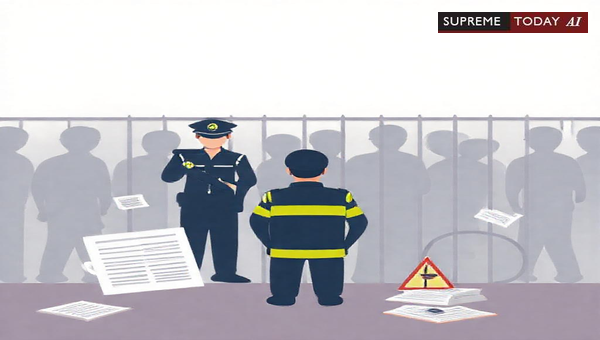
Analyzing the Legality of Police Detention Beyond the Mandatory Twenty-Four Hour Production Window in India
When an individual is taken into custody, the clock for their fundamental right to be produced before a Magistrate begins ticking almost immediately. In a scenario where a person is taken into police custody at 2:30 PM on September 12, 2026, but is not produced before a Magistrate until 8:30 PM on September 13, 2026, a critical legal question arises: Is this custody illegal? This thirty-hour gap exceeds the constitutional mandate for judicial oversight, raising serious questions about the lawfulness of the detention and the protection of .
The Constitutional Mandate: The
The Constitution of India and the Code of Criminal Procedure (Cr.P.C.) provide robust safeguards against arbitrary detention. of the Constitution and clearly state that every person who is arrested and detained in custody must be produced before the nearest Magistrate within a period of 24 hours of such arrest 2025 Supreme(Online)(Bom) 4472
T. Ramadevi VS State of Telangana, rep. by its Principal Secretary
.This is not merely a procedural guideline; it is a fundamental right. The only time that can be legally excluded from this 24-hour calculation is the time strictly necessary for the journey from the place of arrest to the Magistrate’s Court. If the detention period exceeds this timeframe without specific justification, the custody is generally considered illegal, and the individual may be entitled to release 2025 Supreme(Online)(Bom) 4472 and 2024 0 Supreme(Telangana) 367.
Understanding vs.
A common point of contention in such cases is when the clock actually starts. Police authorities often argue that the 24-hour period begins only from the formal recording of the arrest. However, judicial precedents consistently clarify that this is a misconception. The 24-hour clock begins the moment an individual's liberty is effectively curtailed.
Courts have criticized the equivocatory quibblings sometimes used by law enforcement, such as claiming a person was merely detained for interrogation rather than formally arrested. These tactics are viewed as unfair evasions of the law. If an individual's movement is restricted and they are under the control of the police, they are, for all practical purposes, in custody, regardless of whether a record has been generated at that specific moment 2010 6 Supreme 692 and 2025 Supreme(Online)(Bom) 4472.
The Requirement of a
In instances where an accused is arrested in one jurisdiction and must be transported to another for production before a Magistrate, the police must act with procedural diligence. The law requires that the police secure a or from the nearest Magistrate before transporting the individual across jurisdictions
Vishal Manohar Mandrekar VS State of Telangana represented by its Public Prosecutor - Crimes (2024)
.If the police transport an accused without this warrant, they cannot claim the travel time as an exclusion for the 24-hour limit. The absence of a in cross-jurisdictional arrests is frequently cited by courts as a primary reason for declaring detention illegal. When an accused is held for 30 hours—as in the case of the September 12th arrest—without having been produced before the nearest Magistrate or having obtained a , the detention violates the constitutional protection afforded by 2024 0 Supreme(Telangana) 1040.
Can a Subsequent Remand Order Cure Illegality?
A common argument raised by the state is that once a Magistrate has ordered a remand, the detention is legalized. However, the legal position is that a Magistrate's subsequent remand order cannot retroactively validate an that occurred prior to production. If the initial detention period exceeded 24 hours without lawful justification, the illegality is already complete.
While the Magistrate holds the power to remand an accused to custody, they are also obligated to scrutinize whether the procedures leading up to that production were followed. The Supreme Court has indicated that the right to challenge the illegality of detention persists even after production, provided the initial violation was clear and demonstrable 2011 0 Supreme(Mad) 4908.
Exceptions and Procedural Reality
While the is strict, there are limited exceptions. For instance, if an accused was already in judicial custody in connection with a separate case and a was executed while in prison, the clock may not apply in the same manner as a fresh arrest on the street 2007 4 Supreme 136. Furthermore, lawful investigative detention—when explicitly authorized by specific statutes like the NDPS Act or PMLA, where a person is summoned or examined without yet being under arrest—might not trigger the 24-hour requirement immediately. However, in the absence of such specific statutory authorization, any deprivation of liberty must be treated as custody, and the applies strictly 2026 0 Supreme(Ker) 1268.
Summary of Legal Implications
When assessing whether detention from 2:30 PM on September 12 to 8:30 PM on September 13 is illegal, the following factors are decisive:
- Total Duration: The total time elapsed is 30 hours. This clearly exceeds the 24-hour statutory limit.
- Lack of Justification: Unless the police can demonstrate that the extra 6 hours were absolutely required for unavoidable travel and that a was secured, the detention fails the legal test.
- Violation of Rights: The failure to produce the accused within the window constitutes a violation of and
T. Ramadevi VS State of Telangana, rep. by its Principal Secretary
.
In conclusion, the is a bedrock principle of in the Indian legal system. Law enforcement agencies are required to adhere strictly to these timelines. Whenever there is a significant delay, as seen in the 30-hour example, the courts have consistently set aside remand orders and granted relief to the accused, emphasizing that procedural compliance is not optional but mandatory. If you or someone you know is facing a situation involving delayed production before a Magistrate, it is crucial to consult with a legal professional to evaluate the specific facts of the case, as the remedies available depend heavily on the documentation and the precise timeline of events.
#LegalRights #CriminalLaw #PoliceCustody #ConstitutionalLaw










