


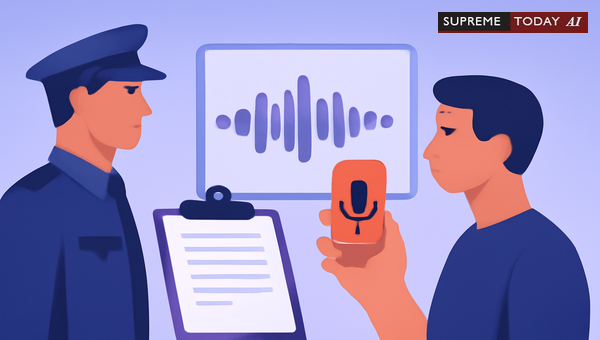
for Voice Sample Collection in India: Is It Legal?
In today's digital age, voice recordings often play a pivotal role in criminal investigations, from extortion calls to threats. But what happens when police seek to collect a suspect's voice sample while in custody? Can they legally do so, or does it infringe on fundamental rights? This question— for Collecting Voice Sample—raises critical issues of law enforcement powers, constitutional protections, and procedural fairness in India.
This blog post delves into the legal framework governing voice sample collection during , drawing from precedents, constitutional provisions, and judicial safeguards. Note that this is general information based on established case law and should not be considered specific legal advice. Consult a qualified lawyer for personalized guidance.
Legal Authority for Voice Sample Collection
Courts in India have affirmed that magistrates hold the statutory power to order voice sample collection during investigations, provided there's a solid procedural foundation. The landmark case of (often cited as Supra) is central here, where the upheld magistrates' authority to permit such collections for
2022 0 Supreme(P&H) 408.
This power stems from the need for modern forensic tools in investigations. As noted in judicial observations, Courts have recognized that magistrates possess the statutory power to order the collection of voice samples during investigation, provided there is a procedural basis and adherence to legal standards
2022 0 Supreme(P&H) 408.
Even from non-accused individuals, courts have allowed it in certain contexts. For instance, in one case, the petitioner argued against voice sample collection, but the court clarified custody isn't limited to post-arrest scenarios: He can be in custody not merely when the police arrests him, produces him before a Magistrate and gets a to judicial or other custody 2023 Supreme(Online)(KER) 7976.
Constitutionality: Does It Violate ?
of the safeguards against : no accused person shall be compelled to be a witness against themselves. However, courts have consistently ruled that voice samples for forensic purposes do not qualify as .
In Ritesh Sinha and subsequent rulings, the held that such collections are akin to like fingerprints or blood samples, not incriminating testimony 2024 0 Supreme(Gau) 909 2022 0 Supreme(P&H) 408 2024 0 Supreme(Ker) 1302. Compelling a person to give a voice sample for forensic purposes does not amount to or in the constitutional sense, especially when the procedure is standardized, fair, and for a legitimate investigation purpose 2024 0 Supreme(Gau) 909 2022 0 Supreme(P&H) 408 2024 0 Supreme(Ker) 1302.
Privacy rights under are also balanced against investigative needs. The right to privacy, as a fundamental right, is subject to in the interest of and investigation 2024 0 Supreme(Gau) 909 2024 0 Supreme(Ker) 1302. Courts uphold this when is followed, rejecting blanket violations claims.
Collection During : Permissible with Safeguards
A key concern is whether voice samples can be taken while the accused is in . Judicial precedents confirm yes, provided transparency and exist. Courts have upheld the authority to collect voice samples even when the accused is in , provided the process is transparent, with , and the sample is obtained 2024 0 Supreme(Gau) 909 2024 0 Supreme(Raj) 1567 2024 0 Supreme(Ker) 1302.
Real-world examples abound. In one investigation, While A-2 was in , his voice sample was recorded. The conversation recorded in mobile phone and the specimen voice sample of A1 and A3 were sent for report 2019 0 Supreme(Bom) 1030. Another case noted, He was taken in and his voice sample was recorded for comparison with the voice recorded in MO13(a) 2017 0 Supreme(Ker) 509.
However, police cannot act unilaterally. The judiciary has clarified that the police or investigating agencies cannot arbitrarily compel voice samples without judicial sanction 2024 0 Supreme(Raj) 1567 2024 0 Supreme(Ker) 1302. Magistrates must review applications, assessing necessity.
and Best Practices
To ensure legality and , strict procedures apply:
- Prior Judicial Permission: Applications must detail necessity, submitted to a magistrate.
- Fair and Voluntary Collection: Samples taken without coercion, often with witnesses present. The collection of voice samples must follow prescribed procedures, including: Obtaining prior permission from a magistrate based on a proper application stating the necessity. Ensuring the sample is collected in a fair, voluntary manner, with standard precautions 2024 0 Supreme(Gau) 909 2024 0 Supreme(Raj) 1567 2024 0 Supreme(Ker) 1302.
- Documentation and Sealing: Proper chaining of custody, sealing samples for integrity.
- Evidence Act Compliance: Under , electronic records (like voice samples) require certificates for 2024 0 Supreme(Gau) 909 2024 0 Supreme(Raj) 1567 2024 0 Supreme(Ker) 1302.
Additional insights from sources emphasize: The process is akin to collecting a blood sample and is supported by judicial orders or statutory provisions, ensuring procedural and constitutional propriety 2024 0 Supreme(Raj) 1567. Courts may oversee collection in person for sanctity, as in Ritesh Sinha2024 0 Supreme(Raj) 1567 2023 0 Supreme(Raj) 220.
Challenges, Illegality, and Court Scrutiny
Not all collections sail smoothly. Coercive or procedure-less takings can be challenged. Illegal or coercive collection of voice samples, such as under duress or without proper legal procedures, can be challenged in court 2024 0 Supreme(Gau) 909 2022 0 Supreme(P&H) 780. Evidence may become inadmissible if safeguards fail.
Petitioners often argue lack of consent or non-accused status: The petitioner is not an accused and his voice sample cannot be taken 2024 0 Supreme(HP) 54. Courts scrutinize: Is it necessary? Relevant? One ruling noted, For that purpose, the police must get the voice sample of the accused under Evidence Act considerations 2017 0 Supreme(Guj) 224.
Privacy and consent concerns persist, but courts have generally upheld the legality of voice sampling... provided it is done lawfully and with proper judicial oversight 2023 Supreme(Online)(HP) 14851 2023 0 Supreme(SC) 1794. In applications, police seek custody specifically: The investigating authority has submitted an application for police of the applicant to collect voice sample 2021 0 Supreme(MP) 85.
No specific pre- statutes existed, yet courts relied on inherent powers, stressing equipment standards for reliability 2022 0 Supreme(Guj) 1546.
Key Takeaways and Recommendations
- Voice sample collection in is generally permissible under magistrate orders, not violating or privacy when procedurally sound 2024 0 Supreme(Gau) 909 2024 0 Supreme(Ker) 1302.
- Always secure and document meticulously.
- Challenge irregularities promptly to protect rights.
- For investigators: Demonstrate necessity; for accused: Verify voluntariness and oversight.
Recommendations:- Obtain orders from competent magistrates via detailed applications.- Follow voluntary, witnessed processes with sealed documentation.- Adhere to Section 65B for electronic evidence.- Prepare to contest coercive actions in court.
In summary, Indian law supports voice samples in custody as a vital investigative tool under judicial oversight. This balance aids justice while upholding rights, as affirmed across precedents. Stay informed on evolving forensics and consult professionals for case-specific strategies.
(Word count: 1028. References integrated from provided sources; general analysis only.)
#VoiceSampleIndia #PoliceCustodyLaw #CriminalInvestigation












