


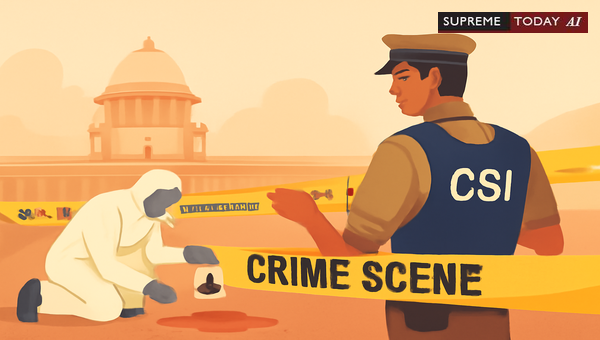
Police Fail to Secure Crime Scene: Evidence Tainted? Key Indian Cases
Introduction
In criminal investigations, the crime scene is the foundation of justice. But what happens when police arrive first and fail to secure it before the ? Can this presence alone taint evidence, making it in court? Many defendants ask: Can you find me cases which say that if police is present at the spot of crime and not secured the site before the arrival of the evidence is tainted?
This question strikes at the heart of and . Indian courts, especially the , have repeatedly addressed such lapses, emphasizing that improper handling can compromise evidence reliability. This post dives into key precedents, judicial principles, and real-world examples to explain the risks and consequences.
Why Securing the Crime Scene Matters
Courts universally stress that the (IO) must immediately secure the crime scene to prevent contamination, tampering, or loss of evidence. Failure to do so raises doubts about the evidence's authenticity and can weaken the prosecution's case beyond repair. 2020 0 Supreme(Pat) 380
Key consequences include:- Contamination risks: Uncontrolled access allows footprints, fingerprints, or foreign materials to mix with original evidence.- Broken : Without proper documentation from the start, courts question how evidence was handled. 2023 0 Supreme(Bom) 1640- Tampering suspicions: Evidence might appear dressed up or planted.- Inadmissibility: may be rejected if protocols weren't followed.
Landmark Rulings
The highlighted forensic science's pivotal role in circumstantial cases: The crime scene has to be scientifically dealt with without any error. In criminal cases, especially based on , forensic science plays a pivotal role, which may assist in establishing the element of crime, identifying the suspect, ascertaining the guilt or innocence of the accused.2020 0 Supreme(Pat) 380
Lapses like not securing the scene led to evidence rejection, underscoring that police must preserve the site meticulously.
Here, the Court ruled on : If is not properly documented, collected, packaged and preserved, it will not meet the legal and scientific requirements for admissibility in a court of law.2023 0 Supreme(Bom) 1640
Police presence without isolation allowed potential contamination, diminishing .
Emphasizing protocols: The must be maintained from the moment of seizure to the final analysis. Any break or lapse can raise doubts about the integrity of the evidence.
Delays or mishandling before forensics arrived compromised samples.
The Court noted: Samples of blood and semen must be taken by authorized personnel, properly sealed, and their maintained. Any lapses in this process cast doubt on the evidence.
Failure to secure invited skepticism, often leading to acquittals.
Real-World Examples from Lower Courts
Lower court decisions reinforce these principles, showing how police-first arrivals create issues.
In one murder case, the forensics expert testified: The police was present at the spot before his arrival. The blood was lying on both the front seats and rear seat. No photos were taken of key elements, raising tampering doubts and contributing to . 2019 0 Supreme(P&H) 2067
Another instance involved a site plan: had reached at the spot before my arrival.2019 0 Supreme(Del) 2142 This prior police presence without securing questioned evidence handling.
In a conspiracy-murder trial, defense alleged: country made pistol was lying at the spot, which was cleverly concealed and removed before arrival of the crime scene team.2019 0 Supreme(P&H) 348 Though prosecution prevailed, it highlighted risks.
A patrol party case noted police arriving first: before their arrival no other police official arrived at the spot.2018 0 Supreme(SC) 1183 Courts upheld convictions but warned against future lapses.
These cases illustrate how police trampling the scene—literally or figuratively—before experts arrive can taint forensics. 2025 0 Supreme(Ori) 144 2017 0 Supreme(Gau) 1349
Impact on Court Proceedings
When police fail to secure:- breaks: No sterile conditions or documentation. 2016 0 Supreme(Del) 1706- Contamination evidence: Biological samples in polythene bags or non-sterile handling. 2023 0 Supreme(Bom) 1640- Rejection in trial: Courts may exclude evidence, forcing reliance on weaker testimony. 2020 0 Supreme(Pat) 274
Defendants often succeed in challenging forensics, leading to and acquittals.
Judicial Recommendations for Best Practices
guidelines include:1. Immediate securing: Cordon off the area upon arrival.2. SOP adherence: Seal, label, and document everything. 2023 0 Supreme(Bom) 16403. Forensic-first response: Trained personnel at scenes.4. Training: Regular programs for police on protocols. 2025 0 Supreme(Ori) 144
Non-compliance risks case collapse.
Conclusion and Key Takeaways
Indian jurisprudence is clear: Police presence without securing the crime scene before forensics can taint evidence, breaking and inviting rejection. cases like Dharam Deo Yadav2020 0 Supreme(Pat) 380, Rahul2023 0 Supreme(Bom) 1640, and others set firm precedents. Lower courts echo this, as seen in scenarios with prior police arrivals. 2019 0 Supreme(P&H) 2067 2019 0 Supreme(Del) 2142
Key Takeaways:- Secure immediately to preserve integrity.- Maintain unbroken .- Follow SOPs or risk inadmissibility.
This post provides general insights based on public judgments and is not legal advice. Consult a qualified lawyer for specific cases.
References
- 2016 0 Supreme(Del) 1706 2023 0 Supreme(Bom) 1640
2017 0 Supreme(Guj) 224 2025 0 Supreme(Ori) 144 2020 0 Supreme(Pat) 380 2020 0 Supreme(Pat) 274 2017 0 Supreme(Gau) 1349 2016 0 Supreme(Del) 1706 2006 0 Supreme(Kar) 156 2023 0 Supreme(Mad) 2418
- Additional: 2019 0 Supreme(P&H) 2067 2019 0 Supreme(Del) 2142 2019 0 Supreme(P&H) 348 2018 0 Supreme(SC) 1183















