



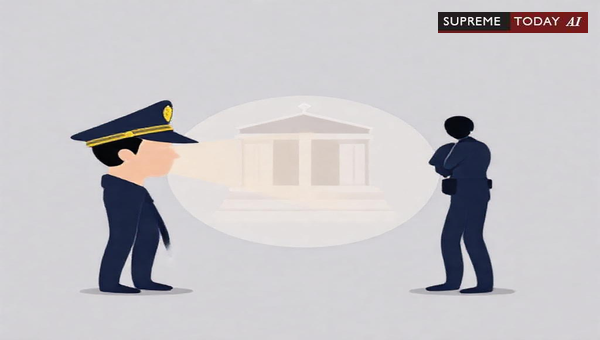
The Impact of Sole Reliance on Police Witnesses During Criminal Investigation and Trial Proceedings
In the landscape of criminal litigation, the cornerstone of the prosecution’s case is the quality of its evidence. Often, defendants or legal observers ask: When the police associate only the spot witnesses, do the entire proceedings become automatically doubtful? This is a nuanced question. While there is no absolute rule stating that police testimony, standing alone, is inadmissible, the law places a high value on independent . When the prosecution relies exclusively on testimony from officers who were themselves participants in a raid or the investigation, the court’s scrutiny intensifies, and the risk of creating for the defense increases significantly.
The Problem of the Interested Witness
A primary concern in criminal trials is the dual role often played by law enforcement. When a police officer acts as both a member of the raiding team and the investigating officer, their impartiality may be called into question. Courts have frequently noted that such a convergence of roles can compromise the fairness of the entire process.
The foundational issue is whether the testimony of police officers who are also the investigating officers or direct participants in an incident can alone sustain a conviction. The judiciary often views such evidence with suspicion because these officers are essentially to the outcome of the case. In one instance, the court observed that where a police officer acts as both a member of the raiding team and the investigating officer, the fairness and independence of the investigation are compromised. Furthermore, failures to record information in a or produce can violate , further weakening the prosecution's position 2026 Supreme(Online)(Guj) 9445.
The Necessity of Independent
The legal system generally encourages, and in many cases expects, the presence of during significant procedural events like searches, seizures, or arrests. When an investigating officer fails to call who were available at the scene, the omission can become a fatal flaw in the prosecution’s case.
The courts have held that police witnesses, even when credible, cannot fully replace the need for independent . If independent individuals are available but the police fail to associate them, the defense can rightfully argue that the investigation was not conducted fairly. As highlighted by the , the non-joining of despite their availability is fatal to the case of prosecution 2025 Supreme(Online)(HP) 7091. However, this is not an absolute rule; if independent persons are not willing to cooperate, the prosecution cannot be blamed, and that fact alone will not necessarily result in an acquittal 2000 2 Supreme 633.
Procedural Irregularities and the Cloud of Suspicion
Beyond the issue of sole witnesses, the credibility of the police story often hinges on strict adherence to . When the prosecution relies exclusively on police witnesses, any procedural lapse—such as an inordinate delay in registering the , failing to send case diaries to superior officers, or the ante-dating of documents—casts a cloud of suspicion on the entire warp and woof of the 1978 0 Supreme(SC) 323.
When these procedural irregularities are combined with a lack of , the proceedings can indeed become doubtful. For example, non-compliance with mandatory search procedures (such as those under the ) often renders a recovery suspicious, frequently leading to the acquittal of the accused 2026 0 Supreme(HP) 493. In essence, suspicion and conjecture cannot substitute for clear, cogent, and unimpeachable evidence. When the prosecution’s case is built on a shaky foundation of interested witnesses and procedural shortcuts, the is generally granted to the accused 2026 0 Supreme(All) 670.
The Ring of Truth: When Police Testimony Stands
It is important to understand that reliance on police witnesses does not guarantee an acquittal. Courts often distinguish between cases where the investigation was clearly biased or flawed and cases where police testimony remains consistent and reliable.
If the testimony of police officers is found to be reliable and trustworthy, the court can—and does—act upon it, even without . This is particularly true in instances of , where police officers encounter criminal activity while on routine patrol and may not have the luxury of calling a public witness immediately. In these scenarios, the non-association of is not automatically fatal 2026 Supreme(Online)(HP) 2198.
The standard the court applies is whether the testimony has a ring of truth. Minor contradictions regarding time or exact sequences of events are common and do not necessarily invalidate evidence. If the witnesses' testimonies are corroborated by other reliable evidence—such as medical evidence, forensic reports, or physical evidence—the conviction may be upheld despite the absence of independent public witnesses 2026 Supreme(Online)(HP) 3233. As noted in several rulings, minor discrepancies that do not touch the core of the case should not be used to discard the prosecution's case if the evidence, read as a whole, maintains credibility 2026 0 Supreme(HP) 259.
Strategic Defense Considerations
For a legal defense strategy, the sole police witness scenario provides a critical avenue for cross-examination. Defense counsel should focus on:
- The Interested Status: Challenging the independence of officers who were both participants in the raid and the ones who filed the complaint or conducted the investigation.
- Availability of Public Witnesses: Establishing that the area of the incident was public or populated, making the absence of public witnesses highly improbable.
- Procedural Lapses: Rigorously cross-examining regarding the , the timing of registration, and any discrepancies between the and the official testimony.
- Consistency: Exploiting between different police witnesses’ statements, which can suggest that the official version was managed or constructed after the fact 2022 0 Supreme(P&H) 858 and 2017 0 Supreme(All) 690.
Conclusion
While the presence of police as the only witnesses does not make a case legally invalid per se, it shifts the burden of scrutiny heavily toward the prosecution. If the investigation was handled in a way that ignored , failed to recruit when they were available, or relied on officers who had a direct interest in the conviction, the entire proceeding becomes highly vulnerable to challenge. Ultimately, whether a case stands or falls depends on the specific circumstances—whether the evidence provided is solid and unimpeachable, or whether it is marred by contradictions and procedural neglect. Because legal outcomes depend heavily on the specific facts of each case, those involved in such matters should consult with a qualified legal professional to evaluate the merits of their specific situation.
#CriminalDefense #EvidenceLaw #LegalInsights







