


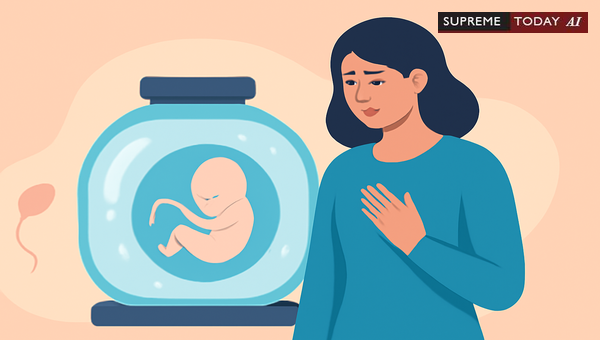
Can Wife Use Deceased Husband's Frozen Embryo in India?
Advancements in () have opened new possibilities for parenthood, but they also raise complex legal questions—especially when tragedy strikes. Imagine a couple who, after struggling with infertility, freezes embryos during IVF treatment. What happens if the husband passes away? Can the wife proceed with implantation using those frozen embryos? This poignant issue intersects family law, reproductive rights, and consent principles under Indian regulations.
In this post, we delve into the legal framework governing frozen embryos, focusing on whether a wife can use her deceased husband's embryos. We'll draw from key statutory provisions and related case contexts to provide clarity. Note: This is general information based on available legal documents and not specific legal advice. Consult a qualified lawyer for personalized guidance.
The Core Legal Question
A common query arises: Can the frozen embryo of the deceased husband be used by the wife? Please provide case laws.
The short answer, based on Indian regulations, is typically no, unless there is clear, specific from the husband given at the time of cryopreservation2023 0 Supreme(Cal) 1285. Without this, the wife generally cannot lawfully use the embryo. This hinges on stringent consent requirements designed to protect all parties involved in procedures.
Legal Framework for in India
India's regulatory landscape for is primarily governed by provisions on , as outlined in key documents 2023 0 Supreme(Cal) 1285. An embryo is defined as a developing or developed organism after fertilization till the end of . Cryopreservation—the freezing and storage of embryos—is permitted, but only under strict conditions:
- Mandatory: Cryopreservation and subsequent use for require of all parties seeking 2023 0 Supreme(Cal) 1285. explicitly prohibits cryopreservation without specific instructions and from all parties 2023 0 Supreme(Cal) 1285.
- Storage Limits: Embryos can be stored for a maximum of 10 years, after which they must be perished or donated with the consent of the commissioning couple 2023 0 Supreme(Cal) 1285.
- Statutory Forms: Consent must be recorded in prescribed formats, such as , duly signed and filed 2023 0 Supreme(Cal) 1285.
These safeguards emphasize that embryos are not mere property but entities tied to the intentions of both gamete providers—the husband and wife.
Posthumous Use: The Consent Barrier
The documents do not explicitly address posthumous embryo use, but the heavy emphasis on prior, explicit consent implies it would be unlawful without the deceased husband's documented agreement 2023 0 Supreme(Cal) 1285. For the wife to proceed:
- The husband's consent must be clear, unambiguous, and specific to the intended use (e.g., by the wife after his death) 2023 0 Supreme(Cal) 1285.
- Unilateral decisions by the surviving spouse are invalid, as the law prioritizes joint consent at the cryopreservation stage.
In the absence of such consent, any attempt to implant the embryo could be challenged as unauthorized, potentially violating procedural safeguards.
Related Case Laws and Broader Contexts
While no provided sources cite direct precedents on posthumous embryo use, several cases illustrate how Indian courts handle in marital disputes, infertility, and reproductive rights. These offer indirect insights into consent's primacy and family law tensions.
IVF in Marital Cruelty Claims
In divorce proceedings under the (Section 13(1)(ia)), courts have examined IVF use amid allegations of cruelty. For instance, one case involved a couple resorting to IVF with a donor after infertility issues, leading to the birth of twin girls. The husband alleged cruelty due to the wife's sarcastic comments about his potency and threats of false cases, but the court held: A demand to have child by wife from husband cannot be constituted a cruelty
P. Venkat Rao VS P. Padmavati
2023 Supreme(Online)(Chh) 11588 2023 0 Supreme(Chh) 457. No cruelty was inferred absent evidence, underscoring that fertility pursuits alone do not dissolve marriages. This highlights 's role in strained relationships but reinforces consent's importance—even in living spouses.Surrogacy and Age/ Donor Restrictions
Related rulings on the , limit options for older couples. In one petition, a 57-year-old husband and 45-year-old wife sought surrogacy, but the husband exceeded the age limit (55 years), prohibiting use of his sperm with donor eggs from the wife's sister: The law prohibits it, as the husband is beyond 55 years 2023 0 Supreme(Kar) 225. Courts directed applications under triple tests: genetic, physical, and economical, pending review 2023 0 Supreme(Kar) 225. Another case exempted medically infertile couples from donor gamete bans in surrogacy, affirming reproductive rights under but tying them to statutory compliance 2023 0 Supreme(Kar) 608.
These cases show courts balancing procreative rights with regulations, often deferring to consent and eligibility—principles applicable to embryo disputes.
Other Family Law Intersections
Infertility has fueled cruelty claims in other scenarios. A husband sought divorce alleging his wife's threats to falsely implicate him, including after IVF attempts, but courts scrutinized evidence closely
. Murder cases tied to childlessness further illustrate relational strains, though irrelevant to consent directly 2019 0 Supreme(Bom) 1008 2011 0 Supreme(MP) 1413 2011 0 Supreme(MP) 1156 2008 0 Supreme(Ori) 1066. Collectively, they portray as a double-edged sword in family courts, where documented consent prevents posthumous conflicts.
Exceptions, Limitations, and Practical Recommendations
- Valid Prior Consent: If Forms 9 or 10 explicitly allow posthumous use, the wife may proceed 2023 0 Supreme(Cal) 1285.
- No Consent: Use is likely illegal and contestable.
- Seek Court Intervention: In extenuating cases with documented consent, a court order might be advisable.
Recommendations:- Verify cryopreservation records for the husband's consent.- Consult fertility clinics for Form 9/10 compliance.- Engage family law experts early.- Consider wills or advance directives for reproductive materials.
Key Takeaways
- Frozen embryos require joint for creation, storage, and use 2023 0 Supreme(Cal) 1285.
- Posthumous implantation by the wife hinges on the deceased husband's specific prior consent—absent which, it's generally impermissible.
- Broader cases affirm 's legitimacy but stress regulatory adherence amid marital issues.
Reproductive technologies evolve, but Indian law prioritizes consent to honor all parties' autonomy. Families navigating loss and longing deserve compassionate, compliant paths forward. For tailored advice, reach out to a legal professional specializing in and family law.
References:- 2023 0 Supreme(Cal) 1285: Core provisions on cryopreservation, consent, and storage.- Related cases:
P. Venkat Rao VS P. Padmavati
, 2023 0 Supreme(Kar) 225, 2023 0 Supreme(Kar) 608, et al., for contextual insights. #FrozenEmbryoLaw, #ARTIndia, #FamilyLawIndia















