


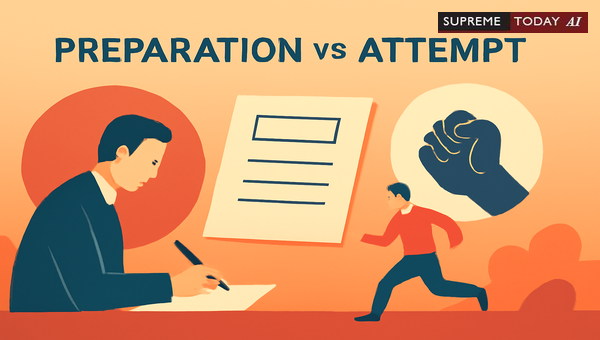
vs. in Criminal Law: Understanding the IPC Distinction
In criminal law, the line between planning a crime and actually trying to commit it can determine whether someone faces charges—or walks free. A common question arises: Discuss the Difference between and in Criminal Law with Reference to Relevant IPC. This distinction is pivotal under the , as it affects prosecution strategies, defenses, and punishments. While is often not punishable, an typically is. This blog post breaks down the concepts, legal thresholds, key cases, and practical implications, drawing from established IPC provisions and judicial interpretations.
Whether you're a law student, legal professional, or curious citizen, understanding this helps navigate criminal liability. Note: This is general information and not specific legal advice—consult a qualified lawyer for your situation.
Defining and Under IPC
What Constitutes ?
involves devising or arranging the means necessary for the commission of an offence. It is generally a mental act or preliminary step that remains unpunishable under the IPC, except for specific grave offences listed in sections like 122, 126, 233-235, 257, 242, 243, 259, 266, and 399. 2002 0 Supreme(Gau) 444
- Acts are to the crime and do not cross into execution. 2002 0 Supreme(Gau) 444
- Primarily involves (guilty intent) without a clear (guilty act), making it harmless in most cases. 2002 0 Supreme(Gau) 444
For instance, under , to commit dacoity is punishable: 399. ... In order to establish an offence under some act amounting to must be proved, and what must be further proved is that the act for which was made, was for dacoity. 2025 0 Supreme(Guj) 1323
What is an ?
, on the other hand, marks the towards the commission of the offence after preparations are complete. It requires an to the intended crime, which, if uninterrupted, would lead to completion. 2002 0 Supreme(Gau) 444 2019 0 Supreme(Mad) 2108
- More than mere but short of full consummation. 2022 0 Supreme(All) 1250 2018 0 Supreme(Del) 2078
- Combines with —an act showing clear intent and progression. 2002 0 Supreme(Gau) 444 2019 0 Supreme(Mad) 2108
The prosecution must prove the accused has gone beyond the stage of . As held: The difference between and actual to commit an offence consists chiefly in the greater . 2025 0 Supreme(All) 79 1996 0 Supreme(Del) 159
Legal Threshold: When Does Become ?
The shift from to occurs when the accused takes a definitive step post-. Courts assess:
- : Remote planning stays ; direct action is . 2002 0 Supreme(Gau) 444 2022 0 Supreme(All) 1250
- : The difference between and an to commit an offence consists chiefly in the greater and what is necessary to prove for .... 2024 0 Supreme(Chh) 559
In , the differentiated to commit rape under from mere : ... The difference between and an at-tempt to commit an offence consists chiefly in the greater ... 2024 0 Supreme(Chh) 559
is usually not punishable unless for grave offences requiring early intervention. 2002 0 Supreme(Gau) 444 begins with initiated acts beyond planning. 2020 0 Supreme(Jhk) 238 2018 0 Supreme(Del) 2078
and : The Core Elements
- : Focuses on intention; lacks , hence no punishment in routine cases. 2002 0 Supreme(Gau) 444
- : Demands both—intent plus a physical step that could culminate in the offence if unchecked. 2002 0 Supreme(Gau) 444 2019 0 Supreme(Mad) 2108
This ensures the law punishes only culpable actions, not thoughts. IN order to bring out a charge of to rape the prosecution must establish that it had gone beyond the stage of . The difference between and actual to commit an offence consists chiefly in the greater . 1996 0 Supreme(Del) 159
Punishment Framework and Exceptions
- : Punishable only in exceptional cases (e.g., dacoity under Section 399, conspiracy under 120B). 2002 0 Supreme(Gau) 444 2025 0 Supreme(Guj) 1323
- : Covered under , which punishes attempts to commit offences punishable by imprisonment. Specifics include to murder () or rape. 2002 0 Supreme(Gau) 444 2022 0 Supreme(Pat) 347
The principle of applies—punishments reflect the stage of culpability. Courts emphasize evidence of . 2021 7 Supreme 409 1980 0 Supreme(SC) 108 2022 0 Supreme(All) 1250
Judicial Interpretations and Landmark Cases
Indian courts meticulously distinguish based on facts:
- Degree of Act and Proximity: The courts emphasize the importance of the degree of act and to distinguish between and . 2021 7 Supreme 409 1980 0 Supreme(SC) 108 2022 0 Supreme(All) 1250
- Rape Cases: Thin line between indecent assault and ; force and determination key. It is a well settled proposition that the distinction between an to commit rape and an act of indecent assault or outrage of a womans modesty is somehow thin... It is also said that the difference between mere and the actual to commit an offence lies in the greater degree of determ.... 1994 0 Supreme(Bom) 149
- : Prosecution must prove , as in , discussing vs. . 2019 0 Supreme(Bom) 1431
In State of J&K v. Case (1997) 7 SCC 677, for rape was distinguished from by lack of direct action. 2024 0 Supreme(Chh) 559
Determining is a , case-specific. 2024 0 Supreme(Raj) 679
Practical Implications for Prosecution and Defense
- Prosecution Tips: Show acts exceed —prove and determination. Use Section 511 illustrations. 2025 0 Supreme(Pat) 264
- Defense Strategies: Argue remoteness or mere planning, absent overt acts.
In dacoity preparations under , specific acts must link to the crime. 2025 0 Supreme(Guj) 1323
Key Takeaways
| Aspect | | ||--------|-------------|---------|| Stage | Planning/arranging means | post-prep || Punishable? | Rarely (grave offences only) | Yes, under Sec 511 IPC || Key Test | Remote/mental | / || + | Intent only | Both required |
- : Generally safe from punishment; exceptions for serious crimes. 2002 0 Supreme(Gau) 444
- : Punishable when showing greater determination and action. 2024 0 Supreme(Chh) 559 2025 0 Supreme(All) 79
Conclusion
The IPC wisely differentiates from to balance prevention with fairness—punishing intent only when paired with dangerous proximity. As courts note, it hinges on and . 2002 0 Supreme(Gau) 444 2018 0 Supreme(Del) 2078
For deeper insights, review cases like State of J&K (1997) or . Always seek professional advice for legal matters.
References:- IPC Sections 399, 511, etc. 2002 0 Supreme(Gau) 444- 2024 0 Supreme(Chh) 559- Other cited documents as per inline references.
#IPCLaw, #CriminalAttempt, #PreparationVsAttempt















