
Searching Case Laws & Precedent on Legal Query.....!
Analysing the retrieved Case Laws
Scanned Judgements…!
Searching Case Laws & Precedent on Legal Query.....!
Analysing the retrieved Case Laws
Scanned Judgements…!
Sanjay Jain (In JC) VS Enforcement Directorate - Crimes
"] ["2012 0 Supreme(Raj) 599"] ["2025 0 Supreme(Mad) 4704"].The legal framework mandates that the health care system within prisons must meet a high standard, and any failure to provide adequate care constitutes a violation of constitutional rights ["2023 0 Supreme(Del) 6003"] ["2025 0 Supreme(Mad) 4704"].
Analysis and Conclusion:
References:- ["2023 0 Supreme(Del) 2458"]- ["2025 0 Supreme(Ori) 346"]- ["2023 0 Supreme(P&H) 1561"]- ["2025 0 Supreme(SC) 1062"]- ["2023 0 Supreme(Del) 3619"]- ["2012 0 Supreme(Raj) 599"]- ["2025 0 Supreme(Mad) 4704"]- ["2023 0 Supreme(Del) 6003"]
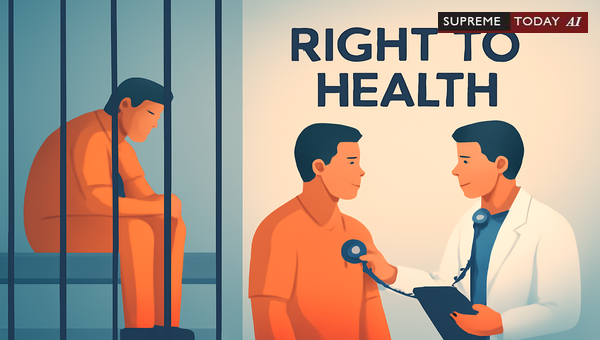
In the realm of human rights, few issues are as critical as ensuring dignity behind bars. The question Is the right to health for prisoners a fundamental right? strikes at the heart of constitutional protections in India. While incarceration limits certain freedoms, it does not strip away core entitlements like access to medical care. This blog delves into judicial interpretations, state responsibilities, and real-world implications, drawing from landmark cases to clarify this vital issue.
Note: This post provides general information based on legal precedents and is not specific legal advice. Consult a qualified lawyer for personalized guidance.
The Indian Constitution's Article 21 guarantees the right to life and personal liberty, which courts have expansively interpreted to include the right to health. As established, the right to health is an integral part of the right to life under Article 21 of the Constitution 2019 0 Supreme(SC) 887. This is not mere survival but living with human dignity, encompassing protection of health and strength, which are minimum essentials for dignified living 2019 0 Supreme(SC) 887.
For prisoners—whether convicted or undertrial—this protection persists. Prisoners, whether convicted or undertrial, do not lose their fundamental rights upon incarceration; their right to health remains protected 2019 0 Supreme(SC) 887 2000 4 Supreme 742. The <court>Supreme Courtcourt> has repeatedly affirmed that there exists no iron curtain between the prisoners and the Constitution and that a prisoner is not denuded of his fundamental rights except to the extent lawful incarceration by its own compulsion has the effect 2023 0 Supreme(Chh) 213.
Key rulings underscore the state's duty. In State of Andhra Pradesh v. Challa Ramkrishna Reddy, the Court held that neglecting prisoners' medical needs violates Article 21, emphasizing that prisoners do not cease to enjoy their rights under Articles 14 and 21 when inside prison walls 2000 4 Supreme 742 2019 0 Supreme(SC) 887. The state bears a constitutional obligation to provide adequate medical facilities to prisoners, and failure to do so constitutes a violation of their fundamental rights 2019 0 Supreme(SC) 887 2000 4 Supreme 742.
This duty extends to timely treatment and infrastructure. Courts have directed active measures, noting that the State must take active measures to protect prisoners’ health, including ensuring the availability of medical infrastructure and timely treatment 2019 0 Supreme(SC) 887 2000 4 Supreme 742. In cases of inadequate facilities, failure to refer externally breaches dignity 2000 4 Supreme 742.
Supporting this, other precedents reinforce health as fundamental. Right to health is the fundamental right stands well established. By virtue of Article 21 and Article 47 of the Constitution of India, the State is under an obligation to ensure raising the standard of public health 2021 0 Supreme(Pat) 690. Though not prisoner-specific, this broadens to custody scenarios, as seen in disability and pandemic contexts 2021 0 Supreme(Pat) 690.
Prison authorities must prioritize healthcare. Experiences in states like Karnataka, West Bengal, and Delhi reveal substandard facilities contributing to unnatural deaths, prompting directives: Providing medical assistance and facilities to inmates in prisons needs no reaffirmation. The right to health is undoubtedly a human right and all State Governments should concentrate on making this a reality for all, including prisoners 2019 0 Supreme(MP) 490 2018 0 Supreme(Sikk) 60.
Negligence cases highlight liability. In a custodial death inquiry, courts ordered compensation and fresh probes due to poor medical aid, stressing the obligation of the state to protect fundamental rights 2019 0 Supreme(MP) 490. Internationally aligned, UN Standard Minimum Rules demand healthcare comparable to civilians, prohibiting inhumane conditions 2019 0 Supreme(SC) 887.
Comparative insights, like a Malaysian case, affirm duty of care: prison authorities were held liable for delays causing permanent injuries, awarding damages for negligence
KARTIK PUROSOTHMEN vs MOHAMAD FERDAUS MOHAMAD ASRI & ORS
. While not binding, it echoes Indian principles of vicarious liability and timely care.The right is robust but not absolute. The right to health may be subject to reasonable restrictions for security or discipline, but neglect or denial of medical treatment violates the core principle of the right to life 2019 0 Supreme(SC) 887. Resource constraints do not excuse the state; minimum standards must be met 2019 0 Supreme(SC) 887.
Bail on health grounds requires scrutiny: Bail cannot be granted solely on the basis of alleged sickness; adequate medical facilities in jail must be considered 2025 0 Supreme(Ker) 552. Courts assess necessity for external treatment, balancing rights with case gravity 2025 0 Supreme(Ker) 552.
Even under-trials face restrictions: Even though the right to life is a fundamental right, there are reasonable restrictions permitted in the case of under-trial prisoners and convicts on the exercise of their fundamental rights under Article 21 2025 0 Supreme(Ker) 552.
To uphold these rights, courts and experts suggest:- Ensuring adequate medical infrastructure, including specialized facilities for critical cases 2019 0 Supreme(SC) 887.- Establishing protocols for timely intervention and external referrals 2019 0 Supreme(SC) 887.- Conducting regular audits of prison healthcare 2019 0 Supreme(SC) 887.- Exercising judicial oversight for compliance 2019 0 Supreme(SC) 887.
Broader measures include vaccination drives for vulnerable inmates and incentives for rural postings to bolster public health systems feeding prisons 2021 0 Supreme(Pat) 690.
In conclusion, while prisons inherently restrict freedoms, the right to health remains a cornerstone of humanity. Judicial vigilance ensures states fulfill their mandate, preventing tragedies and upholding dignity. For deeper insights, review references like 2019 0 Supreme(SC) 887 and 2000 4 Supreme 742. Stay informed on evolving jurisprudence to advocate effectively.
References:1. 2019 0 Supreme(SC) 887: Core on Article 21, state obligations for prisoners' health.2. 2000 4 Supreme 742: Retention of fundamental rights in custody.
#PrisonersRights, #RightToHealth, #Article21
of an offence or infringement of a fundamental right or availing compensation for injuries even as a prisoner. ... Since the question of fundamental right of the prisoners is in issue and the legal position of they being on different footing than a workman and not under the fault of employee/employer relationship, a specific mechanism in relation to the issue in question is the requirement of the day. ... While this judgment does not intend to create new rights of prisoners, it express....
It is axiomatic that convicts, prisoners or undertrials are not denuded of their fundamental rights under Article 21 and it is only such restrictions, as are permitted by law, which can be imposed on the enjoyment of the fundamental right by such persons. ... Thus according to the definition under the Prisoners Act, there is a convict, there is an undertrial and there is a civil prisoner who may be a detenu under preventive detention law of the three cotsportes of prisoners lose their ....
A convict whom the law bids to live in confinement though stands denuded of some of the fundamental rights, like the right to move freely or the right to practice a profession, nonetheless, such convict shall continue to enjoy other constitutional guarantees including the precious right guaranteed by ... The classification of prisoners for purposes of separation.- The different categories of prisoners for the time being confined in every jail should be kept in separate institutions, pa....
The right to health is undoubtedly a human right and all State Governments should concentrate on making this a reality for all, including prisoners. ... the right to live with dignity, which applies equally to prisoners. ... The right to life under Article 21 of the Constitution undoubtedly extends to all prisoners, including those with disabilities. However, this does not confer a right to demand personalised or luxurious food choi....
The right to health is undoubtedly a human right and all State Governments should concentrate on making this a reality for all, including prisoners. ... Undoubtedly, the health of the petitioner has to be given primacy and it is his fundamental right to be given adequate and effective treatment whilst in jail. ... If the fundamental right to life and liberty postulated by Article 21 of the Constitution is to be given its true meanin....
The scope of this right has been interpreted by the courts to extend beyond mere physical survival and to include the right to adequate medical care and treatment, particularly for individuals in state custody, such as prisoners. ... For item (a) damages due to trauma, and mental health instability, pain and suffering including insomnia, mental disorders and medical expenses, the Plaintiff did not prove the health problems that he had suffered by producing medical evidence pertaining to his current #HL_....
research titled ‘A Mental Health
A compulsion under the authority of law, following upon a conviction, to live in a prison-house entails by its own force the deprivation of fundamental freedoms like the right to move freely throughout the territory of India or the right to “practise” a profession. ... It is now well settled that there exists no iron curtain between the prisoners and the Constitution and that a prisoner is not denuded of his fundamental rights except to the extent lawful incarceration by its own compulsion has the effec....
Even though the right to life is a fundamental right, there are reasonable restrictions permitted in the case of under-trial prisoners and convicts on the exercise of their fundamental rights under Article 21 of the Constitution of India. ... The basic difference is of freedom available to undertrial prisoners / convict and the citizen who is outside the jail in exercise of the said fundamental right guaranteed under Art.21 of the Constitution of Ind....
The right to health is undoubtedly a human right and all State Governments should concentrate on making this a reality for all, including prisoners. ... Plainly, the health of the petitioner has to be given primacy and it is his fundamental right to be given adequate and effective treatment whilst in jail. ... If the fundamental right to life and liberty postulated by Article 21 of the Constitution is to be given its true meaning, t....
3. Right to health is the fundamental right stands well established. By virtue of Article 21 and Article 47 of the Constitution of India, the State is under an obligation to ensure raising the standard of public health. (See- Passchim Banga Khet Mazdur Samity v. State of West Bengal, (1996) 4 SCC 37; State of Punjab & Ors.
Undoubtedly, right to health is a fundamental right. Right to good health is now a facet of right to life under Article 21 of the Constitution of India and when we talk of justice which is social it would also include opportunities of availing facilities and infrastructure in the health sector.
Providing medical assistance and facilities to inmates in prisons needs no reaffirmation. The right to health is undoubtedly a human right and all State Governments should concentrate on making this a reality for all, including prisoners. The experiences in Karnataka, West Bengal and Delhi to the effect that medical facilities in prisons do not meet minimum standards of care is an indication that the human right to health is not given adequate importance in prisons and that may also be one of the causes of unnatural deaths in prisons. The State Governments are directed to s....
The right to health is undoubtedly a human right and all State Governments should concentrate on making this a reality for all, including prisoners. 8. Providing medical assistance and facilities to inmates in prisons needs no reaffirmation. The experiences in Karnataka, West Bengal and Delhi to the effect that medical facilities in prisons do not meet minimum standards of care is an indication that the human right to health is not given adequate importance in prisons and that may also be one of the causes of unnatural deaths in prisons. The State Governments are directed t....
Therefore, right to life enshrined in Article 21 means something more than mere survival of animal existence. Right to health of a worker is a fundamental right. The right to live with human dignity with minimum sustenance and shelter and all those rights and aspects of life which would go to make a man's life complete and worth living, would form part of the right to life. 4. In C.E.S.C. Ltd. v. Subhash Chandra Bose, (1992) 1 SCC 441 this Court held that right to social and economic justice is a fundamental right.
Login now and unlock free premium legal research
Login to SupremeToday AI and access free legal analysis, AI highlights, and smart tools.
Login
now!
India’s Legal research and Law Firm App, Download now!
Copyright © 2023 Vikas Info Solution Pvt Ltd. All Rights Reserved.








