Searching Case Laws & Precedent on Legal Query.....!
Analysing the retrieved Case Laws
Scanned Judgements…!



Searching Case Laws & Precedent on Legal Query.....!
Analysing the retrieved Case Laws
Scanned Judgements…!
Entitlement to Complete Disciplinary Proceedings - A probationer or officer facing termination is generally entitled to a fair and complete disciplinary proceeding, including a proper inquiry and opportunity to be heard before any penalty is imposed ["2025 Supreme(Online)(CAT) 13247"], ["2023 0 Supreme(MP) 682"].
Principles of Natural Justice - Disciplinary proceedings are quasi-judicial and must adhere to natural justice principles; violations, such as conducting proceedings without proper authority or excluding relevant evidence, can render termination illegal ["2024 0 Supreme(Pat) 656"].
Scope of Disciplinary Proceedings for Probationers - For probationers, the focus is on evaluating work and conduct during the probation period; disciplinary proceedings should be fair, and termination can be challenged if not properly conducted ["2025 Supreme(Online)(CAT) 13247"].
Punitive vs. Simpliciter Termination - Courts distinguish between punitive termination (based on misconduct) and termination simpliciter (without misconduct). A full inquiry, involving a formal investigation and findings, is essential to establish whether a termination is punitive ["2025 Supreme(Online)(Kar) 36594"].
Role of Inquiry Reports and Disciplinary Authority - The inquiry officer's report is not final; the disciplinary authority must independently assess evidence and afford an opportunity to respond before imposing penalties. Lack of proper record or breach of procedure can invalidate the termination ["2024 0 Supreme(Chh) 122"].
Legal Recourse and Judicial Review - Employees or probationers can approach courts or tribunals for relief if disciplinary procedures are not followed or if the termination is arbitrary or disproportionate, especially when it involves misconduct ["
PACKWELL LANKA (PVT) LTD VS. COMMISSIONER GENERAL OF LABOUR AND OTHERS
"], ["2021 0 Supreme(All) 1547"].Post-Retirement Proceedings - In absence of statutory provisions allowing continuation of disciplinary proceedings after retirement, such proceedings are generally not sustainable. Proper opportunity and adherence to rules are mandatory before termination ["2021 0 Supreme(All) 1547"].
Analysis and Conclusion:A Probationer Officer is entitled to a complete disciplinary proceeding before termination, including a fair inquiry, evidence evaluation, and opportunity to be heard, consistent with principles of natural justice. Termination without such procedures is liable to be challenged and may be deemed illegal. Courts emphasize that disciplinary actions must be based on proper, unbiased proceedings, especially when the termination is punitive, to ensure justice and legality.
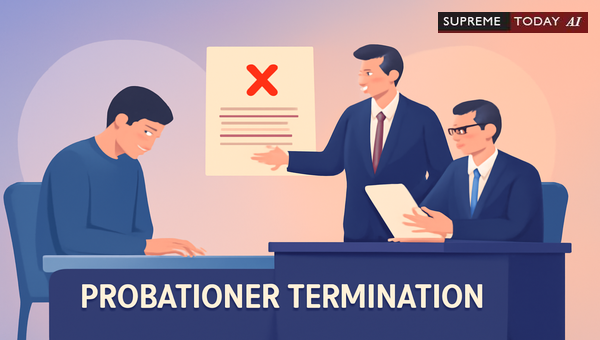
In the realm of employment law, particularly in public sector or organized establishments in India, the termination of a probationer officer's services raises critical questions about fairness and . Imagine an officer on probation facing sudden dismissal amid allegations of —is a complete disciplinary proceeding mandatory before such termination? This issue strikes at the heart of principles of and , often litigated in courts.
This blog post delves into the legal landscape, drawing from established precedents and judicial interpretations. While this provides general insights, it is not legal advice—consult a qualified lawyer for specific cases.
A probationer officer, typically in government or banking services, serves a trial period to assess suitability. The question arises: Whether a Probationer Officer is Entitled for a Complete Disciplinary Proceeding before Termination?
Generally, termination during probation can be simpler than for confirmed employees, but when is alleged, courts demand adherence to . Termination without a full inquiry may be deemed arbitrary and unsustainable 1999 2 Supreme 34 1998 9 Supreme 504.
Key principles include:- (hear the other side): The probationer must have an opportunity to defend.- Proper inquiry involving hearing, cross-examination, and evidence presentation.- Courts often set aside terminations based on preliminary or incomplete proceedings 1998 9 Supreme 504.
Disciplinary action, including termination, typically requires a to uphold fairness. As noted, Disciplinary action, including termination, generally requires a to ensure fairness and adherence to principles of . Termination without such an inquiry is often deemed unsustainable 1999 2 Supreme 34 1998 9 Supreme 504.
For probationers:- They are entitled to procedures similar to confirmed employees, especially in cases.- Absence of comprehensive inquiry renders termination challengeable, potentially leading to or (fresh) proceedings 1998 9 Supreme 504.
Courts emphasize: Courts have consistently emphasized that dismissal or termination should not be ordered without a proper inquiry, especially when is involved. The inquiry must be fair, and the probationer must be given adequate opportunity to defend himself 1999 2 Supreme 34.
Judicial precedents reinforce these principles:
Additional sources echo this:- Under , termination for embezzlement without following (which mandates cross-examination and full mechanism for major penalties like dismissal) was quashed. The court held: Admittedly, impugned order of termination has been passed without following the mandatory provisions beside being in violation of principles of —Nothing on record to show that the Inquiry Officer had fixed any date for oral inquiry—Punishment of termination imposed even without following the procedure prescribed in —Impugned order quashed 2012 0 Supreme(All) 600. Directions for followed.
These rulings underscore that procedural lapses vitiate terminations, even for probationers.
While full inquiries are generally required, exceptions exist:
Apprentices/Trainees: Not entitled to full employee protections. The court affirmed that an apprentice trainee is not entitled to the same protections as an employee, allowing termination for without a disciplinary proceeding 2025 0 Supreme(Gau) 38. Release from training post-inquiry into unauthorized acts was upheld, as disciplinary codes do not apply to apprentices.
Post-Retirement: No disciplinary enquiry after superannuation, nor deductions from retiral benefits without specific provisions: There is no provision for conducting a disciplinary enquiry after his retirement and nor any provision stating that in case is established, a deduction could be made from retiral benefits 2023 0 Supreme(All) 136.
Administrative Grounds: If proceedings are dropped administratively before completion (e.g., due to age), termination may stand, but challenges arise if improper 2023 0 Supreme(All) 136.
Judicial review is limited but intervenes if arbitrary: Courts examine for real prejudice from violations 2009 0 Supreme(J&K) 530. Non-observance of principles of and denial of reasonable opportunity vitiates the order only when some real prejudice is caused to the delinquent official 2009 0 Supreme(J&K) 530.
For confirmed workmen, terminations on disciplinary grounds are scrutinized for unlawfulness or injustice
.
For Employers:- Initiate full inquiries for allegations against probationers.- Document opportunities for hearing and responses.- Avoid summary terminations to prevent litigation.
For Employees/Probationers:- Challenge incomplete processes via .- Seek inquiries if is lacking 2004 6 Supreme 127 2000 1 Supreme 538.
Rules like Regulations mandate justifications and hearings, with courts quashing non-compliant removals 2025 0 Supreme(Bom) 797.
In summary, a probationer officer is generally entitled to a complete disciplinary proceeding before termination, particularly when is alleged. Courts prioritize , often quashing hasty actions and ordering fresh inquiries 1999 2 Supreme 34 1998 9 Supreme 504.
Exceptions for apprentices or post-retirement scenarios highlight nuances, but the default is procedural rigor. A probationer officer is generally entitled to a complete disciplinary proceeding, including a fair and proper inquiry, before termination can be lawfully effected. Termination without such an inquiry, or based on incomplete proceedings, is likely to be considered arbitrary and unlawful (from core analysis).
Key Takeaways:- Full inquiry mandatory for fairness.- principles apply broadly.- Courts may reinstate with on lapses.- Exceptions limited to non-employees or administrative drops.
Stay informed on service rules under . For tailored advice, approach legal experts. This evolving area underscores balancing employer discretion with employee rights in India's .
#ProbationerRights #DisciplinaryInquiry #EmploymentLaw


The courts exercising power of judicial review are entitled to consider as to whether while inferring commission of misconduct on the part of a delinquent officer relevant piece of evidence has been taken into consideration and irrelevant facts have been excluded therefrom. ... A disciplinary proceeding was initiated and major penalty was finally passed against him. ... Thus, though a departmental #HL_STA....

However the Courts can lift the veil and see whether the disciplinary enquiry was the ‘motive’ for the termination or ‘foundation’ for the termination of the services the delinquent. 32. ... Sanjay Gandhi PGI of Medical Sciences [(2002) 1 SCC 520] this Court considered what should be the best to determine whether a letter of termination of service was termination simpli....

Termination of service. ... Disciplinary proceedings were initiated against him but before these could be completed the officer was informed by the Bank through its letter dated 5.5.1976, that it was not possible for the Bank to complete the enquiry well in time before the officer attained the age of 60 years which was the date ... was concerned, the officer was not entitled#HL....

Though a disciplinary proceeding was recommended, respondents proceeded to terminate the applicant. Definitely the materials so gathered formed the foundation for termination. ... It was held that supervising officer has to concentrate on the special need of probation and to decide whether the work and conduct of the officer duringthe period of probation is satisfactory and to decide #HL....
He can go before the Labour Tribunal in terms of section 31 B(1)(a) of the Industrial Disputes Act, No. 43 of 1950, as amended, seeking relief for termination of services whether it be by way of disciplinary action or otherwise. ... That can happen before, in the course of, or after the inquiry into the question whether the termination is in contravention of the. provisions of the Act. ... The reason....

(B) Whether finding of the disciplinary authority holding the charge no.8 to be “proved” while disagreeing with the finding of the Enquiry Officer in this regard, has been arrived at in violation of Rule 15(2) of the Chhattisgarh Civil Services (Classification, Control and Appeal ... It is contended further that since the original record of the enquiry proceeding was not available with the respondent authorities during th....

The impugned termination order dated 27/01/2020 and the appellate orders dated 29/07/2020 and 04/12/2020 are set aside. As a consequence, the petitioner shall be entitled to get all consequential benefits except honorarium of 08 days aforesaid. ... Dissatisfied with the said reply, the Project Officer by order dated 10/01/2020 decided to deduct 08 days' honorarium of the petitioner and observed that henceforth, if any such misconduct is com....
The cause for termination of services of a confirmed workman would mostly fall within the ambit of misconduct or on disciplinary grounds. A tribunal is thus competent to examine not merely whether such termination is unlawful but also whether it is unjust. ... The grounds of termination can be examined only for the limited purpose of ascertaining whether the emp....

In our view, in the absence of any denial of the petitioner’s stand that he was jobless after the termination of his services, the petitioner is entitled to relief in that regard. ... After the conclusion of the enquiry proceeding, the Enquiry Officer submitted his report dated nil to the respondent no.2 who was the Disciplinary Authority stating therein that charges levelled against the petitioner were ....

Termination of service. ... The District Basic Education Officer, after hearing the parties, disapproved the proposal of the prior approval of the disciplinary proceeding of the respondent No.5 on the ground that while concluding the disciplinary proceeding proper opportunity of hearing was not provided to the respondent No.5. ... Disciplinary proceedings were initiated....

The court affirmed that an apprentice trainee is not entitled to the same protections as an employee, allowing termination for misconduct without a disciplinary proceeding. N. Unni Krishnan Nair, J. Heard Mr. G. Alam, learned counsel, appearing on behalf of the petitioner. Also heard Mr. G. N. Sahewalla, learned senior counsel, assisted by Ms. Garima Dugar, learned counsel, appearing on behalf of all the respondents. 2. The petitioner by way of instituting the present proce....
The Rules also provides for cross-examination of the witnesses relied upon. After going through the provisions of Rule 5, it transpires that a complete mechanism has been provided for holding a disciplinary proceeding for imposing major penalty of dismissal, termination or removal from the service.
After the decision is taken by the disciplinary authority/competent authority against the employee on the basis of report submitted by the enquiry officer in accordance with rules/regulation, the same cannot be challenged by an employee who is aggrieved by the punishment order taken by the disciplinary authority, the court has scrutinized the same within the guideline and parameter as laid down by Hon'ble Apex Court in the case of H.B. Gandhi, Excise and Taxation Officer-cum-Assessing Authorit....

In a disciplinary proceeding, the disciplinary authority may hold inquiry and thereupon conclude the matter. If the inquiry part is delegated to an inquiring authority, the said authority is required to report back to the disciplinary authority the result of his inquiry. The requirement of furnishing reason in support of a conclusion is to let the person, who is likely to be affected by such conclusion, to know why the matter has been concluded thus. While furnishing the resu....

Service conditions, including disciplinary proceedings and penalty that can be imposed against them are governed by statutory rules subject to Articles 310 and 311 of the constitution. Service conditions, including disciplinary proceedings and penalty that can be imposed against them are governed by statutory rules subject to Articles 310 and 311 of the constitution. Referring to the Manual of the CBI, it was contended that it is fallacious to refer thereto as the source of power of CBI to rec....


An indispensable Tool for Legal Professionals, Endorsed by Various High Court and Judicial Officers
Please visit our Training & Support
Center or Contact Us for assistance

Scan Me!
India’s Legal research and Law Firm App, Download now!


For Daily Legal Updates, Join us on :



 Back to top


