


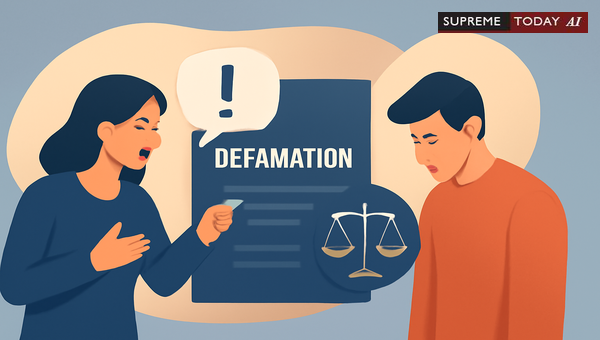
Can a Spouse Face Charges in India?
In the heat of marital disputes, words can escalate quickly, sometimes crossing legal lines. A common question arises: Can a Spouse be Guilty for in India? This issue is particularly relevant amid rising matrimonial conflicts where accusations fly between partners. Understanding laws helps navigate these sensitive situations without unintended legal consequences.
This article breaks down the legal framework under the (), examines spousal liability, judicial precedents, defenses, and practical advice. Note that this is general information based on established laws and cases; it is not specific legal advice. Consult a qualified lawyer for personalized guidance.
Overview of in India
is primarily governed by . defines defamation as making or publishing any imputation concerning a person intending to harm, or knowing it will harm, their reputation. prescribes punishment—simple imprisonment up to two years, fine, or both. 2022 8 Supreme 274
Key elements include:- The statement must be specific, not vague.- It must have the potential to harm reputation.- Publication to a third party is often required. 2022 8 Supreme 274
Unlike , criminal cases involve state prosecution, emphasizing public interest in protecting reputations. Courts stress the balance between free speech () and reputation rights (). 2024 0 Supreme(Cal) 1176
Spousal Liability: No Immunity for Marital Bonds
A critical point: marital status does not grant immunity. Spouses can be held liable if their statements meet defamation criteria. The has rejected the outdated husband and wife are one principle in contexts. Each spouse is individually accountable. 2019 0 Supreme(SC) 1351 2024 2 Supreme 158
For instance, false allegations during disputes—like accusing a spouse of infidelity or misconduct—can be actionable if proven false and harmful. 2017 4 Supreme 52
In matrimonial cases, courts scrutinize context. A ruling quashed proceedings where a wife filed defamation against another for statements targeting her husband, holding: In absence of any imputation against the complainant, she cannot be held to be an , within the meaning of . 2013 0 Supreme(Gau) 796 This underscores that only direct victims can typically complain, preventing indirect harassment.
Another case highlighted limits: Directors of a magazine were absolved for lack of specific allegations, while the author faced trial. 2023 0 Supreme(Telangana) 646 Similarly, in spousal scenarios, mere association isn't enough—specific acts matter. 2022 8 Supreme 57
Judicial Precedents on Spousal Defamation
Courts have consistently upheld liability:- Clarification: Spouses aren't shielded; statements against each other are prosecutable. 2019 0 Supreme(SC) 1351 2024 2 Supreme 158- Intent and Harm: Proven falsity and harm intent are pivotal. In a case quashed for lacking evidence, the court noted no clear intent to harm under 's ninth exception. 2024 0 Supreme(Cal) 1176
In , allegations under failed due to unsubstantiated claims, emphasizing credible evidence needs. 2024 0 Supreme(Cal) 590
Press cases offer analogies: Editors aren't liable without specific roles, mirroring how spouses can't be vicariously blamed. 2022 8 Supreme 57 Though presumption under is available with regard to Editor, even a Chief Editor can be proceeded against if facts so justify. 2022 8 Supreme 57
Exceptions and Defenses Available
lists 10 exceptions mitigating liability:- for protection: Statements safeguarding interests or . 2016 3 Supreme 598- : Truth published for public benefit.- : On public matters without malice.
In matrimonial disputes, context matters. Statements in during legal proceedings (e.g., divorce filings) may qualify. 2024 2 Supreme 158 Courts quash frivolous complaints abusing process, as in cases lacking specific allegations or evidence. 2023 0 Supreme(Telangana) 646 2013 0 Supreme(Gau) 796
Burden of Proof: Lies with the prosecution; evidence of publication and harm is key.
There is an important difference between the offence of under the English common law and the offence of defamation defined by . (Analogous principles apply.)
Defenses succeed when:1. Statements are true and for .2. Made in privileged contexts (absolute/). 2014 0 Supreme(Guj) 6003. No malice or improper motive proven. 2013 0 Supreme(Gau) 796
Integrating Broader Contexts from Case Law
Defamation intersects with other laws:- (): Rarely applies without evidence. 2023 0 Supreme(Telangana) 646- Media/Public Figures: Higher thresholds; investigative journalism protected if not malicious. 2017 0 Supreme(Del) 4850
In Subramanian Swamy v. Union of India, the upheld 's constitutionality, stressing balance. 2024 0 Supreme(Cal) 1176
Spousal cases often arise in harassment complaints. Lodging sexual harassment against a spouse doesn't justify counter-defamation by their partner: Principle that what cannot be done directly cannot be done indirectly will apply. 2013 0 Supreme(Gau) 796
International notes: Unlike France (fines only) or Australia (civil preference), India's criminal sanctions remain robust. 2015 0 Supreme(Mad) 2467
Practical Recommendations and Risks
- For Accused Spouses: Gather evidence of /context. Petition under for quashing if no case. 2013 0 Supreme(Gau) 796
- Caution in Disputes: Avoid public accusations; use legal channels.
- Victims: Ensure specific, evidenced complaints under .
Risks include imprisonment/fines, plus civil damages. Media archives perpetuate harm, as noted: The story is still continuing as part of the archives. 2022 8 Supreme 57
Key Takeaways
- Yes, spouses can be guilty of if statements harm reputation without defenses. 2019 0 Supreme(SC) 1351
- Evaluate intent, truth, context.
- Defenses abound but require proof.
- In disputes, prioritize legal remedies over public statements.
Marital harmony benefits from restraint. For tailored advice, reach out to a legal expert. Stay informed, communicate wisely.
References: 2022 8 Supreme 274 2019 0 Supreme(SC) 1351 2024 2 Supreme 158 2016 3 Supreme 598 2017 4 Supreme 52 2013 0 Supreme(Gau) 796 2023 0 Supreme(Telangana) 646 2024 0 Supreme(Cal) 1176 2022 8 Supreme 57
#CriminalDefamation, #SpouseLiabilityIndia, #IPCDefamation















