


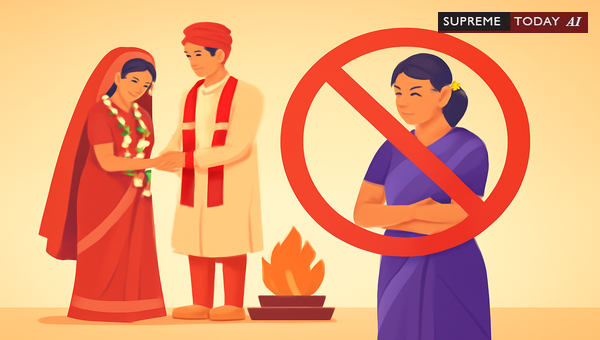
Under IPC Section 494: Do Vague Statements in Complaints Prove a Second Marriage?
In the realm of family law and criminal proceedings in India, allegations of under often arise amid heated matrimonial disputes. But what happens when a party files a complaint claiming a bigamous marriage, makes statements in applications about children born from it, and references it in civil suits? Can such statements alone sustain a , or do they crumble without solid evidence?
This post delves into a common scenario: a party to a suit makes a statement in a complaint under alleging a bigamous marriage, claims children from it in an application, and repeats it in other civil suits. We'll examine why courts typically demand more than mere assertions, drawing from key judgments and legal principles. Note: This is general information based on case law and not specific legal advice. Consult a qualified lawyer for your situation.
What is Under ?
punishes marrying again during the lifetime of a husband or wife, making it void under personal laws like the (). It's a requiring proof of:- A valid first marriage subsisting.- A second marriage with knowledge of the first.- Performance of essential ceremonies (e.g., for Hindus) 1994 0 Supreme(SC) 741.
is primarily a personal offence between spouses; third parties can't be roped in without proof of under 2023 0 Supreme(Raj) 1036. Courts quash proceedings if ingredients aren't met 2024 4 Supreme 762.
The Core Issue: Statements in Complaints and Applications
Consider this frequent query: A party files a criminal complaint under alleging a second marriage, states in an application that children were born from this bigamous marriage, and echoes it in civil suits. Do these statements automatically prove ?
Short answer: No. A complaint's allegations must be clear, specific, and backed by evidence. Vague claims—lacking details on ceremonies, witnesses, or dates—fail to establish the offence. Statements serve as a foundation for proceedings but need proof beyond reasonable doubt for 1998 0 Supreme(Bom) 733.
Key Legal Findings on Complaint Sufficiency
Clarity and Specificity Are Crucial
Courts scrutinize complaints for precision. In one case, vague allegations of conspiracy without overt acts or ceremony participation were deemed insufficient: In view of the allegations, relating to the petitioner contained in the complaint, is vague, and it cannot be said that he abetted to commit the offence as envisaged under Section 114 of the IPC 1998 0 Supreme(Bom) 733.
Similarly, complaints must plead the form of marriage, time, place, and witnesses: It is obvious that to attract , the form of marriage alleged to have taken place, the details of the time and the name of the witnesses whose presence the second marriage have taken place must be pleaded in the complaint 2018 0 Supreme(Mad) 4236. Absent these, shouldn't take cognizance 2008 0 Supreme(Mad) 4432.
Proof of Essential Ceremonies Like
For Hindus, the second marriage's validity hinges on rites like (seven steps) and . Mere living as spouses or vague claims don't suffice: The absence of proof of these ceremonies meant that the second marriage could not be established legally, and thus no offence of was proved 1994 0 Supreme(SC) 741.
In another ruling: Allegations based solely on conspiracy or vague assertions without proof of essential marriage ceremonies are inadequate for 1971 0 Supreme(SC) 178. Even admissions aren't proof; evidence is mandatory 2018 0 Supreme(Mad) 4236.
Vague Allegations Lead to Quashing
Courts invoke to quash vexatious complaints. Relatives present at ceremonies aren't abettors without knowledge or active role: Merely being present or participating in a ceremony does not establish of 2023 0 Supreme(Raj) 1036.
In a Kerala case, charges under against non-spouses were quashed for lacking evidence: Involvement of accused for charge of having a to commit offence under is not established by an iota of evidence 2024 4 Supreme 762. Parents or relatives can't be implicated merely for attendance 2016 0 Supreme(P&H) 486.
Another instance: No offence under Section 494 if essential marriage elements are missing in complaint or statement 2009 0 Supreme(P&H) 1934.
Implications in Civil Suits and Applications
Statements in complaints or applications (e.g., claiming children from the union) don't bind automatically. Under Hindu Marriage Act, suits for injunctions are maintainable, but proof is key 1963 0 Supreme(Kar) 55. A civil court may grant relief to prevent second marriages, citing HMA, but criminal needs independent evidence.
If a complaint references a bigamous marriage in civil pleadings, it risks being seen as abuse if unsubstantiated—especially if quashed criminally. Settlement deeds sustaining are void as against ()
.
Exceptions and Special Cases
- Customary Marriages: For tribes, prove custom's validity; general claims fail 2001 1 Supreme 681.
- Limits: No liability for third parties without direct aid 2020 0 Supreme(Bom) 553.
- Compounding: Can't compound pre-registration; knowledge/date must be specific 2020 0 Supreme(Bom) 553.
- Pending Civil Suits: may avoid if civil court seized
Ippan & two Ors. VS State of Uttar Pradesh
.
Practical Recommendations
- For Complainants: Draft precisely—detail ceremonies, witnesses, dates. Gather photos, invitations, priest testimonies.
- For Accused: Seek quashing under if vague.
- Courts' Role: Scrutinize for case before charges 2018 0 Supreme(Mad) 4236.
Key Takeaways
- Vague statements in complaints rarely prove without evidence of ceremonies like 1994 0 Supreme(SC) 741 1971 0 Supreme(SC) 178.
- against third parties needs active complicity, not mere presence 2023 0 Supreme(Raj) 1036.
- Courts quash unsubstantiated claims to prevent abuse 1998 0 Supreme(Bom) 733.
cases underscore evidence's primacy. While statements initiate probes, convictions demand proof. If facing such allegations, professional guidance is essential to navigate civil-criminal overlaps.
References:- 1998 0 Supreme(Bom) 733, 1971 0 Supreme(SC) 178, 1994 0 Supreme(SC) 741, 2023 0 Supreme(Raj) 1036, 2024 4 Supreme 762, 2018 0 Supreme(Mad) 4236, 1963 0 Supreme(Kar) 55, 2016 0 Supreme(P&H) 486, 2008 0 Supreme(Mad) 4432.
#BigamyLaw #IPC494 #IndianPenalCode















