


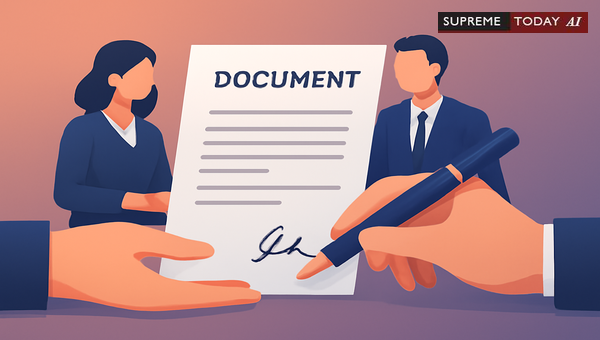
: Meaning, Proof & Principles
In the world of contracts, deeds, and legal agreements, the term often arises, but what does it truly entail? Whether you're a business owner finalizing a , an individual signing a , or involved in a dispute over a , understanding execution is crucial. This article breaks down the legal concept of , drawing from established principles under the and related laws. We'll explore its definition, requirements, proof mechanisms, and common challenges like denials or fraud claims.
Note: This is general information based on legal precedents and is not a substitute for professional legal advice. Consult a qualified lawyer for your specific situation.
What is ?
At its core, refers to the formal completion of the document, typically involving signing, sealing, and delivering it. 1991 0 Supreme(Ker) 297 2005 0 Supreme(Guj) 757 It's not just a casual scribble—it's a deliberate act that binds the parties legally.
A key principle is that mere signing is insufficient. The person executing (the executant) must sign after being aware of and consenting to its contents. 2022 6 Supreme 291 1991 0 Supreme(Ker) 297 This ensures the act is voluntary and informed. For instance, courts have emphasized that execution denotes a conscious act of subscribing to a document, as evidenced by witnesses present at the time. 2010 0 Supreme(Chh) 5
Additionally, if the law requires (like for certain deeds under the ), execution demands signatures of the executant plus by witnesses. 1950 0 Supreme(Raj) 171 2005 0 Supreme(Guj) 757 Voluntary execution means signing of one's free will, underscoring the need for genuine intent. 1999 0 Supreme(Mad) 223
Key Principles Governing Execution
Legal execution follows strict guidelines to prevent disputes:
- Full Consent and Awareness: The executant must understand the document's terms before signing. Blind or coerced signatures don't count.
- Formal Acts: Beyond signing, delivery (handing over possession or intent to be bound) is essential.
- Where Required: Witnesses must verify, proving the document's authenticity.
These principles align with , which doesn't prescribe a rigid proof mode but requires establishing signature genuineness and handwriting. 2023 0 Supreme(SC) 20 As one ruling notes, means signing a document by consenting on it by a party. 2023 0 Supreme(SC) 20
Burden of Proof for Execution
Who bears the responsibility to show a document was properly executed? The burden lies on the party relying on the document. 2005 0 Supreme(Guj) 757 1950 0 Supreme(Pat) 69 If the alleged executant denies it, the onus shifts firmly to the claimant to prove execution through cogent evidence. 2005 0 Supreme(Guj) 757 1950 0 Supreme(Pat) 69
This was highlighted in a case involving sale deeds in a . Plaintiffs claiming title via registered sale deeds had to prove even the execution, as defendants weren't obligated to challenge it preemptively. Non-compliance with Registration Act provisions (Sections 32, 33(1)(c)) meant no statutory presumption of validity. 2023 0 Supreme(SC) 20 Justice M.R. Shah stressed that under Section 60 apply only if execution complies fully with the Act. 2023 0 Supreme(SC) 20
In contrast, Justice B.V. Nagarathna (dissenting) noted that a registered document carries a presumption of authority, rebuttable only by strong evidence—especially if the original owner never disputed the . 2023 0 Supreme(SC) 20 This split underscores that while registration helps, it's no silver bullet.
How to Prove
Proving execution isn't guesswork; it demands solid evidence:
- Establish Signatures and Handwriting: Prove the executant's signature and attesting witnesses' handwriting (if applicable). 1950 0 Supreme(Raj) 171
- Witness Testimony: Secondary evidence like accounts from those present at execution is admissible if the original is lost. 2019 0 Supreme(Telangana) 284
- Avoid Common Pitfalls: Mere registration or admitting a signature before the Registrar isn't enough. Full proof per Evidence Act rules is required. 1979 0 Supreme(Gau) 23 2022 6 Supreme 291 2023 0 Supreme(SC) 20 Courts have ruled, Mere registration of a document is not self-sufficient proof of its execution. 2023 0 Supreme(SC) 20
In a suit, the court upheld execution based on witness depositions confirming the seller's intent to execute an agreement of sale. The plaintiff proved readiness under . 2010 0 Supreme(Chh) 5
For older documents (30+ years), presumes execution if from proper custody, but suspicious circumstances demand full proof. 2018 0 Supreme(Gau) 697
Role of Registration
Registration under the , provides but doesn't prove execution outright. A registered within four months of execution (per Section 23) is valid if dates align and parties consent—even if altered mutually. However, failure to rebut presumptions or prove compliance voids reliance. 1999 0 Supreme(Mad) 339 2023 0 Supreme(SC) 20
Challenges: Denial of Execution
Denials complicate matters. If the executant claims the signature was on blank paper, via fraud, or coercion, the document isn't executed. The relying party must disprove this. 1950 0 Supreme(Pat) 69 2022 6 Supreme 291
Courts scrutinize such claims. In one case, lack of corroboration for intimidation allegations weakened the denial, but proof burdens remained strict. 2025 Supreme(SRI)(SC) 9744 Unproven fraud renders the document inadmissible.
Practical Implications and Case Insights
Consider a scenario: Plaintiffs sue based on an agreement (Ex.P/1). Witness testimony lays the foundation for execution, but denial shifts the burden back. 2019 0 Supreme(Telangana) 284
In redemption suits, valid execution (e.g., dated , registered soon after) defeats limitation defenses if proven voluntarily. 1999 0 Supreme(Mad) 223
These cases illustrate: Always document consent, use witnesses, and prepare evidence trails.
Key Takeaways
- Execution requires informed signing, delivery, and (where needed). 1991 0 Supreme(Ker) 297 2005 0 Supreme(Guj) 757
- Burden starts with the relying party, intensifying on denial. 2005 0 Supreme(Guj) 757
- Proof demands signatures, handwriting, witnesses—not just registration. 1950 0 Supreme(Raj) 171 2023 0 Supreme(SC) 20
- Voluntary intent is paramount; fraud claims need rebuttal.
Understanding these ensures stronger legal positions. For tailored advice, reach out to a legal expert.
Word count: ~1050. Sources cited from judicial precedents for educational purposes.
#DocumentExecution #LegalProof #ContractLaw












