


Proving Gang Membership Without Public Witnesses: A Legal Guide
In high-stakes criminal cases involving organized crime, proving an individual's membership in a gang is often pivotal. But what happens when public witnesses—those independent bystanders who could corroborate key facts—are not examined by the prosecution? Can the case still stand? This question arises frequently in appeals, challenging the strength of the prosecution's evidence.
Non Examination of Public Witness: How Can the Prosecution Prove that Appellant was Member of a Gang? This is the core issue we'll dissect today, drawing from established legal principles, case law, and practical strategies. While this post provides general insights into Indian criminal jurisprudence (primarily under laws like the ), it is not legal advice. Consult a qualified attorney for case-specific guidance.
Understanding the Burden of Proof in Gang Cases
The prosecution always carries the heavy burden of proving the accused's guilt beyond a reasonable doubt. , such as a public witness, can lead to against the prosecution2008 0 Supreme(Mad) 1569. However, this does not automatically doom the case.
Courts have consistently ruled that the prosecution is not obligated to examine every possible witness. It can select those essential to unfolding its narrative. As noted in key precedents, the absence of certain witnesses does not invalidate the case if remaining evidence suffices [](https://supremetoday.ai/doc/judgement/01000010706) 1984 0 Supreme(All) 154. Furthermore, non-examination of public witnesses does not necessarily undermine credibility if other evidence is compelling2000 7 Supreme 184 2015 6 Supreme 1.
For instance, in a murder case under , the court held: Moreover, they could not have identified the assailants. Non-examination of a member of public would have no bearing on the prosecution case2020 0 Supreme(All) 723. This underscores that context matters—public witnesses may not add value if identification or relevance is doubtful.
Alternative Evidence: Building a Strong Case Without Public Witnesses
Prosecutors have robust tools beyond public testimony to establish gang membership. Here's how:
1. Testimonies from Non-Public Witnesses
- Reliable accounts from police officers, informants, or co-accused can form the backbone. from police officers, provided credible, is admissible2010 5 Supreme 582.
- Eye-witnesses who are not 'public' (e.g., victims' relatives) can suffice if consistent and medically corroborated, as seen in cases where statements of eye-witnesses are almost identical with no major contradictions2020 0 Supreme(All) 723.
2. Documentary and Circumstantial Evidence
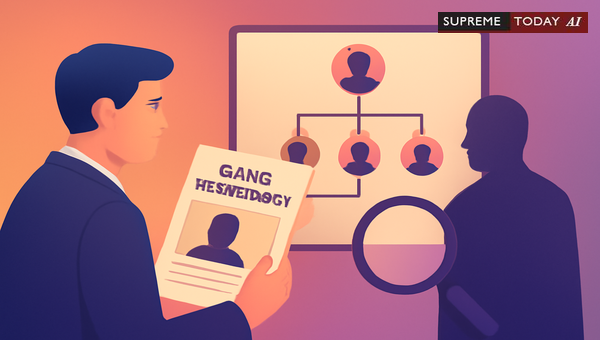
- Gang charts mapping hierarchies and activities are powerful. These can be presented and corroborated by other witnesses2023 0 Supreme(All) 903.
- Prior convictions or FIRs, even if resulting in acquittals, may indicate a pattern of behavior suggestive of gang involvement 2021 0 Supreme(UK) 770. Note, however, courts caution against over-reliance: Therefore, the prosecution has failed to prove that the appellant is a member of the Mahendra Fauji gang. However, none of these FIRs, or criminal cases, involved the appellant2021 0 Supreme(UK) 181.
- Social media or out-of-court statements for non-hearsay purposes, like proving gang coordination: Kent told Michael to contact Christopher Nwanjoku, a fellow gang member, to order all gang members to take down their social media2024 Supreme(US)(ca11) 206.
3. Avoiding
- Courts may draw if an essential witness is withheld 1995 0 Supreme(SC) 1018. But this is context-dependent—if the witness isn't critical, no penalty applies.
- Strategy: Emphasize why public witnesses were omitted (e.g., fear of reprisal, irrelevance) and highlight the sufficiency of available evidence.
Case Studies: Successes and Failures
Successful prosecutions pivot on holistic evidence:- Gang charts and police testimonies proved membership despite gaps 2023 0 Supreme(All) 903.- In contrast, failures occur when evidence is thin: The prosecution miserably failed to prove that there was a gang and the appellant was its member/leader under the , as no was shown 2021 0 Supreme(UK) 584. The court stressed proving involvement in under , leading to acquittal.
under highlight pitfalls: How do the in-camera witness statement correlate so as to point to a consistent pattern of criminal conduct of the Petitioners as a gang? Lacking and , orders were set aside 2013 0 Supreme(Bom) 1758.
Absconding alone doesn't prove guilt: Conviction cannot be based only on the ground that the alleged accused has absconded2021 0 Supreme(UK) 181.
Application to Real-World Scenarios
Imagine an appellant charged under the . Prosecution skips public witnesses at a street brawl but presents:- A gang chart linking the appellant to leaders.- Police testimony on prior joint FIRs.- Digital evidence of gang signals.
This builds a clear narrative of pattern and association, satisfying courts even without bystanders 2021 0 Supreme(UK) 770.
Defendants counter by arguing gaps, but judges assess overall credibility. As in rape appeals, contradictions in accused statements can bolster prosecution
.
Strategic Recommendations for Prosecutors and Defense
For Prosecutors:- Thoroughly present gang charts, prior cases, and officer testimonies.- Preempt adverse inference claims by proving sufficiency.- Use IPC patterns under Sections like 302 r/w 120-B 2021 0 Supreme(UK) 181.
For Defense:- Highlight missing public witnesses if material.- Challenge gang proof: Demand evidence of 2021 0 Supreme(UK) 584.- Argue no '' or pattern 2020 0 Supreme(All) 723.
Key Takeaways
- Non-examination of public witnesses is not fatal if alternatives suffice [](https://supremetoday.ai/doc/judgement/01000010706).
- Focus on credible, like charts and patterns.
- Courts prioritize holistic proof over perfection.
In gang cases, strength lies in the narrative, not every voice. Stay informed on evolving precedents to navigate these complexities.
This analysis draws from general principles and cited cases. Legal outcomes vary; seek professional advice.
References:2008 0 Supreme(Mad) 1569 [](https://supremetoday.ai/doc/judgement/01000010706) 1984 0 Supreme(All) 154 2000 7 Supreme 184 2015 6 Supreme 1 2021 0 Supreme(UK) 770 2023 0 Supreme(All) 903 2010 5 Supreme 582 1995 0 Supreme(SC) 1018 2021 0 Supreme(UK) 181 2021 0 Supreme(UK) 584 2020 0 Supreme(All) 723 2013 0 Supreme(Bom) 1758
2024 Supreme(US)(ca11) 206 #CriminalLaw #GangProsecution #LegalEvidence




![Rajesh Panika [died and deleted], S/o Gharbharan Panika VS State of Chhattisgarh, through: Incharge of Police Station Udaypur, District Surguja (C. G. ) - 2024 Supreme(Chh) 26](https://supremetoday-s3.b-cdn.net/Chhattisgarh_small_3.png)












