


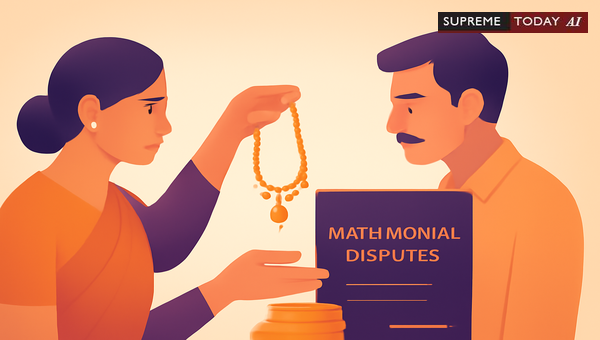
Key Judgments on Gold in Return Cases
Introduction
In Indian matrimonial disputes, claims for the return of gold ornaments are common, often tied to allegations of cruelty, dowry demands, or . A pivotal question arises: Judgements on of Gold in Return of Gold Cases. Courts consistently scrutinize whether gold was actually entrusted to the spouse or in-laws, emphasizing the need for specific pleadings and robust evidence. This blog post delves into key legal principles, landmark case summaries, and evidentiary standards drawn from judicial precedents, helping readers understand what typically sways . Note that this is general information and not specific legal advice—consult a qualified lawyer for your situation.
Gold ornaments, often given as or gifts during marriage, hold significant cultural and financial value. However, proving —actual delivery for safekeeping or use—remains challenging without clear proof. Courts apply a standard, recognizing the familial context where formal documents are rare. Let's explore the core rulings and insights.
Key Legal Principles Governing Claims
Indian courts have established clear guidelines for return of gold petitions under family law, particularly in and decisions. Here are the foundational principles:
Requirement: For a claim to succeed, there must be specific pleadings and sufficient evidence of actual . Mere assertions or circumstantial evidence alone won't suffice. For a claim regarding the return of gold ornaments to be valid, there must be specific pleadings and sufficient evidence demonstrating the actual of the gold ornaments. Mere assertions or circumstantial evidence are insufficient 2018 0 Supreme(Ker) 305. Courts reject constructive or without physical delivery, especially against in-laws. 2018 0 Supreme(Ker) 305
on Claimant: The plaintiff (often the wife) bears the initial burden to prove and . The lies with the claimant to substantiate claims of . The absence of credible evidence can lead to the dismissal of claims for the return of gold ornaments
. It may be mentioned here that the initial burden of proving the of gold ornaments and the amount is on the plaintiff 2017 0 Supreme(Ker) 216. Once proven, the onus shifts to defendants to explain disposal.
Credibility and Consistency: Testimonies must be credible and consistent, especially alongside cruelty or dowry claims. Courts have emphasized the need for credible evidence to support claims of cruelty and dowry demands, which often accompany disputes over gold ornaments. The credibility of witnesses and the consistency of testimonies play a crucial role in the court's decision 2020 0 Supreme(Ker) 969. Oral evidence from family members or jewelers can suffice if corroborated, as strict documentary proof isn't always required due to familial trust. 2025 Supreme(Online)(Ker) 56292
: Unlike criminal cases, use a civil standard—balance of probabilities. is often inferred from oral testimony, family context, and circumstances. Courts generally apply the standard, given the familial and social nature of such entrustments (derived from 2025 0 Supreme(Ker) 1887, 2025 Supreme(Online)(Ker) 46170). Even without bills, courts assess based on trust and oral proof. 2025 0 Supreme(Ker) 1647
These principles underscore that vague claims fail, while detailed, corroborated evidence prevails.
Notable Case Summaries
Judicial precedents provide practical illustrations. Here's a curated selection:
Insufficient Evidence Leads to Dismissal: In a case, the court dismissed the return claim due to lack of proof, awarding Rs.3,00,000/- with interest instead. The petitioner was directed to pay a consolidated amount of Rs.3,00,000/- with interest, while the claim for the return of gold ornaments was dismissed due to lack of evidence 2017 0 Supreme(Ker) 317. Similarly, Unless there is pleading and proof regarding of gold ornaments and its appropriation by the husband, no decree can be granted for return of gold ornaments 2017 0 Supreme(Ker) 420.
Quantity Disputes: Courts modify decrees when extra gold isn't proven. The court concluded that the petitioner had not provided sufficient evidence to prove the of additional gold ornaments, leading to a modification of the decree 2020 0 Supreme(Ker) 969.
Successful Finding: Where evidence was clear, courts ordered return. The concluded that the appellant was liable to return six sovereigns of gold ornaments, as there was clear evidence of 2020 0 Supreme(Ker) 559. Respondents are liable to return the said ar.... 2025 Supreme(Online)(Ker) 57413.
Joint Family Claims Fail Without Proof: No liability for parents without delivery evidence. Claims against the husband’s parents were dismissed due to the lack of evidence proving that the ornaments were entrusted to them 2018 0 Supreme(Ker) 305.
Oral Evidence and Denials: Only if the fact of of the gold ornaments to the respondent is proved, the appellant can claim return of such ornaments 2023 0 Supreme(Ker) 67. In another, jeweler testimony failed as he denied receipt: Though the owner of Navarathna Jewellery was examined as PW1 to prove the of 35 sovereigns of gold ornaments, he testified that no gold ornaments were given to him 2025 0 Supreme(Ker) 2013.
Value Awards as Alternative: When is doubted, courts may decree monetary equivalents. therefore granted a decree for recovering the value of gold ornaments and also Rs. 2 lakhs based on the evidence 2017 0 Supreme(Ker) 1454.
These cases highlight courts' focus on specifics—dates, quantities, witnesses—over generalizations.
Evidence Standards and Challenges
Proving often hinges on:
Oral and Circumstantial Proof: Family testimonies, marriage photos, or post-marital conduct. of Gold - Courts emphasize verifying actual of gold ornaments, not just proof of purchase. Even without bills or invoices, courts assess whether gold was entrusted based on familial trust and oral evidence 2025 Supreme(Online)(Ker) 56292.
Common Pitfalls: Vague dates or amounts lead to dismissals. Courts have found difficulties in establishing precise dates or amounts of when evidence is vague 2025 Supreme(Online)(Ker) 46170. Denials by respondents shift weight to claimant's credibility. 2025 Supreme(Online)(Ker) 58528
Favorable Scenarios: Credible witnesses and context favor claimants. When credible oral evidence and circumstantial proof are present, courts tend to favor the claimant for the return of gold 2025 0 Supreme(Ker) 479.
This judgment was cited to emphasise that the initial burden of proving of gold ornaments is on the plaintiff 2019 0 Supreme(Ker) 980.
Conclusion and Key Takeaways
Judgments on of gold in return cases consistently demand specific evidence and credible testimonies. Claims lacking proof are typically dismissed, while corroborated accounts succeed under the preponderance standard. Familial trust aids inference but doesn't replace evidence.
Key Takeaways:- Gather witness statements, photos, or jeweler records early.- Plead details precisely: who, what, when, how.- Anticipate denials; build consistent testimonies.- Consider alternatives like value claims if return is disputed.
Legal practitioners should guide clients accordingly. This analysis draws from precedents like 2017 0 Supreme(Ker) 317, 2020 0 Supreme(Ker) 969, 2020 0 Supreme(Ker) 559, 2018 0 Supreme(Ker) 305,
, 2023 0 Supreme(Ker) 67, 2025 0 Supreme(Ker) 2013, 2025 Supreme(Online)(Ker) 57413, 2019 0 Supreme(Ker) 980, 2017 0 Supreme(Ker) 420, 2017 0 Supreme(Ker) 216, and others. Always seek professional advice tailored to your case. #GoldEntrustment, #MatrimonialLaw, #FamilyCourt












