


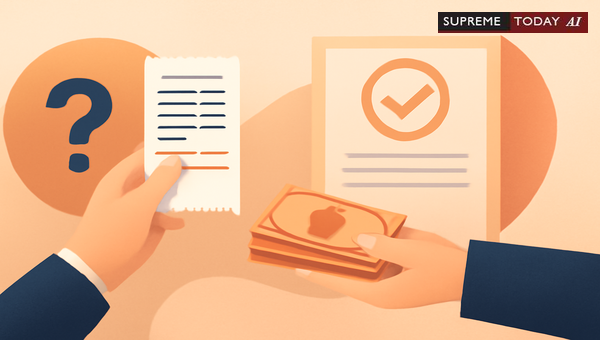
Payments Without Receipts: Why Courts Doubt Them
In legal disputes involving payments, a common refrain echoes through courtrooms: . This principle underscores the critical role of documentation in proving transactions. Whether you're a business owner settling debts or an individual in a contractual disagreement, the absence of a receipt can undermine your claim significantly. This blog post delves into the legal analysis, key principles, judicial precedents, and practical recommendations to help you navigate this issue.
Important Disclaimer: This article provides general information based on legal principles and case precedents. It is not a substitute for professional legal advice. Consult a qualified attorney for advice specific to your situation.
The Core Legal Issue: No Person Would Make Payment Without a Receipt
The statement captures a foundational expectation in contract and commercial law. Courts routinely apply this logic, viewing undocumented payments—especially substantial ones—with skepticism. It is a well-established principle that no person would make a payment of any significant amount without obtaining a receipt, particularly in commercial transactions where documentation ensures legal and financial accountability. The absence of a receipt raises doubts about the legitimacy of the claimed payment 2018 0 Supreme(P&H) 1923 2005 0 Supreme(HP) 253.
This isn't mere formality; it's rooted in evidentiary standards. Without a receipt, claims of payment become scenarios, tilting the scales against the claimant.
Key Legal Principles Governing Payments and Receipts
1. Receipt as Evidence of Payment
Receipts serve as primary evidence of transactions. Courts emphasize that prudent individuals, especially in business dealings, always demand acknowledgment. For instance, one ruling notes: It is improbable that a person would pay the amount without getting an acknowledgment of receipt. 2018 0 Supreme(Chh) 580
In another context: No one is likely to make payments ....
, highlighting the implausibility of large undocumented transfers.
2. on the Claimant
The party asserting payment bears the . Mere oral assertions without documentation are insufficient. Courts have consistently ruled that if a party claims payment, they must substantiate it with evidence like receipts. 1991 0 Supreme(P&H) 821 1993 0 Supreme(SC) 905
Failure to produce a receipt shifts doubt: It is not even credible that any person would be making such a huge payment without any receipt therefore. 2014 0 Supreme(Del) 1212
3. Judicial Skepticism Toward Undocumented Payments
Payments without receipts are viewed skeptically, especially for cash or large sums. In a significant cash transaction case, the court deemed it implausible for someone to pay without documentation, implying such claims lack credibility. 2000 0 Supreme(Del) 719 2005 0 Supreme(HP) 253
Similarly: There was no question to make payment to him without receipt. 2012 0 Supreme(Bom) 175
Relevant Case Law and Precedents
Indian courts have reinforced this principle across various disputes. Here are key examples:
: The court held that without a receipt, a payment is considered unilateral, leaving disputes unresolved. 1993 0 Supreme(SC) 905
Bhan Prakash Case: This reinforced that claims without receipts lack credibility, presuming no payment occurred. 2000 6 Supreme 211
Additional precedents echo this:- In a dispute over installments: Even no details of amount paid in installment has been given much less any acknowledgment of receipt given by the plaintiff in writing. 2018 0 Supreme(Chh) 580
- Regarding cheques: The complainant failed to prove payments without receipts or account payee cheques.
These cases illustrate a pattern: courts presume rationality—no one parts with significant money without proof.
Exceptions and Counterarguments
While the rule is stringent, exceptions exist, though rare:- Small Transactions: Minor amounts might not warrant receipts due to informality.- Trust-Based Relationships: Long-standing personal or business ties may imply trust, reducing documentation needs. 2023 0 Supreme(AP) 718 1998 0 Supreme(Bom) 332
However, these rarely apply to substantial sums. Even in cheque-related matters under the , proper documentation like notices and endorsements is crucial, but the core issue remains: undocumented payments falter. Mere receipt of a cheque without proof of demand doesn't establish liability. 2024 0 Supreme(Chh) 189
Integrating Related Legal Contexts: Cheques and Notices
Payments often intersect with cheque dishonour under . Here, receipts and notices play pivotal roles:
A drawer must receive written notice of dishonour and fail to pay within 15 days. Mere receipt without demand proof isn't an offence. 2022 0 Supreme(Del) 2037 2024 0 Supreme(Raj) 826 2023 0 Supreme(Cal) 253
Partial payments require endorsement; stop payments without notice don't trigger liability.
shifts burden to the drawer upon dishonour and proper notice. 2023 0 Supreme(P&H) 906
This reinforces the broader theme: documentation is non-negotiable. demands proof at every step. 2024 0 Supreme(All) 250
Practical Recommendations for Individuals and Businesses
To safeguard your interests:1. Always Obtain Receipts: Insist on written acknowledgments for any payment, especially over small thresholds.2. Use Digital Trails: Opt for bank transfers, account-payee cheques, or apps with instant confirmations.3. Gather Corroborative Evidence: If no receipt exists, collect witness statements, bank records, or emails.4. Legal Strategy in Disputes: Prepare for skepticism; bolster claims with alternatives, but prioritize prevention.
In summary, documentation protects payers and payees alike. 2023 0 Supreme(Del) 851
Hemarajasekar VS M. Natesan - Consumer (2022)
1991 0 Supreme(P&H) 821Conclusion and Key Takeaways
The legal landscape is clear: payments without receipts, particularly substantial ones, face uphill battles in court. The principle that isn't hyperbole—it's evidentiary reality backed by precedents. By prioritizing documentation, you mitigate risks and ensure enforceability.
Key Takeaways:- lies with the claimant—receipts are king.- Courts view undocumented claims skeptically, presuming implausibility.- Exceptions are narrow; don't rely on them for big amounts.- In cheque cases, notices and proofs amplify the need for records.
Stay proactive, document diligently, and consult professionals for tailored guidance. Your next transaction could hinge on a simple piece of paper.
#PaymentReceipt, #LegalEvidence, #CourtProof















