


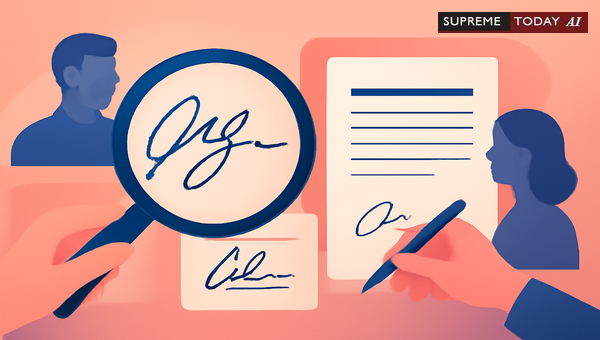
Proving Your Signature is Genuine: A Guide for Plaintiffs in Disputes
Imagine you're in court, and the opposing party—a document writer—claims your signature on a crucial document is forged. As the plaintiff, how do you counter this? Many individuals face this dilemma: Please help plaintiff to cross a document writer who claims that signature put by plaintiff in the document. This common legal challenge hinges on established principles of evidence law, particularly the and the . In this post, we'll explore strategies to defend your signature's authenticity, backed by legal precedents and practical advice.
While this information is for educational purposes and draws from general legal principles, it is not specific legal advice. Consult a qualified attorney for your case.
The
Under the law, a signature on a document is presumed to have been made personally by the signer unless proven otherwise. Courts generally hold that signatures must be personally affixed by the individual whose signature it is, and the law generally presumes that a signature is made by the person himself, especially when there is no evidence of force, fraud, or . 1950 0 Supreme(SC) 16
This presumption arises because signing is a deliberate act of assent. As noted in , signing means writing one's name on a document with the intention to authenticate it. 1966 0 Supreme(SC) 272 Without evidence rebutting this, mere denial by the document writer isn't enough.
Key Legal Points
- : Assumed made by the signer absent proof. 1950 0 Supreme(SC) 16
- Intent Matters: The signer's understanding at signing is key. 1966 0 Supreme(SC) 272
- Burden on Claimant: Party alleging must provide evidence like forensics or proof. 2021 0 Supreme(Mad) 2511
- Mere Assertion Insufficient: Document writer's claim alone doesn't prove . 1950 0 Supreme(SC) 16
- Suspicious Features Need Support: Discrepancies require expert backing. 2020 3 Supreme 675
in Signature Claims
The party challenging the signature—the document writer here—bears the full burden. A simple denial or claim that the signature was not made by the plaintiff fails without substantiation. In , authenticity is presumed until contradicted by credible evidence. 1966 0 Supreme(SC) 272
Courts demand more than words: forensic exams, , or proof of . As one ruling states, the party alleging must produce evidence to rebut the presumption of genuineness, such as forensic examination or proof of , , or . 2021 0 Supreme(Mad) 2511
From additional case law, when authenticity is disputed, proactive steps are essential. When the defendant denies the signature in a particular document which is very much relied on by the plaintiff, it is for the plaintiff to take steps for examination of the disputed signature by sending the document to a . 2018 0 Supreme(Mad) 2963 2016 0 Supreme(Mad) 3328 2012 0 Supreme(Mad) 167
This shifts focus: even if the opponent claims , you as plaintiff should secure expert verification to strengthen your position.
Cross-Examining the Document Writer: Strategies for Plaintiffs
To effectively cross-examine the document writer, highlight the weaknesses in their claim:
- Question Their Evidence: Ask for specifics on why they believe it's forged. Probe for forensic reports or witnesses. Without these, their testimony lacks weight. 1950 0 Supreme(SC) 16
- Expose Inconsistencies: Point out if the document shows no tampering signs, like consistent ink or natural placement. Unusual features alone aren't proof. 2020 3 Supreme 675
- Leverage Presumption: Remind the court of the legal default favoring genuineness. 1966 0 Supreme(SC) 272
In practice, courts empower comparison of disputed vs. admitted signatures under and . One case directed: The trial court was directed to compare the signatures and dispose of the suit within three months. 2018 0 Supreme(Mad) 2963
Role of Forensic Evidence and
Forensic handwriting analysis is often decisive. Courts recognize experts under . If is alleged, request the document be sent to a . As held, The court has power to compare the signatures and form its opinion under . However, if the court finds it difficult... it may take steps to secure an expert’s opinion. 2012 0 Supreme(Mad) 167
Supporting cases affirm this:- Trial courts can appoint commissioners for on disputed wills or agreements. 2010 0 Supreme(Mad) 4795- Even late applications may proceed if no prejudice. 2016 0 Supreme(Mad) 3328
In one instance, the trial court has the authority to compare disputed signatures with admitted signatures and seek expert opinion if necessary. 2018 0 Supreme(Mad) 2963
Other sources reinforce: Plaintiffs should present genuine signature samples for comparison, especially if the opponent admits parts of the document. 2025 Supreme(Online)(P&H) 8734 For example, if the first page is admitted, compare it to disputed pages. 2016 0 Supreme(Mad) 3328
Application to Your Case: Steps for the Plaintiff
If facing a document writer's claim:1. Object to Authenticity: Note suspicious features like unnatural positioning or ink discrepancies. 2020 3 Supreme 6752. Demand Forensic Exam: File for expert analysis via court order. 2021 0 Supreme(Mad) 25113. Submit Admitted Signatures: Provide other documents with your genuine signatures for comparison. 2018 0 Supreme(Mad) 29634. Call Witnesses: Those familiar with your signature or present at signing.
5. Challenge Opponent: Force them to produce rebuttal evidence. Mere denial fails. 1950 0 Supreme(SC) 16
Exceptions exist: Clear , (e.g., illness, tremors), or fraud can rebut presumption, but need proof like medical evidence. 1950 0 Supreme(SC) 16 2020 3 Supreme 675
Insights from Related Cases
Cases like
show witnesses attesting to seeing the plaintiff sign strengthen claims: The plaintiff had signed the document in his presence.
In partition disputes, admitting a signature doesn't admit contents, avoiding traps. 2019 0 Supreme(Kar) 1604 don't transfer title, underscoring document validity. 2019 0 Supreme(Kar) 1604
Disputed wills or agreements often turn on expert reports, with courts directing swift disposal post-analysis. 2010 0 Supreme(Mad) 4795
Recommendations for Success
- Insist on handwriting analysis immediately.
- Collect genuine signature samples.
- Highlight document anomalies.
- Use witnesses if available.
- Cross-examine rigorously on lack of proof.
Conclusion: Key Takeaways
Signature disputes favor the presumption of genuineness—put the burden back on the accuser. By securing forensic evidence and , plaintiffs can effectively counter document writers' claims. Remember, suspicious circumstances alone don't suffice; concrete proof rules. 2020 3 Supreme 675
Stay proactive: Courts support tools like signature comparisons and experts to resolve doubts fairly. For tailored guidance, reach out to a legal professional. This approach not only defends your position but upholds justice in document authenticity battles.
References:- 1950 0 Supreme(SC) 16, 1966 0 Supreme(SC) 272, 2021 0 Supreme(Mad) 2511, 2020 3 Supreme 675, 2018 0 Supreme(Mad) 2963, 2016 0 Supreme(Mad) 3328, 2012 0 Supreme(Mad) 167, 2010 0 Supreme(Mad) 4795,
, 2025 Supreme(Online)(P&H) 8734, 2019 0 Supreme(Kar) 1604 #SignatureForgery, #HandwritingExpert, #LegalProof















