


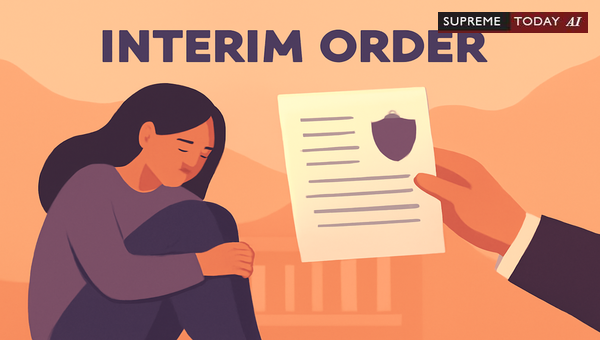
Can a DV Interim Order Be Passed Without Notice to Respondent?
In domestic violence proceedings, urgency often drives the need for quick judicial intervention. But can a court issue an interim order—commonly known as a DV interim order—without notifying the respondent? This question arises frequently under the (), where orders are sought to protect the aggrieved person. Understanding the balance between immediate relief and principles of is crucial for victims, respondents, and legal practitioners alike.
This article delves into the legal framework, judicial precedents, and procedural safeguards, drawing from established case law. Note: This is general information and not specific legal advice. Consult a qualified lawyer for your situation.
The Legal Principle: Notice is Mandatory Before Orders
The core issue is whether an interim order can be passed without proper notice to the respondent in DV cases. Courts have consistently held that such orders cannot be issued without serving notice, as this violates the tenets of —specifically, the right to be heard ().
Under the , while the law aims to provide swift protection, procedural fairness remains paramount. In the context of the Protection of Women from Domestic Violence (PWDV) Act, it is established that an order cannot be passed without proper notice being served to the respondent. 2015 0 Supreme(Chh) 255
Key Requirement: Mandatory Service of Notice
Service Must Follow Prescribed Procedures: Courts emphasize that notice must be served as per legal norms. Failure invalidates the order. For instance, in one case, the improperly accepted a 's report without verifying notice procedures, leading to an unjust order. 2015 0 Supreme(Chh) 255
Violation of : Passing orders sans notice is impermissible. Several cases highlight that passing an order without serving proper notice violates the principles of . Courts have consistently ruled that such actions are impermissible and have set aside orders on these grounds.
K. S. E. B. VS MADHAVAN NAIR - Consumer (2003)
SECRETARY, K. S. E. B. VS MADHAVAN NAIR - Consumer (2003)
Judicial Precedents Reinforce This: orders are only justified post-notification and opportunity to respond. Where notice was improperly served, courts set aside the orders.
1951 0 Supreme(Cal) 1
provides that a 's declaration of service is proof, but courts must still ensure compliance. states that a declaration of service of notice made by the serves as proof of service. However, this does not absolve the court from ensuring that the service was conducted in accordance with the law. 2009 0 Supreme(Chh) 187
Insights from Related Cases and Broader Context
While the focuses on domestic violence, parallels in other proceedings underscore notice's importance. For example, in enforcement scenarios under the Act, courts scrutinize interim orders' validity.
In a , the court examined police execution of a PWDV interim order dated . However, the records reflect that the proceedings under the provision of were initiated and pursuant to the direction so passed the police authorities executed the order. It has been brought to the notice of this Court that there was an interim order under . 2025 Supreme(Online)(Cal) 4052 The findings highlighted jurisdictional limits, implying procedural lapses like improper notice could undermine enforcement.
Another case involved an interim order under dated , prohibiting certain actions. This was challenged, reinforcing that even urgent orders demand procedural rigor.
In custody matters linked to DV, appellate courts have limited powers to stay orders, prioritizing child welfare but still upholding notice principles. Learned , by order dated , set-aside the ex-parte interim order granting temporary custody... The welfare of the child is a paramount consideration in matters of custody, and the has limited power to stay the operation of the order passed by the under the . 2020 0 Supreme(Kar) 725
Broader procedural analogies, such as under , stress reasonable notice even in emergencies. Except in cases of emergency or the situation unexceptionably demanding so, reasonable notice/time for execution of the order or compliance with the directions issued in the order itself or in furtherance thereto is the pre-requisite. 2012 2 Supreme 36 Though not directly DV, this illustrates courts' aversion to hasty actions without justification.
Procedural Steps and Common Pitfalls
To seek a valid interim order:1. File Application with Urgency Grounds: Detail why immediate relief is needed without notice, but courts rarely dispense with it entirely.2. Serve Notice Promptly: Use Protection Officers or court processes.3. Post-Order Compliance: Respondents can challenge on notice grounds.
Common pitfalls include:- Relying solely on reports without verification. 2015 0 Supreme(Chh) 255- Ignoring service modes, leading to invalidation.
K. S. E. B. VS MADHAVAN NAIR - Consumer (2003)
In one DV appeal, despite notice, elements were scrutinized.
Recommendations for Parties Involved
- For Aggrieved Persons: Meticulously follow notice procedures to strengthen orders. 2015 0 Supreme(Chh) 255
- For Respondents: Challenge orders citing improper notice and breaches.
SECRETARY, K. S. E. B. VS MADHAVAN NAIR - Consumer (2003)
- Stay Updated: Judicial interpretations evolve; reference PWDV provisions and precedents.
Conclusion and Key Takeaways
Under the , DV interim orders generally cannot be passed without notice to the respondent. Courts prioritize , invalidating non-compliant orders across precedents.
1951 0 Supreme(Cal) 1
Key Takeaways:- Notice service is mandatory; procedural lapses void orders.- trumps urgency unless exceptional.- Challenge flawed orders promptly.- Police enforcement hinges on valid interim orders. 2025 Supreme(Online)(Cal) 4052
This framework ensures fairness in sensitive DV matters. For tailored guidance, seek professional legal counsel.
References: 2015 0 Supreme(Chh) 255
K. S. E. B. VS MADHAVAN NAIR - Consumer (2003)
SECRETARY, K. S. E. B. VS MADHAVAN NAIR - Consumer (2003)
1951 0 Supreme(Cal) 1 2009 0 Supreme(Chh) 187 2025 Supreme(Online)(Cal) 4052
2020 0 Supreme(Kar) 725 2012 2 Supreme 36 #PWDVAct #ExParteDVOrder #DomesticViolenceLaw















