


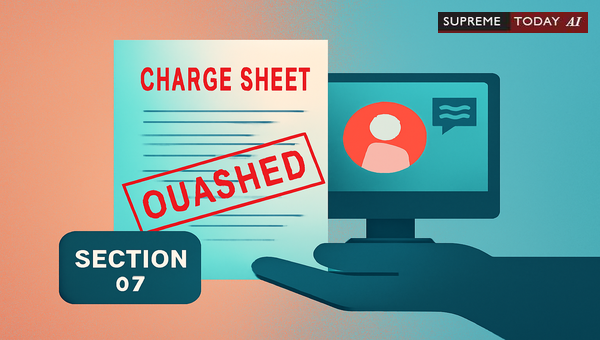
Grounds for a Under Section 67 of the IT Act: Key Insights and Case Laws
In the digital age, charges under (IT Act) for publishing or transmitting obscene material in electronic form are increasingly common. But what if the prosecution's case lacks solid evidence? Many accused individuals seek to quash the at the to avoid protracted legal battles. If you're facing such charges or advising someone who is, understanding the grounds for can be crucial.
This article addresses the question: What are all the Grounds that can be Taken for Filed under Section 67 of Information Technology Act? Explain with Latest Case Laws. We'll break down the primary grounds, supported by judicial precedents, while integrating insights from related cases. Note: This is general information based on legal precedents and not specific legal advice. Consult a qualified lawyer for your situation.
Understanding Section 67 of the IT Act
Section 67 punishes whoever publishes or transmits obscene material in electronic form, where obscene means , appealing to , or tending to those who see, hear, or read it. For a to survive, the prosecution must establish:- Publication or transmission by the accused.- The material's obscene nature per legal standards.
Failure on these fronts often leads courts to exercise under to quash proceedings, preventing . 2025 0 Supreme(Gau) 103
Primary Grounds for a
Courts have consistently outlined specific grounds where proceedings under Section 67 can be quashed. Here's a detailed look:
1. Lack of Evidence of Publication or Transmission
No offence is made out without proof that the accused published or transmitted the material electronically. If the lacks this evidence, is warranted.
- In one case, the court quashed proceedings due to absence of evidence of publication or transmission of obscene material by the accused. 2013 0 Supreme(UK) 642
- Similarly, where are not fulfilled, courts accept settlements or quash reports/charge-sheets.
2. Material Does Not Meet Criteria
Content must appeal to , be , or deprave/corrupt viewers. Vulgarity or profanities alone don't suffice; it must violate .
- The court in held that mere publication isn't enough unless the material is or appeals to , backed by sound evidence. 2025 0 Supreme(Gau) 103
- Vulgarity and profanities do not per se amount to , and the content must be gauged with respect to . 2024 5 Supreme 120
- Prosecution failure to show content justifies . 2025 0 Supreme(Gau) 103
3. No Material Supporting Allegations
don't support charges. Courts won't assume guilt pre-trial.
- The Court cannot assume guilt at the and that the material must be evaluated for its obscene nature; otherwise, proceedings can be quashed. 2022 0 Supreme(All) 133
- In another instance, charge sheets were quashed for lack of material constituting offences under Section 67 alongside IPC sections. 2023 Supreme(Online)(ALL) 10230
4. Absence of
The accused must have knowledge of the material's obscene nature. Without evidence of intent, charges falter.
- The presumption of knowledge and the requirement to prove that the content is or appeals to are crucial. 2022 0 Supreme(All) 133
5. Other Procedural or Evidentiary Lapses
- No case if content doesn't depict sexually explicit acts or meet Section 67 thresholds.
- Disputes better suited as civil matters, not criminal .
- Lack of sanction or evidence for related IT Act offences leads to . 2017 0 Supreme(Kar) 583
Landmark and Recent Case Laws
2025 0 Supreme(Gau) 103
The court clarified Section 67's exclusivity for electronic , where prosecution failed to prove content with .
Case No. 2013 0 Supreme(UK) 642
Reinforced for absent proof of transmission of obscene material, emphasizing .
Case No. 2024 5 Supreme 120
Established that requires appeal to per , not mere vulgarity.
Case No. 2022 0 Supreme(All) 133
Highlighted pre-trial when no sound evidence supports .
Additional Precedents from Recent Sources
- In a case, proceedings under Section 67 were quashed as ingredients weren't met, allowing settlement.
- quashed cognizance under Section 67 for arbitrary submission without offence establishment. 2023 Supreme(Online)(ALL) 10230
- dealt with , stressing material review.
- Even in combined charges (e.g., ), lack of proof led to . 2023 Supreme(Online)(UT) 903
- A case under noted courts altering charges or if no IT Act offences via case diary review. 2022 0 Supreme(All) 1578
These cases show courts' reluctance to proceed without robust evidence, often invoking or .
Exceptions and When May Be Denied
isn't automatic. If prosecution shows:- Clear content tending to deprave. 2025 0 Supreme(Gau) 103- Transmission proof with intent. 2013 0 Supreme(UK) 642
Proceedings continue. Artistic or expressive content protected under free speech may still be scrutinized against . 2024 5 Supreme 120
In some instances, courts refuse but direct surrender/bail, balancing accused rights. 2016 0 Supreme(All) 2359
Practical Recommendations
To challenge a Section 67 :- Highlight evidentiary gaps in publication/transmission.- Argue non- using tests.- Demand proof of knowledge/intent.- File under early, citing precedents.
Ensure all materials are evaluated; courts avoid but require brief offence ingredient outlines. 2022 0 Supreme(All) 1578
Conclusion and Key Takeaways
a under Section 67 IT Act typically hinges on absent proof of electronic transmission of truly obscene material—, prurient, or depraving per law. Recent cases like those cited 2025 0 Supreme(Gau) 103 2013 0 Supreme(UK) 642 2024 5 Supreme 120 2022 0 Supreme(All) 133 underscore courts' focus on evidence over assumptions.
Key Takeaways:- Prosecution bears the burden; vagueness favors .- isn't vulgarity— apply.- Integrate IT Act specifics; avoid IPC overlaps without proof.
Stay informed on cyber laws to navigate these issues effectively. For personalized guidance, reach out to a legal expert.
References: All insights drawn from provided legal documents. Case IDs: 2025 0 Supreme(Gau) 103 2013 0 Supreme(UK) 642 2024 5 Supreme 120 2022 0 Supreme(All) 133 2023 Supreme(Online)(ALL) 10230 2022 0 Supreme(All) 1578 and others noted inline.












