


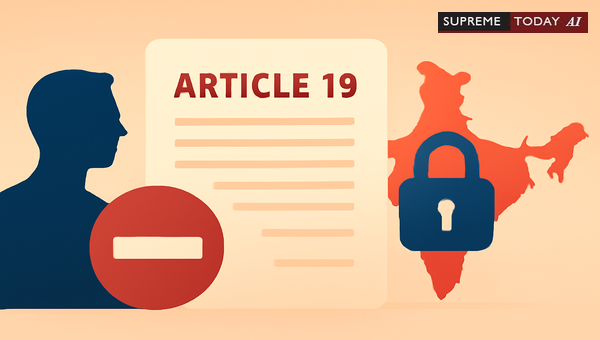
Understanding Under of the Indian Constitution
Freedom of speech, assembly, and profession are cornerstones of democracy, but are they absolute? Many citizens wonder: What are under of the Constitution? This question arises frequently in legal debates, protests, business regulations, and personal rights challenges. of the Indian Constitution guarantees six key freedoms to citizens, yet these are balanced against societal needs through '.'
In this post, we break down the legal framework, criteria, and real-world applications. Drawing from constitutional provisions and judicial interpretations, we'll explore how courts ensure these limits are fair and proportionate. Note: This is general information, not specific legal advice—consult a lawyer for your situation.
Legal Framework: Fundamental Rights and Their Limits
(1) enshrines essential freedoms:- 19(1)(a): - 19(1)(b): - 19(1)(c): - 19(1)(d): Freedom to move freely throughout India- 19(1)(e): - 19(1)(g): Right to practice any profession, occupation, trade, or business
These rights are not unlimited. allows imposed by law for specific purposes. As established, restrictions must be 'imposed by law'—meaning enacted by the legislature—and must be 'reasonable' in nature, serving a legitimate purpose 2015 0 Supreme(Mad) 2640 2014 0 Supreme(Mad) 3992 2015 0 Supreme(Mad) 2648.
The has emphasized that reasonableness is assessed qualitatively, quantitatively, and relatively, ensuring restrictions aren't arbitrary or excessive 2022 0 Supreme(Ker) 58.
Criteria for by Specific Rights
(1)(a)
Restrictions must have a direct with enumerated grounds in (2):- - - - - - -
They must be justified, proportionate, and serve a legitimate aim 2015 0 Supreme(Mad) 2640 2022 0 Supreme(Ker) 58 2015 0 Supreme(Mad) 2648 1996 0 Supreme(Cal) 152. The grounds are exhaustive—courts cannot add new ones via interpretation 2005 0 Supreme(Mad) 741
02400015696
. In one ruling, the Court held: The grounds lined up in (2) for restricting right to free speech are exhaustive – Under guise of invoking other fundamental rights... additional restrictions not found in (2), cannot be imposed 2023 0 Supreme(SC) 5.Peaceful Assembly (1)(b)
Narrower scope: only with or 2015 0 Supreme(Mad) 2640 2014 0 Supreme(Mad) 3992 2022 0 Supreme(Ker) 58. This limits state overreach in regulating protests.
Residence and Settlement (1)(e)
Restrictions in the interests of the general public2020 0 Supreme(All) 1075.
Profession, Trade, or Business (1)(g)
Must be reasonable and lawful, protecting public interest, morality, or other concerns 1988 0 Supreme(MP) 222. Courts uphold guidelines if they provide frameworks for opportunities without undue burden. For instance, in ex-servicemen resettlement schemes, restrictions preventing other business pursuits were deemed valid to prioritize those without alternatives: The restriction that ex-servicemen availing such opportunities cannot carry on any other business has been inserted only to exclude such ex-servicemen who have other employment opportunities 2018 0 Supreme(Del) 619 2017 0 Supreme(Del) 2102.
Judicial Tests for Reasonableness
Courts apply a multi-pronged test:1. Imposed by valid law: Executive instructions alone may not suffice 2019 0 Supreme(Del) 2597.2. Direct to permitted grounds.3. : Not excessive; balances individual rights with public good.4. Non-arbitrary: Follows 2025 Supreme(Online)(Kar) 36005.
In administrative contexts, like electricity duty hikes, courts stress reasonableness to uphold and 19: Administrative decisions must maintain reasonableness to uphold constitutional rights during litigation (from case summary on ) 2025 Supreme(Online)(AP) 11017.
Street vending regulations exemplify this. Public streets are held in trust, with use limited reasonably: The State as trustee is entitled to impose all necessary limitations on the character and extent of the user 2016 0 Supreme(Del) 4615. The , protects livelihoods under 19(1)(g) via surveys and seniority principles.
impacting liberty under must also heed reasonableness, following
2025 Supreme(Online)(Kar) 36005.
Real-World Applications and Case Insights
Ex-Servicemen Schemes: Guidelines for coal transportation companies by ex-servicemen were challenged under (1)(g). Courts rejected claims, noting restrictions ensure benefits reach the needy: The guidelines provide a framework for providing employment opportunities to ex-servicemen 2018 0 Supreme(Del) 619 2017 0 Supreme(Del) 2102 2019 0 Supreme(Del) 2597.
Victim Rights vs. Speech: No additional curbs on 19(1)(a) beyond 19(2), even balancing 2023 0 Supreme(SC) 5.
International Travel: Rights like re-entry may face reasonable public interest limits, akin to
Mujibur Rahman and others .............Petitioners in WP No. 6234 of 2024 Jewel Khan and others .............Petitioners in WP No. 6083 of 2024 -VS- Judge Artha Rin Adalat Chattogram and others .............Respondents in both writ petitions - 2024 Supreme(BD)(SC) 8348
.
These cases show courts scrutinize for fairness, often maintaining status quo in disputes to avoid hardship 2025 Supreme(Online)(AP) 11017.
Key Takeaways and Recommendations
under are laws limiting freedoms proportionately for state interests like or morality. Grounds are exhaustive and right-specific, with judicial oversight ensuring balance.
Practical Tips:- Challenge invalid curbs: Verify if 'by law,' -linked, and reasonable 2015 0 Supreme(Mad) 2640.- For businesses/protests: Note narrower assembly limits; ensure compliance with guidelines.- Litigation strategy: Highlight arbitrariness or lack of .
In summary, fosters liberty while permitting necessary safeguards. As the notes, rights thrive when individuals respect others'—a horizontal effect balancing vertical state duties 2023 0 Supreme(SC) 5. Stay informed, but seek professional advice for cases.
This post synthesizes constitutional principles and precedents for educational purposes.
#Article19 #IndianConstitution #FundamentalRights












