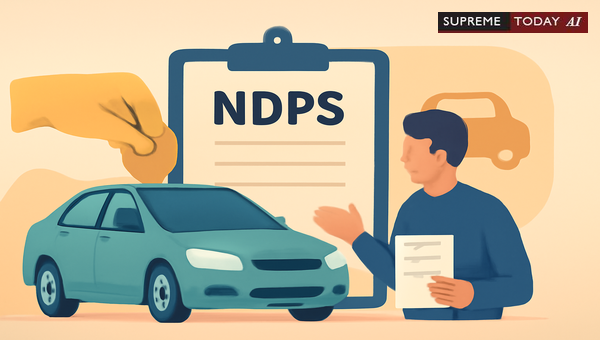
Can RC Owners Secure Release of NDPS-Seized Vehicles If Not Accused?
In the high-stakes world of narcotics enforcement under India's , vehicles used in drug trafficking are often seized, leaving innocent owners in a bind. Imagine you're the registered owner () of a vehicle seized during an NDPS raid, but you're neither an accused nor involved in the crime. The key question arises: Can the petitioner, as of the NDPS but not an accused, file a ?
This blog dives deep into the legal landscape, drawing from court judgments and principles to clarify your rights. We'll explore eligibility, conditions, exceptions, and practical steps, helping vehicle owners navigate this complex area. Note: This is general information based on precedents; consult a lawyer for case-specific advice.
Eligibility of RC Owners to File Release Petitions
Courts have consistently held that the of a vehicle seized under the can seek its release, provided no has been passed2021 0 Supreme(Raj) 386 2022 0 Supreme(Raj) 2418. Ownership via the Registration Certificate is typically sufficient to establish standing, even if the owner is not implicated in the offense.
Several judgments affirm this: If no confiscation proceedings are pending, the vehicle may be released to the 2022 0 Supreme(Pat) 1180 2022 0 Supreme(Pat) 981. The legal documents establish that registered owners have this right, emphasizing protection for innocent parties 2021 0 Supreme(Raj) 386.
For instance, in cases where the vehicle was used without the owner's knowledge, courts prioritize to prevent undue hardship 2024 0 Supreme(Kar) 357. Here, the court noted: The vehicle in question was hired by some private party... without the knowledge of the owner of the vehicle. It ruled that the can grant if lack of knowledge is proven, overriding denials by lower courts under and 457.
Key Legal Principles Governing Release
The judiciary's stance is clear: Absence of a is pivotal, allowing RC owners to file petitions successfully 2021 0 Supreme(Raj) 386 2018 0 Supreme(Tri) 76 2022 0 Supreme(Ori) 44. Courts stress safeguarding innocent owners' rights, often permitting release during on (bail-like conditions) or bonds 2022 0 Supreme(Raj) 2418.
Key principles include:- under and 63, read with : Special Courts retain powers to release vehicles, focusing on the owner's innocence 2024 0 Supreme(Kar) 357.- No bar for non-accused owners: Even if proceedings are ongoing, release is favored absent confiscation 2022 0 Supreme(Raj) 2418.- Protection against depreciation: Vehicles left idle depreciate, justifying release 2020 0 Supreme(Mad) 1220 2020 0 Supreme(Mad) 1291 2020 0 Supreme(Mad) 2031. Courts have observed: The vehicle was being kept idle in the police station premises, which would lead to its depreciation in value.
These principles underscore that ownership alone suffices for petitioning, promoting fairness.
Specific Conditions and Limitations for Release
Release isn't automatic; courts impose safeguards:- Bonds or : Often required for or 2012 0 Supreme(P&H) 312 2017 0 Supreme(Raj) 2247.- No alienation: Vehicles can't be sold or misused during custody 2020 0 Supreme(Mad) 1291.- Cooperation with authorities: Owners must aid investigations 2020 0 Supreme(Mad) 2031.
Even if the owner is an accused, absence of confiscation allows petitions 2022 0 Supreme(Raj) 2418. In non-NDPS parallels, like forest offenses, courts direct release to non-accused owners post-report to magistrates, without compounding 2021 0 Supreme(Telangana) 179: The petitioner is not an accused and he is only an owner of the subject vehicle.
Under sand mining cases, absconding accused doesn't bar owner release 2021 0 Supreme(Ker) 218: Mere fact that the accused had absconded cannot be a reason for rejecting the petition filed by the owner.
Exceptions and Key Considerations
While favorable, exceptions exist:- Pending confiscation: Limits immediate release 2018 0 Supreme(Tri) 76.- Owner's knowledge/involvement: May sway decisions, though ownership typically prevails 2022 0 Supreme(Ori) 44.
Courts balance prosecution needs with owner rights, often conditioning release to prevent evasion. In hired vehicle scenarios, proven lack of complicity is crucial 2024 0 Supreme(Kar) 357.
Practical Steps to File a
To strengthen your case:1. Substantiate ownership: Attach RC, insurance, etc.2. Prove no confiscation: Highlight absence of proceedings.3. Cite precedents: Reference judgments like those emphasizing innocent owners 2021 0 Supreme(Raj) 386 2022 0 Supreme(Raj) 2418.4. Propose conditions: Offer bonds/ proactively.5. File promptly: Approach or via writs.
Conclusion and Key Takeaways
Yes, as of an NDPS-, you can generally file a even if not an accused, absent a . Courts favor interim release to bona fide owners, protecting against loss while ensuring justice 2021 0 Supreme(Raj) 386 2018 0 Supreme(Tri) 76 2022 0 Supreme(Ori) 44.
Key Takeaways:- Prioritize lack of knowledge and ownership proof.- Expect conditions like bonds for .- Act swiftly to avoid depreciation 2020 0 Supreme(Mad) 1220.- Draw from broader precedents on seized property release.
This analysis draws from established rulings, but outcomes vary. This is not legal advice—seek professional counsel tailored to your situation. Stay informed, protect your assets, and leverage these rights effectively.
Key Supporting Judgments:- 2021 0 Supreme(Raj) 386 2022 0 Supreme(Raj) 2418 2022 0 Supreme(Pat) 1180 2018 0 Supreme(Tri) 76 2022 0 Supreme(Ori) 44 2024 0 Supreme(Kar) 357 2021 0 Supreme(Telangana) 179
#NDPSAct, #VehicleRelease, #LegalRights