


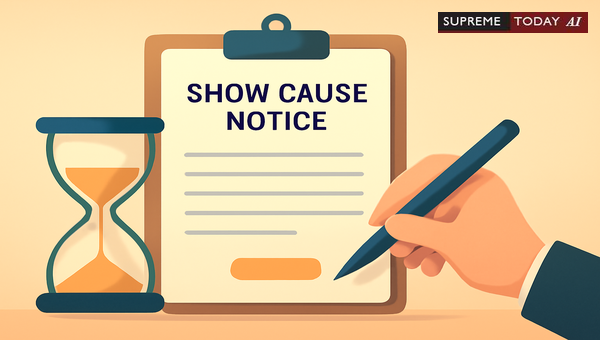
Does Reply to End ?
In the realm of , receiving a (SCN) can be a tense moment. It typically demands an explanation for alleged violations, often with a —a set timeframe to rectify issues or respond. But what happens once you've submitted your reply? Does the stop ticking? This question, of was Stopped after Receiving the Reply of , is common in legal challenges involving government actions, contracts, and penalties.
This blog post breaks down the legal position, drawing from judicial precedents and principles of . While this provides general insights, it's not specific legal advice—consult a lawyer for your case.
Understanding Show Cause Notices and Cure Periods
A is a procedural tool used by authorities, employers, or contracting parties to inform someone of potential wrongdoing and give them a chance to respond before adverse action like penalties, termination, or . The is the window (e.g., 7-30 days) to cure the defect—fix it or explain why no violation occurred.
The core issue: Once the reply is received, does this period cease to operate? Generally, yes. The 's purpose is to provide an opportunity to respond or rectify. Submitting a reply fulfills this, shifting focus to the authority's duty to review it before deciding. Failure to do so can render actions .
Legal Position: Stops Upon Receipt of Reply
Legal documents and judgments indicate that the typically ceases once the reply is received. It doesn't extend or restart automatically; instead, it marks the end of the respondent's opportunity phase. The authority must then duly consider the reply before imposing penalties.
- Stoppage After Reply: The reply signals the respondent has exercised their right. Proceedings move to evaluation. In 2018 0 Supreme(Jhk) 2320, the court noted respondents failed to consider the petitioner’s reply, implying the cure opportunity closed post-submission, but ignoring it violated fairness.
- No Automatic Extension: Receipt doesn't prolong the period. As seen in 2021 0 Supreme(Del) 1260, a reply filed within three days preceded a demolition order passed without consideration, showing the period ended upon submission.
This aligns with principles of , requiring a fair hearing (—hear the other side).
Key Judicial Precedents on Reply Consideration
Courts consistently quash orders where replies are ignored, reinforcing that post-reply, the focus is review, not further curing.
Case Analysis: 2018 0 Supreme(Jhk) 2320 and 2021 0 Supreme(Del) 1260
In 2018 0 Supreme(Jhk) 2320, the court highlighted that adverse action without reply consideration is improper, effectively closing the cure window once replied. Similarly, 2021 0 Supreme(Del) 1260 involved a timely reply to an SCN, yet demolition proceeded unchecked: the demolition order was passed without considering the reply, indicating that the was effectively over once the reply was submitted.
Broader Implications from Related Rulings
Other cases echo this. In scenarios, valid SCNs with precise allegations are crucial, and replies must be addressed. For instance, a case on security services breaches noted: Petitioner was, thus, not served with any valid show-cause notice indicating precise case set up against it... petitioner has been denied adequate opportunity of hearing prior to decision taken... in violation of principles of . The was quashed. (Context from security contract dispute under .)
In 2021 0 Supreme(Gau) 554, after a reply to an SCN dated , the matter rested in that position between the parties, without any decision on the alleged warning, underscoring no rush to act post-reply.
2020 0 Supreme(Jhk) 364 addressed faulty SCNs in license cancellation: show cause notices issued to petitioner were not containing the ground on which order of cancellation... utter violation of principles of . Impugned orders set aside, showing reply review is mandatory.
Election expense cases like 2020 0 Supreme(Bom) 343 and 2019 0 Supreme(Bom) 1198 illustrate: Replies explaining no expenses (due to unopposed elections) were filed post-SCN. Courts held good reasons justified non-submission initially, but authorities must consider such replies: This aspect was brought to the notice of the Authorities immediately by filing reply after receiving the ... good reasons as well as the justification for not submitting the account.
In probation/employment contexts (2019 0 Supreme(Raj) 642), replies with court orders were key: A conviction under didn't disqualify if trivial, and employers must weigh replies per .
notes: Despite submission of the reply, another show-cause notice... issued... obligation on the part of the respondents had not taken into consideration the show-#.
These precedents (including [M. S. Frank [DR. ] VS University - (2015)](https://supremetoday.ai/doc/judgement/01100048687), 2007 0 Supreme(MP) 528) affirm: ends on reply receipt; ignoring it invites challenge.
Principles of in Play
demands:1. Adequate Notice: Clear allegations.2. Opportunity to Respond: Full reply consideration.3. Unbiased Decision: No pre-judged outcomes.
Failure, as in or license cases, leads to quashing. E.g., An order bad in beginning may, by the time it comes to court... (cannot) get validated by additional grounds later brought out. 2020 0 Supreme(Jhk) 364
Practical Recommendations for Respondents
- Submit Timely Replies: Within the , provide evidence.
- Demand Acknowledgment: Track if considered.
- Challenge if Ignored: If orders follow without mention, cite violations.
- Document Everything: For potential under .
Authorities should note: Post-reply orders without reasoning are vulnerable.
Conclusion and Key Takeaways
Generally, the for a ends once the reply is received, transitioning to authority review. This prevents actions and upholds fairness, as reinforced across judgments like 2018 0 Supreme(Jhk) 2320, 2021 0 Supreme(Del) 1260, [M. S. Frank [DR. ] VS University - (2015)](https://supremetoday.ai/doc/judgement/01100048687), and others.
Key Takeaways:- Reply receipt stops the cure clock; no extension typically.- Must consider reply before final orders—or risk quashing.- Applies in contracts, admin law, , elections.- Always seek professional advice for specifics.
Stay informed on your rights. If facing an SCN, act promptly—your reply could be your strongest defense.
This post synthesizes public legal insights; not advice. References: 2018 0 Supreme(Jhk) 2320, 2021 0 Supreme(Del) 1260, [M. S. Frank [DR. ] VS University - (2015)](https://supremetoday.ai/doc/judgement/01100048687), 2007 0 Supreme(MP) 528, 2021 0 Supreme(Gau) 554, 2020 0 Supreme(Jhk) 364, 2020 0 Supreme(Bom) 343, 2019 0 Supreme(Bom) 1198, 2019 0 Supreme(Raj) 642, .












