


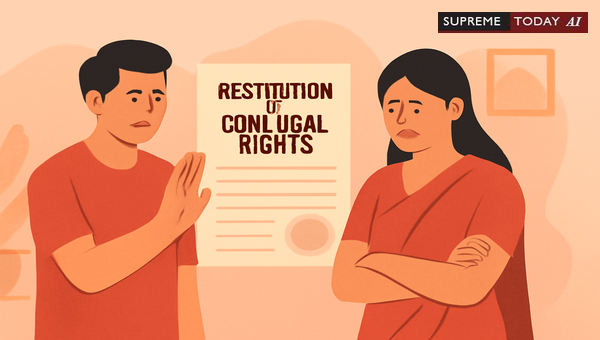
Understanding : Lessons from the Sarita Case
In the realm of family law in India, few remedies stir as much debate as the () under . This provision aims to preserve marriages by directing a spouse who has withdrawn from the other's society without to resume . But what happens when a is issued, yet compliance falters? The query restitution of conjugal right, Sarita points to a pivotal case that sheds light on , willingness to reconcile, and its implications for misconduct or divorce.
This blog delves into the legal nuances, drawing from the Sarita case and related precedents. Note: This is general information based on judicial observations and not specific legal advice. Consult a qualified lawyer for personalized guidance.
What is ?
A for is a judicial order compelling spouses to resume living together, including , to foster reconciliation. As outlined, A for under , is a mutually obligatory aimed at preserving marriage and promoting reconciliation
.
Enforcement mechanisms include or under 2006 0 Supreme(MP) 658. The encompasses sexual , which is an inseparable part of the 2024 5 Supreme 459. However, it's not a tool to force unwilling intimacy but a remedial measure rooted in the inherent right to spousal society 2026 Supreme(Online)(Jhk) 94.
The Sarita Case: Key Facts and Findings
In the documented case of Sarita 2002 0 Supreme(Raj) 571, she filed a petition for , which was granted. Despite the , she did not resume . The court examined her conduct critically: if the wife is willing to live with her husband and there is no for her refusal, then her does not amount to misconduct or misconduct serious enough to bar relief or justify divorce 2002 0 Supreme(Raj) 571.
The ruling emphasized that without reasonable cause or misconduct does not qualify as a wrong under . This protects personal liberty while upholding the 's reconciliatory intent. Sarita's willingness, absent excuses like , meant her actions did not bar other reliefs, such as divorce based on subsequent conduct.
Legal Principles on and Misconduct
with an isn't automatically misconduct. Courts assess context: with a restitution , in the absence of misconduct or reasonable cause, does not necessarily amount to misconduct or a wrong that would bar relief or justify refusal of divorce 1969 0 Supreme(Cal) 225.
Under , divorce may follow if a spouse fails to resume for one year post- without 1984 0 Supreme(SC) 205. Yet, willingness to return shifts the burden: if refusal is unreasonable, it may not equate to 2025 0 Supreme(Jhk) 1343. can be granted if one spouse withdraws from the other's society without ; allegations of must be substantiated with evidence 2025 0 Supreme(Jhk) 1343.
Enforcement Mechanisms and Limitations
Enforcement is procedural, not punitive in a liberty-infringing way. It can be enforced through procedural mechanisms such as or (Order 21, Rules 32 and 33 CPC) 2006 0 Supreme(MP) 658. However, the law recognizes that a for is a remedial measure, not a tool to compel sexual relations against the spouse’s will.
Related cases highlight procedural safeguards. In transfer applications, courts prioritize convenience, often favoring wives in
, stating the court prioritizes the wife’s convenience in matrimonial cases during transfer considerations.
require strict service proof under ; flaws can invalidate them 2022 0 Supreme(Jhk) 953.
Insights from Related Precedents
Other rulings enrich understanding:
via Accusations: A husband's infidelity charges while seeking constituted : The imputation of infidelity by the husband amounted to within the meaning of 1967 0 Supreme(Kar) 20. in matrimonial disputes is not restricted to physical violence and may extend to behavior causing mental pain and injury 1967 0 Supreme(Kar) 20.
Defense: Dismissal of petitions occurs if withdrawal is justified, e.g., ill-treatment: The court affirmed the 's dismissal of the restitution petition, ruling that the respondent had reasonable cause to withdraw from the appellant 2024 0 Supreme(Pat) 751. Evidence must align with pleadings 2024 0 Supreme(Pat) 751.
Positive Remedy Nature: demands : Remedy of is a positive remedy that requires both parties to live together and cohabit
. Yet, concealment of prior marriages or danger justifies refusal
.
Live-in vs. Marriage: Stealthy relations don't qualify for -like reliefs 2016 0 Supreme(Pat) 1683.
These cases underscore that courts scrutinize intent, evidence, and equity.
Exceptions: When Counts as Misconduct
Certain scenarios elevate :- Matrimonial Offenses: Refusal due to or demands bars enforcement and may ground divorce 1984 0 Supreme(SC) 205.- Malicious Conduct: A spouse's conduct amounting to or malicious refusal to comply can be a ground for divorce 2013 0 Supreme(P&H) 1472.- : Petitioners can't benefit from self-inflicted issues 2024 0 Supreme(Pat) 751.
In Sarita's context, no such factors applied, preserving her position.
Practical Recommendations
For parties like Sarita or spouses:- Document Willingness: Record efforts to reconcile; undocumented claims weaken cases 2002 0 Supreme(Raj) 571.- Seek Mediation: Many suits proceed to mediation before decrees 2025 0 Supreme(Jhk) 1343.- Good Faith Approach: Approach in reconciliation spirit, or risk divorce on conduct grounds.- Professional Help: Transfers or procedural queries benefit from legal aid, especially for women
.
Conclusion and Key Takeaways
The Sarita case illustrates that decrees prioritize reconciliation over compulsion. If willing without , typically isn't misconduct, avoiding bars to relief 2002 0 Supreme(Raj) 571. However, , proofs, or procedural lapses can pivot outcomes, as seen in precedents like 1967 0 Supreme(Kar) 20 and 2025 0 Supreme(Jhk) 1343.
Key Takeaways:- enforces via civil remedies, not force.- Willingness trumps mere .- Always substantiate claims with evidence.- Courts balance liberty and marital preservation.
Marital disputes evolve; recent trends question 's constitutionality, but it remains viable. For tailored advice, engage a family law expert.
#RestitutionOfConjugalRights #SaritaCase #FamilyLaw















