


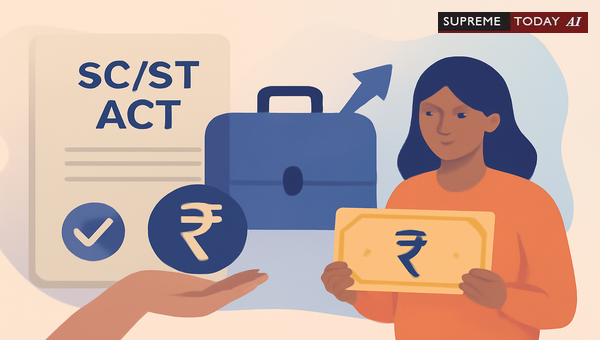
SC/ST Atrocity Act: Travel Reimbursement for Victims
Victims of atrocities under the (commonly known as the SC/ST Atrocity Act) often face significant challenges, including financial burdens from attending court hearings and proceedings. A common question arises: Can reimbursement of travel be made to victims under the SC/ST Atrocity Act? This blog post delves into the legal framework, court directives, and practical steps for victims seeking such support, drawing from judicial precedents and statutory rules.
Understanding your rights as a victim is crucial for accessing the protections intended by this important legislation. While this information is for educational purposes and not specific legal advice, it highlights general principles that may apply in such cases.
Legal Basis for Travel Reimbursement
Courts have explicitly directed authorities to consider made by victims of atrocities, including travel expenses, in line with relevant government orders and rules. In a key ruling, the court held that victims are entitled to seek reimbursement for travel expenses incurred in connection with proceedings or hearings related to atrocities, and authorities are mandated to consider such representations and dispose of them lawfully and within a stipulated timeframe 2020 0 Supreme(Mad) 1260.
This directive underscores the government's obligation to alleviate financial hardships faced by victims during legal processes. Authorities must process these claims promptly, ensuring victims are not deterred from participating due to costs.
Scope of Reimbursement Under the Act
The reimbursement typically covers:- Travel allowances for attending hearings, commissions, or courts related to atrocity cases.- Other incidental expenses as outlined in government orders implementing the SC/ST Atrocity Act 2020 0 Supreme(Mad) 1260.
Victims who submit proper bills or claims are generally eligible, provided the expenses stem directly from case proceedings. For instance, travel to or qualifies, emphasizing the Act's victim-centric approach.
Key Legal Provisions Supporting Reimbursement
The , and subsequent Atrocities Rules establish mechanisms for victims to claim allowances and expenses, explicitly including travel costs 2020 0 Supreme(Ker) 652. These rules aim to provide comprehensive support, ensuring victims can engage in justice processes without economic barriers.
Furthermore, courts have stressed the state's duty to offer legal assistance and support. As noted, the government has a duty to facilitate legal assistance and support, including reimbursement of expenses incurred by victims in connection with their participation in legal proceedings under the Act 2020 0 Supreme(Kar) 959. This aligns with the Act's broader welfare objectives.
Insights from Related Judicial Decisions
While the core issue revolves around reimbursement, related cases under the SC/ST Act provide context on victim protections. For example, in proceedings involving victim compensation schemes, courts have explored additional support mechanisms alongside the Act. One judgment directed parties to consider framing of scheme for the respondent no. 2 under and SC/ST Act 2019 0 Supreme(Jhk) 852, highlighting integrated relief options that may complement travel reimbursements.
In bail and conviction matters, courts scrutinize the establishment of atrocities before restricting rights, as seen where can be granted if no case of caste atrocity is established, despite the restrictions under the SC and ST Act 2024 0 Supreme(AP) 733. Such cases reinforce the Act's focus on genuine victims, who are then entitled to procedural aids like expense reimbursements.
Another decision acquitted appellants under Section 3(2)(v) due to insufficient evidence, stating the charge framed against A1 to A3 under , was held to be not proved 2022 0 Supreme(Mad) 894. This illustrates the evidentiary thresholds but does not detract from established victims' rights to reimbursements in proven cases.
In a unique organ transplantation context, the court quashed SC/ST proceedings, noting no atrocity that is committed in facts of this case does not apply to facts and circumstances of case 2019 0 Supreme(AP) 95, emphasizing precise application of the Act—ensuring resources like travel reimbursements reach true victims.
These precedents collectively affirm that once an atrocity case is underway, victim support mechanisms, including financial reimbursements, must be activated efficiently.
Limitations and Conditions for Claims
Reimbursement is not automatic and subject to certain conditions:- Valid documentation: Victims must submit bills, receipts, and formal representations 2020 0 Supreme(Mad) 1260.- Relevant government orders: Claims depend on specified rules governing allowances 2020 0 Supreme(Mad) 1260.- Timely disposal: Authorities are required to process claims within prescribed periods, but delays can occur, necessitating follow-ups.
Failure to meet these may result in rejection, so meticulous record-keeping is essential. Additionally, reimbursements are typically limited to reasonable expenses as per norms.
Practical Recommendations for Victims
To maximize chances of successful reimbursement:1. Gather evidence: Collect all travel receipts, tickets, and proof of attendance at proceedings.2. Submit promptly: File claims with the , , or designated authority under the Act.3. Seek legal aid: Approach free legal services or NGOs specializing in SC/ST rights for assistance in drafting representations.4. Follow up: If no response within the stipulated time, escalate via court petitions referencing directives like those in 2020 0 Supreme(Mad) 1260.
Victims may also explore broader schemes, such as the , for holistic support 2019 0 Supreme(Jhk) 852.
Conclusion and Key Takeaways
In summary, victims under the SC/ST Atrocity Act are generally entitled to reimbursement of travel expenses incurred for proceedings, backed by court mandates and statutory rules 2020 0 Supreme(Mad) 1260 2020 0 Supreme(Ker) 652. This provision embodies the Act's rehabilitative intent, easing financial burdens on marginalized communities.
Key Takeaways:- Submit documented claims to relevant authorities for consideration.- Authorities must dispose of requests lawfully and timely.- Related cases underscore victim-centric interpretations of the Act.
While these guidelines provide general insights, consult a qualified lawyer for case-specific advice. Empowering victims through accessible justice is at the heart of the SC/ST Atrocity Act—ensuring no one is left behind due to financial constraints.
This post is for informational purposes only and does not constitute legal advice.
#SCSTAct, #VictimRights, #AtrocityAct















