


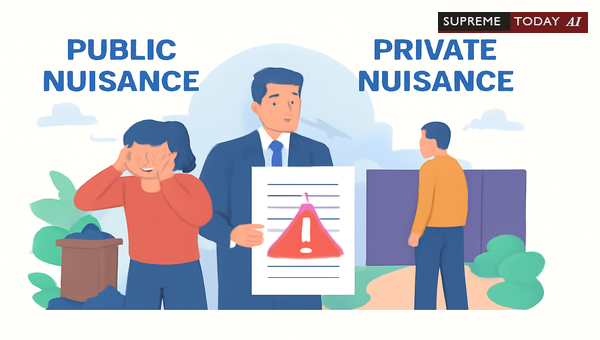
Does CrPC Cover Private Path Nuisances?
In property disputes across India, obstructions on paths often lead to urgent legal actions. A common question arises: Does CrPC encompass on private paths also? Homeowners, landowners, and local residents frequently turn to magistrates for quick relief under this provision of the . However, judicial interpretations consistently draw a clear line between public and private nuisances. This blog post breaks down the legal framework, key case laws, and practical implications to help you understand when applies—and when it doesn't.
Note: This is general information based on established case law and should not be considered specific legal advice. Consult a qualified lawyer for your situation.
Understanding CrPC: The Legal Framework
CrPC empowers executive magistrates to issue for the immediate removal of public nuisances that pose risks to public health, safety, or convenience. It's a designed for urgency, not prolonged litigation.
vs.
- (defined under ): An act causing common , , or to the public or to people in general who dwell or occupy property in the vicinity
11111111111
. targets these, such as obstructions on public roads threatening community safety11111111111
22222222222
. - : Impacts specific individuals or a limited group. Remedies typically involve , not criminal summary actions under CrPC
11111111111
22222222222
.
Courts emphasize that the must affect the public at large for to apply. Private disputes, like blocking a path used by a few families, fall outside its scope
11111111111
22222222222
33333333333
.Judicial Stance: is Not for Private Disputes
have repeatedly quashed proceedings when they mask private grievances. The provision's summary nature suits urgent public threats, not settling or minor inconveniences
11111111111
22222222222
33333333333
.Landmark Case Insights
Here are pivotal judgments reinforcing this principle:- In 1995 0 Supreme(All) 277 , the court ruled proceedings under were not maintainable as the obstruction was a , not public, stressing 's exclusivity to public issues 1995 0 Supreme(All) 277.- 2006 0 Supreme(Cal) 511 clarified a pathway used only by students and teachers lacked status; obstruction was private, making proceedings illegal—civil remedies were advised 2006 0 Supreme(Cal) 511.- reiterated targets public nuisances, excluding private disputes
.- A generator disturbing one individual was deemed private in 1987 0 Supreme(J&K) 37 , unfit for 1987 0 Supreme(J&K) 37.- 2024 0 Supreme(All) 394 held nuisances affecting few (e.g., private student path) don't qualify as public 2024 0 Supreme(All) 394.
Insights from Additional Rulings
Further cases align with this view:- 2025 Supreme(Online)(GAU) 1357 : There is no evidence to suggest that the public was using the path... the dispute between the parties is a private matter. Therefore, of the Cr. P.C. cannot be invoked to settle a private dispute 2025 Supreme(Online)(GAU) 1357.- 2018 0 Supreme(J&K) 657 : No doubt that the provisions of Cr.P.C., cannot be used for settlement of disputes between private parties 2018 0 Supreme(J&K) 657. It protects the public, not individuals.- 2016 0 Supreme(Gau) 875 : Citing precedents, the term 'community' in Cr.P.C. cannot be taken to mean a resident of a particular house or 4/5 houses. A private individual cannot be allowed to use the provision... to remove a purely 2016 0 Supreme(Gau) 875.- 2013 0 Supreme(Gau) 533 : If no , pursue civil remedies under Specific Relief Act or Order 39 2013 0 Supreme(Gau) 533.
These rulings underscore: Mere obstruction of a private path does not trigger unless it endangers public health/safety or affects public rights 2014 0 Supreme(MP) 640.
When Can Apply to Paths?
Exceptions exist if a private issue escalates:- Established: Paths on government land traditionally used by villagers may qualify as public, allowing for obstructions 2025 Supreme(Online)(MP) 9660.- Imminent : Even individual harm over invokes jurisdiction 2014 0 Supreme(MP) 640.- Procedural Safeguards: Orders require evidence, inquiry, and hearing; lack thereof leads to quashing 2025 0 Supreme(Del) 646 2018 0 Supreme(J&K) 657. For instance, a septic tank not on public passage was dropped for no urgency 2025 0 Supreme(Del) 646.
Conversely, long-standing private encroachments or family land disputes demand 2016 0 Supreme(Gau) 875.
Practical Remedies for Private Path Obstructions
If doesn't apply:1. File a Civil Suit: Seek under , or .2. : For public nuisances affecting many, even without special damage.3. Evidence Gathering: Document usage history to prove if contested.
Magistrates must act judiciously, avoiding misuse for private gains
11111111111
22222222222
.Key Takeaways and Conclusion
- CrPC does not encompass private nuisances on private paths; it's reserved for public nuisances affecting the community 1995 0 Supreme(All) 277 2006 0 Supreme(Cal) 511
.
- Private disputes require civil remedies—criminal shortcuts via CrPC are typically quashed.
- Exceptions hinge on proven public rights or urgency2025 Supreme(Online)(MP) 9660 2014 0 Supreme(MP) 640.
- Always verify path status: Private use by few? Go civil. Public access? Consider with proper procedure.
Understanding this distinction prevents wasted efforts and costly reversals. For tailored guidance on path obstructions or nuisances, reach out to a legal expert. Stay informed, and protect your rights the right way.
References
- 1995 0 Supreme(All) 277 2006 0 Supreme(Cal) 511
1987 0 Supreme(J&K) 37 2024 0 Supreme(All) 394
11111111111
22222222222
33333333333
- 2025 0 Supreme(Del) 646 2025 Supreme(Online)(MP) 9660 2025 Supreme(Online)(GAU) 1357 2018 0 Supreme(J&K) 657 2016 0 Supreme(Gau) 875 2014 0 Supreme(MP) 640 2013 0 Supreme(Gau) 533












