




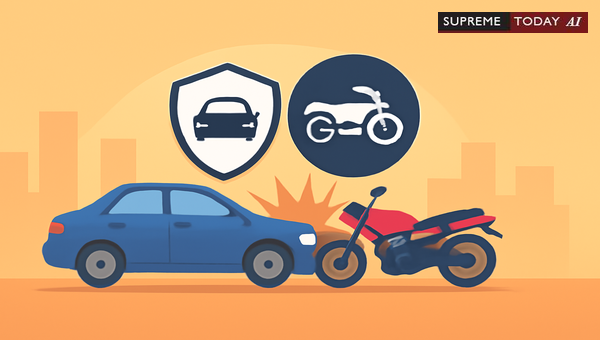
Section 163A MV Act: Does It Apply When a Motorcycle Hits a Car?
Road accidents involving motorcycles and cars are unfortunately common in India, often leaving victims seeking swift compensation without the hassle of proving fault. A frequent question arises: Does (MV Act) apply when a motorcycle hits against a car? This provision offers , providing structured compensation for arising from motor vehicle use. But its applicability hinges on specific factors like and accident circumstances. In this post, we explore the legal nuances, drawing from key judgments and . Note: This is general information, not legal advice—consult a lawyer for your case.
Understanding Section 163A of the MV Act
Introduced as a social security measure, Section 163A allows claims without proving , , or by the owner or driver. It imposes liability on the vehicle owner or insurer based on a in the . The section states it applies when an accident arises out of the use of a motor vehicle, typically benefiting third-party claimants. 2021 0 Supreme(Mad) 140 2010 0 Supreme(SC) 602
Key features include:- No-fault basis: No need to establish negligence. 2021 0 Supreme(Mad) 140- : It supersedes other provisions in qualifying cases. 2010 0 Supreme(SC) 602- Structured payout: Compensation tied to age, income, and injury type. 2010 0 Supreme(SC) 602
This makes it a vital tool for quick relief in motor accidents, including those involving two-wheelers and four-wheelers.
Does Section 163A Apply to Motorcycle Hitting a Car?
Yes, generally, Section 163A can apply even if a motorcycle hits a car, provided the accident arises out of motor vehicle use and the claimant is a third party. The involvement of two vehicles—a motorcycle and a car—does not bar the section, as long as the use of a motor vehicle is established. 2021 0 Supreme(Mad) 140 2010 0 Supreme(SC) 602
For instance, courts have upheld claims where a motorcycle collides with a car, emphasizing that the section covers third-party victims regardless of who hit whom. The focus is on the accident's origin from vehicle operation, not fault allocation. 2021 0 Supreme(Mad) 140 2022 0 Supreme(All) 1707
Essential Conditions for Applicability
To invoke Section 163A:- Third-party claimant: The victim (or heirs) must not be the owner/driver of the involved vehicle. Owners or (those at fault) are typically excluded. 2021 0 Supreme(Mad) 140 2021 0 Supreme(Mad) 260- Arising from use: The accident must stem from motor vehicle usage, not mere presence. 2010 0 Supreme(SC) 602- : Claims limited to these outcomes. 2021 0 Supreme(Mad) 140
If these are met, tribunals award compensation without delving into . 2022 0 Supreme(All) 1707
Insights from Court Decisions
Indian courts have clarified Section 163A's scope in diverse scenarios, including motorcycle-car collisions.
In one case, the affirmed that Section 163A applies to from motor vehicle accidents, overriding fault debates. It stressed no proof of negligence is needed. 2010 0 Supreme(SC) 602 2022 0 Supreme(All) 1707
Another ruling involved a motorcycle hitting a stationary bus, where the insurer argued for negligence proof under Section 163A—rejected, as it mirrors unnecessarily. 2021 Supreme(Online)(MAD) 3746
Consider a -like scenario: An unknown auto hit a motorcycle and fled; the claimant successfully filed under Section 163A without proving negligence, following the . 2020 0 Supreme(Mad) 602
In a multi-vehicle clash, a car hit a motorcycle, which then struck another bike. The court examined third-party status and vehicle use, upholding compensation principles.
Conversely, when only a motorcycle was involved and the owner-rider died due to loss of control, tribunals awarded under via Section 163A, holding insurers liable despite no third party. 2020 0 Supreme(Bom) 936 2020 0 Supreme(Bom) 1344
A pillion rider on a motorcycle hit by a car claimed under Section 163A post-amputation; the court assessed fair compensation, focusing on disability impact. 2015 0 Supreme(J&K) 671
These cases illustrate flexibility: Section 163A often applies in motorcycle-car incidents, but claimant identity is crucial. 2021 0 Supreme(Mad) 140
Exceptions and Limitations
Not every case qualifies:- Owner/driver exclusion: If the claimant is the owner or steps into their shoes (e.g., family claiming for owner-tortfeasor), Section 163A may not apply. 2021 0 Supreme(Mad) 140 2021 0 Supreme(Mad) 260- Non-vehicle use: Pure pedestrian or non-motor incidents don't qualify. 2010 0 Supreme(SC) 602- Procedural issues: Misfiled petitions (e.g., under then converted) may face challenges, though courts prioritize substantive rights.
- specifics: Sometimes treated separately, but can overlap with 163A if vehicle details emerge. 2025 0 Supreme(Telangana) 2028
Insurers may contest, but once under 163A, negligence pleas are limited. 2022 0 Supreme(All) 1707
Practical Recommendations
If involved in a motorcycle-car accident:- Determine status: Third parties should opt for Section 163A for faster payouts.- Gather evidence: FIR, medical records, and witness statements establish vehicle use.- File promptly: Approach ().- Seek conversion if needed: Courts may allow shifting from to 163A.
For owners/drivers, explore or insurance covers. Always verify with documents like policy and license. 2015 0 Supreme(J&K) 671
Key Takeaways
- Section 163A typically applies to motorcycle-car crashes for third-party victims, offering no-fault relief. 2021 0 Supreme(Mad) 140
- Exclusions apply to owners/drivers; focus on accident causation from vehicle use. 2010 0 Supreme(SC) 602
- Courts prioritize victim compensation, as in amputation or death cases. 2015 0 Supreme(J&K) 671
In conclusion, while a motorcycle hitting a car may qualify under Section 163A—especially for third parties—case specifics matter. This provision promotes justice without prolonged litigation, but professional guidance ensures the best outcome. Stay safe on roads, and insure adequately.
References:1. 2021 0 Supreme(Mad) 140: Scope of Section 163A in motor vehicle accidents.2. 2010 0 Supreme(SC) 602: principles.3. 2022 0 Supreme(All) 1707: and negligence irrelevance.4. Additional cases: 2021 Supreme(Online)(MAD) 3746, 2020 0 Supreme(Bom) 936, 2020 0 Supreme(Mad) 602, etc.
Word count approx. 1050. General info only—consult legal experts.
#Section163A, #MVAct, #MotorcycleAccident












