


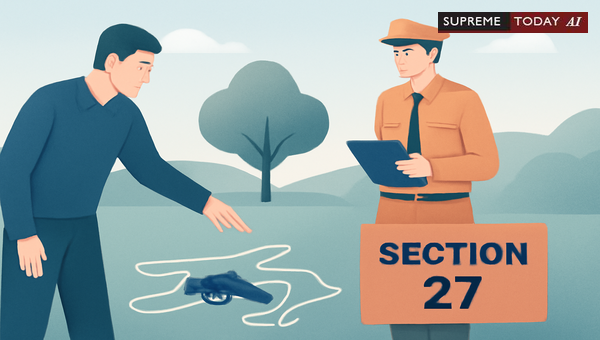
Section 27 Evidence Act: Is Open Space Weapon Recovery Valid?
In , the recovery of weapons or incriminating articles often plays a pivotal role in securing . But what happens when such recoveries occur from open spaces? A common question arises: Section 27 Evidence Act: Open Space Weapon Recovery Valid? This issue frequently surfaces in trials, where courts scrutinize the reliability of evidence to prevent miscarriages of justice. Under , facts discovered in consequence of information provided by the can be , but only under strict conditions.
This blog post delves into the nuances of Section 27, examining when recoveries from open spaces may hold evidentiary value, supported by key judicial precedents. We'll explore conditions for admissibility, limitations, and practical insights for legal practitioners and those navigating criminal proceedings. Note: This is general information and not specific legal advice; consult a qualified lawyer for your case.
Understanding
Section 27 is a proviso to , which generally bars confessions made to police from being . It carves out an exception: Provided that, when any fact is discovered in consequence of information received from a person of any offence, in the , so much of such information, whether it amounts to a or not, as relates distinctly to the fact thereby discovered, may be proved.
The essence is a direct causal link between the 's statement and the discovery. Courts emphasize and integrity to rule out planting or fabrication. Typically, recoveries from concealed, non-public places strengthen admissibility, but open spaces pose challenges due to accessibility.
Applicability of Section 27 to Open Space Recoveries
Recoveries from open spaces can be under Section 27 if they stem directly from the 's information and satisfy safeguards against tampering. The main legal finding is clear: admissibility hinges on the recovery being in consequence of information provided by the , with the place reducing planting risks. 2005 0 Supreme(Gau) 802
Key points include:- Direct Consequence: The 's disclosure must lead to the discovery; mere recovery nearby isn't enough.- Inaccessibility: Even open spaces may qualify if not freely accessible to the public, like secluded areas behind stones or inside wells.- : No coercion, with proper documentation of the statement and recovery process.
In Golakand Venkateshwara Rao, the held that recovery from a concealed place such as inside a well or behind stones is valid if not found from the place where public can have free access. Therefore, there is no reasonable apprehension with the material exhibits being planted. 2014 0 Supreme(SC) 1049
Similarly, reinforced that recoveries following disclosure from non-public places are fortified against planting suspicions. 2005 0 Supreme(Gau) 802
Conditions for Admissibility Under Section 27
Courts outline specific criteria:1. Information from : Must be specific, leading directly to the fact discovered (e.g., weapon location).2. Non-Public Access: The site should minimize public interference. 2014 0 Supreme(SC) 10493. Contemporaneous Recovery: Prompt action post-disclosure to avoid manipulation claims.4. : Supporting evidence like or links, such as blood group matching.
Meticulous documentation is crucial: record the , witness the recovery, and photograph the site.
Landmark Cases Supporting Admissibility
- Golakand Venkateshwara Rao 2014 0 Supreme(SC) 1049: upheld recovery from a non-public concealed spot, stating it reduces reasonable apprehension of planting.
- Nisar Khan 2005 0 Supreme(Gau) 802: Emphasized that non-accessible places post-disclosure make evidence reliable under Section 27.
- Blood-Stained Stones Case
: Recovery from a non-public site with matching blood groups bolstered admissibility.
These rulings illustrate that context matters—even seemingly open areas can qualify if secluded.
Limitations and When Open Space Recoveries Fail
Not all open space recoveries pass muster. Courts often reject them if accessible to the public, raising planting doubts. Contrasting precedents highlight risks:
- In one case, weapons recovered from an open space and therefore accessible for one after a month's delay were deemed unreliable. 2020 0 Supreme(Bom) 1312
- Another judgment noted: Two recoveries of weapons recovered from open place, which is accessible to all and sundry, cannot be said to be a recovery in terms of . 2009 0 Supreme(Guj) 347
- Delayed recoveries without explanation lose connection to the crime: There is no explanation whatsoever for the inordinate delay... these weapons are stated to have been recovered from an open place and therefore, no evidentiary value. 2017 0 Supreme(Kar) 931
Further, if no direct link to the 's disclosure exists, or if solitary lacks , evidence crumbles. 2009 0 Supreme(Guj) 347 In assault cases, open recoveries were scrutinized alongside witness credibility, leading to or based on totality. 2020 0 Supreme(Bom) 922 2020 0 Supreme(Bom) 1312
These examples underscore judicial caution: public accessibility invites skepticism, demanding robust proof of integrity.
Practical Recommendations for Investigations and Trials
To maximize admissibility:- Secure the Site: Choose or identify naturally secluded spots; avoid obvious public areas.- Document Thoroughly: Mahazar () with independent witnesses, video recording where possible.- Link Explicitly: Ensure disclosure pinpoints the exact location.- Backup: Test for blood, fingerprints to corroborate.
Defense counsel should challenge via on access, delays, and planting possibilities. Courts must critically evaluate genuineness. 2005 0 Supreme(Gau) 802
Key Takeaways
- Yes, with Caveats: Open space weapon recoveries may be valid under Section 27 if consequent to 's info and from non-publicly accessible spots. 2014 0 Supreme(SC) 1049
- No for Public Places: Accessible areas risk inadmissibility due to planting fears. 2009 0 Supreme(Guj) 347
- Holistic Scrutiny: Totality of evidence, not isolated recovery, decides cases.
Conclusion
Section 27 balances rights with investigative needs, but open space recoveries demand heightened vigilance. As seen in Golakand and Nisar Khan, inaccessibility fortifies evidence, while cases like 2020 0 Supreme(Bom) 1312 warn against laxity. 2014 0 Supreme(SC) 1049 2005 0 Supreme(Gau) 802 For stakeholders, understanding these principles ensures fair trials. Always seek professional legal counsel tailored to your situation—this overview is for informational purposes only.
References: Judicial documents , 2005 0 Supreme(Gau) 802, 2014 0 Supreme(SC) 1049, 2020 0 Supreme(Bom) 1312, 2009 0 Supreme(Guj) 347, 2017 0 Supreme(Kar) 931, 2020 0 Supreme(Bom) 922.















