


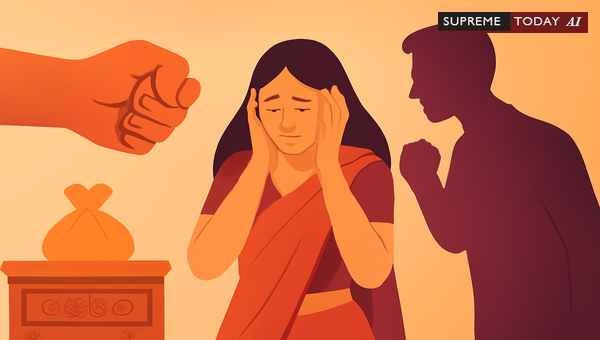
IPC: Dowry Demand Not Necessary if Cruelty is Proven – Latest Judgments
In matrimonial disputes in India, of the Indian Penal Code (IPC) is often invoked to address cruelty against married women. A common misconception persists: that a demand for dowry is mandatory to establish an offence under this section. But what if the latest judgments tell a different story?
Dowry Demand Not Necessary for Offences under if Physical or Mental Cruelty is Established – Latest Judgement. Recent rulings have firmly clarified that proof of physical or mental cruelty alone is sufficient to attract liability under , independent of any dowry demand. This shift broadens the provision's protective scope while emphasizing the need for solid evidence. This blog explores these developments, key interpretations, and practical insights.
Note: This article provides general information based on judicial precedents and is not legal advice. Consult a qualified lawyer for specific cases.
Understanding IPC and the Role of Cruelty
Enacted to safeguard women from domestic cruelty, punishes husbands and relatives for subjecting a woman to cruelty. The Explanation to the section defines cruelty as:- likely to drive the woman to suicide or cause /danger to her life, limb, or health (mental or physical); or- Harassment to coerce her or her relatives to meet for property or valuable security (often linked to dowry).
The main legal finding from recent judgments is clear: dowry demand is not a necessary element. Proof of physical or mental cruelty alone suffices. As highlighted in key rulings, the definition of cruelty includes acts independent of dowry harassment 2024 0 Supreme(SC) 1369 2025 0 Supreme(HP) 698.
's Key Clarifications on Cruelty
The has repeatedly emphasized a of the provision's clauses – meaning cruelty can stand alone without dowry links.
In a pivotal observation, the Court in 2024 0 Supreme(SC) 1369 stated:
The definition of 'harassment' under the Explanation to is specifically outlined in clause (b), independent of the described in clause (a), thus necessitating a separate reading of the two. It is significant to note that the inclusion of the word 'or' at the end of clause (a) clearly indicates that 'cruelty' for the purposes of can either involve that causes mental or physical harm or harassment related to , such as dowry.
This confirms that mental or physical acts of cruelty need not be tied to dowry. Similarly, 2025 0 Supreme(HP) 698 underscores the broader objective:
The broader objective behind its introduction—to safeguard women from all forms of cruelty, regardless of whether the nature of the harm inflicted includes a specific demand for dowry or not.
Acts like verbal abuse, humiliation, threats, deprivation, or physical violence qualify as cruelty, even sans dowry demands 2024 0 Supreme(SC) 1369 2025 0 Supreme(HP) 698. For instance, creating circumstances that drive a woman toward suicide constitutes cruelty independently 2024 0 Supreme(SC) 1369.
Contrasting Earlier Views and Modern Clarifications
Older interpretations sometimes narrowly tied cruelty to dowry, but recent judgments reject this. The Court in 2024 0 Supreme(SC) 1369 explicitly held:
The absence of a dowry-related demand does not negate the applicability of the provision where acts of physical violence and mental distress have been demonstrated.
However, not all cases succeed solely on allegations. Courts demand . In 2023 0 Supreme(Cal) 1170, it's noted that general or vague claims fall short; specific acts must be evidenced.
Insights from Additional Judgments: Balancing Protection and Proof
While the core principle holds, other rulings illustrate practical applications and pitfalls:
Proof Requirements: Prosecution must furnish clear and convincing evidence of specific acts of cruelty. is insufficient; is key 2025 0 Supreme(Ker) 1457. In one appeal, conviction was set aside due to lack of specificity in dowry and cruelty claims, despite initial sentencing 2025 0 Supreme(Ker) 1457.
Acquittal Standards: In dowry harassment cases, insufficient corroboration leads to acquittal. against acquittals is exercised sparingly, only for 2024 0 Supreme(P&H) 1061. The Court reaffirmed a favoring the accused in acquittals 2024 0 Supreme(P&H) 1061.
Distinguishing Assault from Cruelty: Mere physical assault without unlawful demand context may not always suffice under , as cruelty must align with the section's definition 2023 0 Supreme(Cal) 897. Yet, this aligns with the need for contextual proof, not a dowry prerequisite.
Quashing Misuse: Courts invoke inherent powers to quash baseless proceedings motivated by grudges, lacking 2023 0 Supreme(Cal) 897.
Related Offences: For dowry death (), cruelty must link to demands soon before death, unlike standalone 498A 2018 0 Supreme(Del) 3292 2018 0 Supreme(Bom) 49. In one case, 498A conviction held while 304B was overturned due to evidentiary gaps 2018 0 Supreme(Del) 3292.
Evidence Against Specific Accused: Cruelty evidence must pinpoint individuals; distant relatives may be acquitted if uninvolved 2017 0 Supreme(MP) 32.
These cases reinforce that while dowry isn't needed, robust, specific evidence is non-negotiable2023 0 Supreme(Cal) 1170 2025 0 Supreme(Ker) 1457.
Exceptions, Limitations, and Evidentiary Tips
Courts typically require:- Specificity: Details of acts, dates, witnesses – not vague generalizations 2025 0 Supreme(Ker) 1457.- Corroboration: Medical reports for physical cruelty, witness testimonies for mental harassment 2024 0 Supreme(P&H) 1061.- Proximity: Continuous or recent acts strengthen cases.
In 2018 0 Supreme(Bom) 49, evidence showed assaults and ill-treatment leading to grave harm, sufficient for 498A against the husband alone, without dowry proof.
Legal practitioners should prioritize documenting:- Physical violence (injuries, medical records).- Mental torture (threats, isolation, humiliation).- Patterns driving health decline or suicidal tendencies.
Recommendations for Stakeholders
- For Complainants: Gather concrete evidence early; focus on cruelty acts.
- For Accused: Challenge vague claims; highlight lack of proof.
- Practitioners: Leverage disjunctive cruelty readings but prepare for scrutiny 2024 0 Supreme(SC) 1369 2025 0 Supreme(HP) 698.
Key Takeaways
- Dowry demand is not a precondition for ; cruelty alone suffices 2024 0 Supreme(SC) 1369 2025 0 Supreme(HP) 698.
- Cruelty spans physical/mental harm likely causing or suicide.
- Proof is paramount – specific, corroborated evidence wins cases 2025 0 Supreme(Ker) 1457 2023 0 Supreme(Cal) 1170.
- Misuse risks quashing; balance protection with justice 2023 0 Supreme(Cal) 897.
These judgments empower genuine victims while curbing abuse. Stay informed on evolving jurisprudence.
References
- 2024 0 Supreme(SC) 1369: Core clarification on independent cruelty.
- 2025 0 Supreme(HP) 698: Legislative intent beyond dowry.
- 2023 0 Supreme(Cal) 1170: Proof standards.
- 2025 0 Supreme(Ker) 1457, 2024 0 Supreme(P&H) 1061, 2023 0 Supreme(Cal) 897, 2018 0 Supreme(Del) 3292, 2018 0 Supreme(Bom) 49, 2017 0 Supreme(MP) 32: Supporting case insights.















