


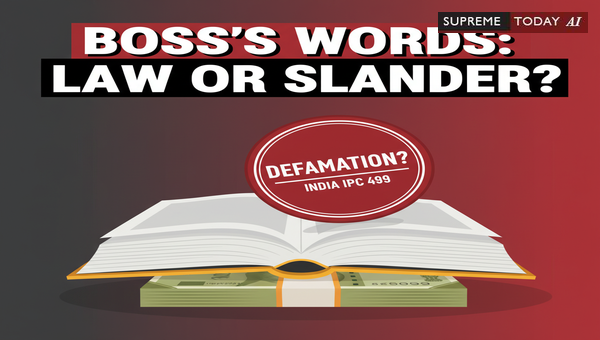
Boss's Statements on Subordinate: Defamation or Protected?
In the workplace, tensions can arise when superiors comment on a subordinate's performance or conduct. But do such statements cross the line into defamation? The question at hand is: of the Ability of his Subordinate does Not Amount to Defamation. This issue hinges on India's defamation laws under and its exceptions, particularly the . This blog post breaks down the legal principles, case laws, and practical applications to help you navigate this nuanced area.
Note: This is general information based on legal precedents and statutes. It is not specific legal advice. Consult a qualified lawyer for your situation.
Understanding Defamation Under Section 499 IPC
Defamation under Section 499 IPC involves making or publishing any imputation concerning a person intending to harm their reputation, expose them to hatred, contempt, or ridicule. However, the IPC provides ten exceptions where certain statements do not constitute defamation. The is central here, protecting communications made in to persons with .
As outlined in legal texts, any censure on the conduct of that other in matters to which such relates.2021 0 Supreme(All) 1014 2019 0 Supreme(Gau) 237 2015 0 Supreme(AP) 925. This directly applies to superiors evaluating subordinates in professional settings.
The : Core Legal Principles
1. Statements to Persons with
The states: an accusation against any person to any of those who have over that person with respect to the subject-matter of accusation.2024 Supreme(Online)(MP) 38640 2021 0 Supreme(All) 1014.
In , the Supreme Court held that accusations made to a person with , such as a Treasury Officer, do not amount to defamation if made in . The court emphasized protection under this exception 2005 0 Supreme(All) 2353. Similarly, accusations made in to a regarding irregularities do not constitute defamation2013 0 Supreme(P&H) 974.
2. Requirement
Protection is not absolute—it requires . Statements must be made with honest intent, reasonable belief in their truth, and without malice. The protection under the is contingent upon the statements being made in . If the statements are found to be malicious or made with the intent to harm, the privilege may not apply.2023 0 Supreme(Ker) 219 2023 0 Supreme(Del) 5759.
Section 499 clearly indicates that it is not a defamation to prefer in an accusation against any person to any of those who have over that person with regard to the subject-matter of accusation.2024 Supreme(Online)(MP) 38640. Courts assess based on context, evidence, and absence of ulterior motives.
3. Scope of
The authority must relate to the subject matter. For instance, a manager reporting a subordinate's performance issues to HR or higher management falls within this, as it pertains to employment duties arising from a lawful contract 2021 0 Supreme(All) 1014. Furthermore, preferring an accusation against any person to any of the persons who have over that person, would not amount to defamation. In one case, a wife accusing her husband to his superior was protected as it was consistent and in 2022 0 Supreme(Cal) 905.
Application to Superiors and Subordinates
In a typical scenario:- A boss emails HR about a subordinate's repeated errors, lack of skills, or misconduct.- If made in , concerning job performance (within the boss's authority), and to the right authority, it's generally protected.
Key factors:- Relevance: Must tie to the subordinate's conduct in matters under the superior's purview 1964 0 Supreme(Pat) 99.- Channel: Directed to the appropriate authority, not broadcast publicly.- Documentation: Backed by evidence to demonstrate .
and Exceptions - Statements made by individuals possessing over another... are generally protected from defamation claims. Exceptions to this include making accusations or imputations in regarding the conduct of the subordinate or in matters related to . These protections are explicitly outlined in ...2023 5 Supreme 571 2023 Supreme(Online)(Cal) 6435 2024 0 Supreme(Cal) 872.
Related exceptions reinforce this:- Ninth Exception: Imputations for public good.- Tenth Exception: Cautions to prevent others from misconduct.
Limitations and Potential Pitfalls
While robust, this defense has boundaries:- Malice Vitiates Protection: Proven ill intent or recklessness negates the exception 2023 0 Supreme(Ker) 219 2024 0 Supreme(Mad) 23.- Lack of Jurisdiction: If the authority lacks oversight on the issue, protection fails 1964 0 Supreme(Pat) 99.- Public Disclosure: Announcing criticisms broadly, like in a village meeting, may not qualify if not to the specific authority 2021 0 Supreme(P&H) 430.
Limitations and Exceptions - While protections exist, the protection does not extend to false accusations made maliciously or without a basis, or when statements are made outside the scope of or .2024 0 Supreme(Mad) 23.
In official contexts, statements concerning conduct related to official duties or lawful contracts, made in , generally do not constitute defamation, but truthfulness and intent matter 2024 Supreme(Online)(Kar) 42699
INMP00000052348
.Key Case Laws and Precedents
- Rajendra Kumar Case: Accusations to Treasury Officer protected 2005 0 Supreme(All) 2353.
- Petitioner Wife Case: Complaint to superior not defamatory 2022 0 Supreme(Cal) 905.
- Broader jurisprudence affirms accusations to authorities are non-defamatory 2024 Supreme(Online)(MP) 38640 2013 0 Supreme(P&H) 974.
Even internationally, similar principles apply, like in Malaysia's Defamation Act recognizing non-malicious statements
.
Practical Tips for Employers and Employees
- For Superiors: Document issues, communicate privately to HR/superiors, focus on facts.
- For Subordinates: Challenge via internal grievance if malicious; defamation suits require proving malice.
- Indicators:
- Objective evidence (emails, reports).
- No personal vendetta.
- Limited audience.
and Public Interest - The law recognizes that accusations or imputations made in , especially when concerning the conduct of a person in authority or for the public good, are protected.2023 Supreme(Online)(Cal) 6435 2024 0 Supreme(Cal) 872.
Conclusion and Key Takeaways
Statements by a person with about a subordinate's ability or conduct typically do not amount to defamation if made in under the to Section 499 IPC. The linchpins are , relevance to duties, and proper channeling to authority. However, malice or extraneous publication can undo this shield.
Key Takeaways:- is paramount—base statements on facts.- Limit to authorized recipients.- Seek legal review for sensitive matters.
Workplace harmony benefits from clear communication within legal bounds. For tailored advice, consult a legal professional.
References (select citations):2023 0 Supreme(Ker) 219 2005 0 Supreme(All) 2353 2013 0 Supreme(P&H) 974 2023 0 Supreme(Del) 5759 1964 0 Supreme(Pat) 99 2024 Supreme(Online)(MP) 38640 2022 0 Supreme(Cal) 905 2021 0 Supreme(All) 1014 2019 0 Supreme(Gau) 237 2015 0 Supreme(AP) 925
#DefamationLaw #IPCSection499 #GoodFaithException















