Searching Case Laws & Precedent on Legal Query..!
Scanned Judgements…!



Searching Case Laws & Precedent on Legal Query..!
Scanned Judgements…!
Secularism as a Fundamental and Basic Feature of the Indian Constitution Multiple sources emphasize that the Supreme Court has consistently recognized secularism as an integral part of the Constitution's basic structure. It is rooted in the Preamble and Articles 25 to 30, which establish India as a secular state without any official religion ["2024 0 Supreme(Chh) 348"] ["2024 8 Supreme 713"] ["2024 0 Supreme(Bom) 109"] ["2022 0 Supreme(Ker) 2"].Analysis and Conclusion: Secularism is not merely a philosophical stance but a constitutional mandate that ensures equal treatment of all religions, forming the bedrock of India's democratic and secular fabric.
Judicial Decisions Affirming Secularism’s Role in Governance and Policy The Supreme Court has declared that decisions violating secular principles, such as certain Cabinet decisions, are challenged on constitutional grounds, asserting that secularism is part of the basic structure ["2024 0 Supreme(Chh) 348"]. The Court has also held that any legislation or government action purportedly violating secularism must be scrutinized for constitutional validity ["2024 8 Supreme 713"].Analysis and Conclusion: Government actions, including policy schemes, are subject to judicial review to ensure they do not breach the secular nature of the state.
Protection and Promotion of Secularism in Political and Social Contexts The Court has reiterated that maintaining secularism is crucial for political parties and organizations, emphasizing the importance of respecting religious diversity and avoiding practices that undermine secular principles ["2022 0 Supreme(Ker) 2"] ["2022 Supreme(Online)(KER) 21223"] ["2023 Supreme(Online)(ALL) 8046"].Analysis and Conclusion: Secularism extends beyond state policy to influence political behavior, party registration, and social discourse, reinforcing its role as a core constitutional value.
Supreme Court's Stance on Violations and Challenges to Secularism Several references indicate that petitions alleging violations of secular principles are often dismissed if they lack substantive legal basis or are deemed frivolous ["2024 0 Supreme(Bom) 109"]. When petitions challenge government actions on secular grounds, the Court tends to stay or withdraw such decisions pending final judgment ["2024 Supreme(Online)(SC) 11262"] ["2024 8 Supreme 206"].Analysis and Conclusion: The Court maintains a cautious approach, emphasizing adherence to constitutional secularism while ensuring that legal challenges are grounded in constitutional principles.
Secularism as a Shield Against Religious Discrimination and for Ensuring Equality The Court has highlighted that secularism requires the state to treat all religious denominations equally and prevent any form of discrimination or favoritism ["2025 Supreme(Online)(Tel) 60525"] ["2025 Supreme(Online)(Tel) 23599"] ["2025 Supreme(Online)(Tel) 33984"].Analysis and Conclusion: Upholding secularism is essential for protecting minority rights and maintaining social harmony.
Overall Summary:In 2024, the Supreme Court reaffirmed that secularism remains a core component of India's constitutional framework, integral to its basic structure. The Court has consistently held that government actions, policies, and political organizations must adhere to secular principles, ensuring equality and non-discrimination among religious groups. Violations are scrutinized and often challenged in courts to uphold the constitutional mandate of secularism, which continues to be a guiding principle for safeguarding democracy and diversity in India.
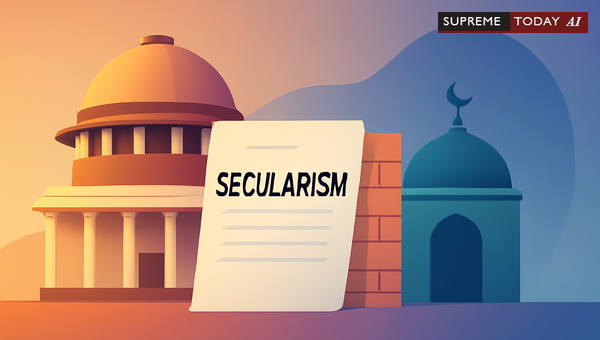
In India's diverse society, secularism stands as a cornerstone of constitutional democracy, ensuring the state remains neutral towards all religions. The question on everyone's mind: Secularism Judgement by Supreme Court – what does it reveal about this enduring principle? While specific judgments build on established precedents, the Supreme Court's consistent jurisprudence reaffirms secularism's role in upholding equality and preventing . This blog delves into the legal analysis, drawing from landmark cases and recent developments to provide clarity on how secularism shapes contemporary judicial decisions.
The has long recognized secularism as a fundamental feature of the Constitution, integral to its 2004 0 Supreme(AP) 87 2024 8 Supreme 713 2024 Supreme(Online)(SC) 12214. Unlike Western models of strict church-state separation, Indian secularism emphasizes the state's obligation to treat all religions equally, offering neither support nor discrimination. This reflects India's unique pluralistic ethos 2024 8 Supreme 713 2024 0 Supreme(All) 319.
Secularism is not a mere philosophical ideal but a derived from (equality) and 25-30 (religious freedoms). It evolved through the nation's history, ensuring laws and policies foster harmony in a multi-religious landscape 2004 0 Supreme(AP) 87.
In this pivotal case, a nine-judge bench explicitly declared secularism part of the Constitution's , prohibiting a or 2004 0 Supreme(AP) 87. The Court stated that secularism is a , underscoring that misuse of () on religious grounds would violate this principle.
Reaffirming Bommai, the nine-judge bench described Indian secularism as a broad concept emphasizing equality of faiths and non-support for any religion by the State2024 8 Supreme 713 2024 Supreme(Online)(SC) 12214. This ruling solidified secularism's unamendable status.
These precedents form the bedrock, guiding interpretations where religious issues intersect with state action.
While the documents do not detail a singular Secularism Judgement, recent rulings illustrate its application. For instance, in a case involving alleged religious provocations, the court invoked secularism to justify investigations under (). The petitioner's self-proclamation as a religious figure was seen as potentially outraging , emphasizing the constitutional obligation to respect all religions and foster harmony 2023 0 Supreme(P&H) 409. The court noted adherence to Sikh principles, recognizing only Guru Granth Sahib as the living Guru, highlighting caution in matters of community sentiments.
In another -related observation, a judgment referenced: Secularism has now been held to be a part of the of the Constitution. This Country has survived for more than 75 years in spite of being diverse in terms of religion, languages, regional practices, etc.2024 0 Supreme(Mad) 2594. Here, while quashing proceedings for lack of intent under , the court stressed zero tolerance for disrupting harmony, aligning with secular principles.
A poignant affirmation came in a Waqf dispute: We have accepted the goal of ‘secularism’ not only because it is our historical legacy and a need of our national unity and integrity but also as a creed of universal brotherhood and humanism. This is what is the essence of ‘secularism’, as enshrined in our Constitution.2017 0 Supreme(All) 2187. The court ordered removal of an unauthorized mosque on land, rejecting waqf claims and , as the state must uphold without .
These cases demonstrate secularism's practical enforcement:- Religious Claims vs. State Property: Unauthorized religious structures cannot persist on public land 2017 0 Supreme(All) 2187.- Speech and Sentiments: Provocative statements risking disharmony face scrutiny, but require proven intent 2024 0 Supreme(Mad) 2594 2023 0 Supreme(P&H) 409.- Broader Implications: Links to laws like retirement benefits, ensuring no religious discrimination .
Even in non-secularism centric cases, like child custody emphasizing welfare over parental conflicts 2025 0 Supreme(Del) 301, or criminal appeals stressing evidence consistency 2024 0 Supreme(All) 1369, the underlying pluralistic fabric echoes secular values.
Any judgment would likely reinforce secularism as a core , guiding 2004 0 Supreme(AP) 87 2024 Supreme(Online)(SC) 12214. It underpins India's , ensuring laws promote equality across religious groups 2024 Supreme(Online)(SC) 12214 2024 0 Supreme(All) 319.
Key implications include:- Policy and Legislation: Governments must avoid favoring any faith.- Judicial Review: Challenges to religiously discriminatory laws invoke doctrine.- Communal Harmony: Courts prioritize preventing outrage while protecting free speech within limits.
In Waqf matters, secularism prevents property grabs under religious guise 2017 0 Supreme(All) 2187. For litigants, precedents like Bommai remain vital.
The Supreme Court's jurisprudence unequivocally positions secularism as an unassailable pillar of the Indian Constitution. While cases apply these principles contextually – from IPC probes to property disputes – the message is clear: equality of religions is non-negotiable.
Key Takeaways:- Secularism is part of the 2004 0 Supreme(AP) 87.- State neutrality ensures of faiths 2024 8 Supreme 713.- Recent rulings combat encroachments and provocations upholding harmony 2017 0 Supreme(All) 2187 2023 0 Supreme(P&H) 409.- Rely on Bommai and Property Owners for arguments.
This analysis is for informational purposes only and does not constitute legal advice. Consult a qualified lawyer for specific cases. Legal interpretations may vary based on facts.
Stay informed on evolving jurisprudence – secularism continues to safeguard India's unity in diversity.
#Secularism2024, #SupremeCourtIndia, #BasicStructure


He relies on a decision of the Supreme Court in Villianur Iyarkkai Padukappu Maiyam v. Union of India & Others {(2009) 7 SCC 561}. 12. Mr. D.K. ... The decision relied on by the learned counsel for the petitioner on the judgment rendered by the Supreme Court in The Commissioner, Hindu Religious Endowments, Madras (supra) and the High Court of Andhra Pradesh in Satish Agrawal (supra) are distinguishable on facts. ... Further, the Supreme Court in Villianur Iyarkkai Pad....

Union of India, (1994) 6 SCC 360 this Court elaborated that the expression secularism in the Indian context is a term of the widest possible scope. ... Miscellaneous Application No. 835 of 2024 1. The Miscellaneous Application is allowed. The Registry is directed to register the Writ Petition (Civil) Diary No. 14904 of 2024. 2. ... Union of India, (1994) Supp (1) SCC 324 the Court elucidated that although the term ‘secular’ was not present in the Constitution before its insertion in the Preamble by t....

Our attention was drawn to the orders passed by the Supreme Court in the case of K. K. Ranesh Vs. ... In such context, we may refer to the decision of the Supreme Court in Dattaraj Nathuji Thaware Vs. ... If this is the understanding of law of these petitioners, in making such statements on the decision of the Supreme Court, as described in paragraph 21 of the petition, to be “startling” and more particularly, with a further overtone of a motive being attributed to the decision of the ....

The Hon'ble Supreme Court in Neeharika Infrastructure Pvt. Ltd. ... Learned Senior Counsel made reference to judgments of Hon'ble Supreme Court in Pritam Dass Mahant Versus Shiromani Gurudwara Prabhandhak Committee, (1984) 2 Supreme Court Cases 600 and also in Shiromoni Gurdwara Prabandhak Committee, Amritsar Versus Som Nath Dass and others, (2000) 4 Supreme Court Cases ... Secularism p.18. ... Learned Senior Counsel also referred t....

in Crl.O.P.No. 5859 of 2022 etc., dated 29.08.2023 and Crl.O.P (MD) No.19526 of 2024 dated 14.11.2024. ... Secularism has now been held to be a part of the basic structure of the Constitution. This Country has survived for more than 75 years in spite of being diverse in terms of religion, languages, regional practices, etc. ... This Court by relying upon the judgment of the Apex Court has repeatedly held that the process of taking cognizance is a judicial process which requires application of mind. ... ....

Special leave petitions were instituted by the appellant(s) before this Court assailing the correctness of the Impugned Judgement. On 5 April 2024, this Court heard the counsel for the various parties and issued notice on the lead petition. ... Hence, in a challenge to the validity of a statute for violation of the principle of secularism, it must be shown that the statute violates provisions of the Constitution pertaining to secularism. 67 Supreme Court#HL_....

No. 43/52-3-3034-2099/4/2024]. 31. Special leave petitions were instituted by the appellant(s) before this Court assailing the correctness of the Impugned Judgement. ... On 5 April 2024, this Court heard the counsel for the various parties and issued notice on the lead petition. While staying the implementation of the Impugned Judgement, this Court recorded the brief reasons for issuing the interim direction. ... Justice Lokur followed the view of the majority in the ....

Petitioners rely upon the Hon’ble Supreme Court judgment in S.R. Bommai’s case (supra), where secularism was recognised as a basic feature, and where the State is required to treat all religious denominations equally. ... The Government has intentionally not obeyed the order in Writ Petition No. 4610 of 2024 and has also disobeyed the order of the Hon’ble Supreme Court. 3.1. ... Petitioner filed reply stating that Respondent No.2 appeared before the Hon’ble Supreme #H....

Petitioners rely upon the Hon’ble Supreme Court judgment in S.R. Bommai’s case (supra), where secularism was recognised as a basic feature, and where the State is required to treat all religious denominations equally. ... The Government has intentionally not obeyed the order in Writ Petition No. 4610 of 2024 and has also disobeyed the order of the Hon’ble Supreme Court. 3.1. ... Petitioner filed reply stating that Respondent No.2 appeared before the Hon’ble Supreme #H....

Petitioners rely upon the Hon’ble Supreme Court judgment in S.R. Bommai’s case (supra), where secularism was recognised as a basic feature, and where the State is required to treat all religious denominations equally. ... The Government has intentionally not obeyed the order in Writ Petition No. 4610 of 2024 and has also disobeyed the order of the Hon’ble Supreme Court. 3.1. ... Petitioner filed reply stating that Respondent No.2 appeared before the Hon’ble Supreme #H....

12. Mr. Neeraj Gupta, learned Senior Counsel, appearing for the defendant has contended that the ACL had blocked/stopped the trucks of plaintiffs on 28.08.2023 i.e. before the filing of the suits and accordingly the ACL had raised an argument before this Court that the suit and application for injunction simpliciter were not maintainable without seeking the relief of declaration and mandatory injunction, but this Court had not considered such plea. 10. Thereafter, the ACL sought intervention of this Court invoking jurisdiction under Article 227 of the Constitution of India. The petitions, so....

24. Following the said judgement, this Court in the case of M/s Shiv Trading Vs. State of UP and others ( Writ Tax No. 1421 of 2022 ) decided on 28.11.2023 has held that onus to prove and establish beyond doubt the actual transaction, physical movement of the goods as well as genuineness of transaction is required. 26. In the case in hand, the petitioner was duty bound to establish beyond doubt the actual physical movement of the goods from West Bengal / Assam to Delhi via Kanpur but the petitioner has failed to do so, therefore, accompanying tax invoices and other documents cannot said to ....

3. In terms of the said judgement dated 11th December, 2024, specific arrangement was made for the visitation of the child with the father. In addition, the parties were to appear before the ld. Mediator on 16th December, 2024 to explore mediation. In the meantime, the judgment dated 11th December, 2024 was challenged by the wife/Respondent No. 2 before the Supreme Court and the Supreme Court vide order dated 20th December, 2024 in SLA Crl. No 18175/2024 issued the following directions: “1. Heard Ms. Divya Upadhyay, learned counsel appearing for the petitioner (wife). Also ....

26. Hon’ble Supreme Court in a recent judgement of Darshan Singh vs. State of Punjab, (2024) 1 SCR 248, dated 4.1.2024 observed in paragraph No.26 as under:- “26. If the PWs had failed to mention in their statements u/s 161 CrPC about the involvement of an accused, their subsequent statement before court during trial regarding involvement of that particular accused cannot be relied upon. Prosecution cannot seek to prove a fact during trial through a witness which such witness had not stated to police during investigation. The evidence of that witness regarding the said impr....

To it, all are equal and all are entitled to be treated equally. Calling a Masjid as “Masjid High Court” itself, in our opinion, is wrong, apart from the fact that it cannot stand or be allowed to continue to stand on its property any more. We have accepted the goal of ‘secularism’ not only because it is our historical legacy and a need of our national unity and integrity but also as a creed of universal brotherhood and humanism. This is what is the essence of ‘secularism’, as enshrined in our Constitution.


An indispensable Tool for Legal Professionals, Endorsed by Various High Court and Judicial Officers
Please visit our Training & Support
Center or Contact Us for assistance

Scan Me!
India’s Legal research and Law Firm App, Download now!


For Daily Legal Updates, Join us on :



 Back to top


