


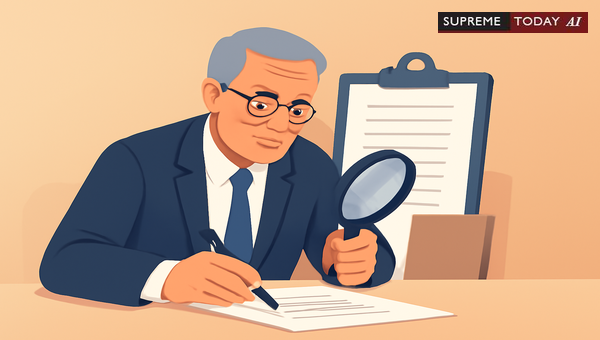
Senior Officer's Duty to Verify Drafts Before Signing in India
In the fast-paced world of corporate and governmental administration, senior officers often handle a deluge of documents under tight deadlines. But what happens when a hasty signature on an unverified draft leads to legal trouble? The question arises: What is the responsibility of a senior officer who failed to verify a draft before signing it?
This issue is particularly pertinent in the Indian legal context, where courts emphasize accountability at higher levels of management. Failing to exercise can expose officers to charges of , , or even . This blog post delves into the judicial stance, key principles, exceptions, and real-world implications, drawing from established precedents to provide clarity.
The Core Duty of Verification for Senior Officers
have consistently underscored that senior officers, especially in managerial or administrative roles, bear a heightened obligation to scrutinize documents before affixing their signatures. This stems from the expectation of and .
- Duty to Verify: Senior officers must verify documents and instruments before signing, irrespective of workload. Courts have ruled that mechanical signing without checks amounts to . 2020 0 Supreme(Guj) 120
- : Affixing a signature to a draft sanction order without proper review signals a lack of diligence. This has been deemed a serious lapse in multiple judgments. 2020 0 Supreme(Bom) 531
- Active Role in : When failure to verify involves financial irregularities or fraud, it may be interpreted as complicity. For instance, overlooking bogus claims can implicate the officer actively. 2020 0 Supreme(Cal) 285
These principles ensure that authority comes with responsibility, preventing systemic errors or abuses.
Strict Standards in Specific Contexts
Certain proceedings demand even stricter adherence. In election matters, for example, falls short; is mandatory, amplifying the verification imperative. 1985 0 Supreme(SC) 198
Judicial scrutiny intensifies in high-stakes areas like public administration. Consider cases involving financial instruments: In one instance, a senior clerk accused of handling bogus bills was acquitted because the prosecution failed to prove custodianship or preparation of fraudulent documents. However, this highlights the baseline expectation—officers in control must verify to avoid such risks. 2015 0 Supreme(Bom) 2466
Exceptions and Mitigating Factors
While the duty is stringent, courts recognize limited exceptions:
- Unavoidable Circumstances: Officers may be excused if genuine, unavoidable reasons preclude verification, such as emergencies documented clearly.
- Statutory Specifics: Laws like the , outline particular verification protocols, which must be followed. 1960 0 Supreme(SC) 37
In practice, these exceptions are narrowly construed. For example, in a concerning service matters, the court emphasized that reviewing officers must verify reporting officers' remarks independently, especially if unfamiliar with the work. In case Reviewing Officer is not sufficiently familiar with the work of the person reported upon... it is responsibility of the Reviewing Officer to verify the correctness of the remarks of the Reporting Officer. 2017 0 Supreme(Raj) 770
Insights from Landmark Cases
Several judgments illustrate the perils of lax verification:
- In _Delhi_WP(C)-5191_, discrepancies between a draft action plan and notified SOP were highlighted, placing enormous responsibility on the petitioner due to unverified changes in Extended Producers Responsibility guidelines. CEMENT MANUFACTURERS ASSOCIATION & ORS. vs UNION OF INDIA THROUGH SECRETARY MINISTRY OF ENVIRONMENT FORESTS CLIMATE CHANGE & ANR.-5191_)
- _Delhi_WP(C)-5235_ involved failed uploads of responses to draft assessment orders, where senior counsel argued technical issues, but the core issue remained timely verification. -5235_)
- A notable fraud case saw an officer passing a forged draft worth Rs. 92,000, leading to criminal charges under . The court upheld dismissal, stressing integrity in handling drafts. 2013 0 Supreme(Jhk) 933
Conversely, acquittals occur when proof falters. In a corruption case under , the accused senior clerk escaped conviction as prosecutors couldn't establish document custodianship or bogus bill creation. This underscores that while duty exists, liability requires evidence. 2015 0 Supreme(Bom) 2466
Another service dispute reinforced procedural fairness: Adverse integrity remarks must be based on cogent material, not rumors, and conveyed promptly. In case any adverse remark is to be recorded... it must precede a clear intimation in advance. 2017 0 Supreme(Raj) 770
In _Delhi_WP(C)-6318_, charges against a petitioner failed because prevailing circulars imposed no verification duty on cover notes. The administrative circulars which prevailed laid no duty or responsibility upon the petitioner to verify the cover notes. DEVENDER MALHOTRA vs & OTHERS-6318_)
These cases from and other tribunals reveal a pattern: Courts intervene when verification lapses cause harm but protect where duties are ambiguous.
Broader Implications for Organizations and Officers
For businesses and public bodies, this duty promotes robust internal controls. Senior officers should:1. Implement checklists for document review.2. Delegate verification with oversight.3. Document any unavoidable signing rationales.4. Train on statutory nuances.
Failure can trigger departmental inquiries, even alongside criminal probes. As seen in a dismissal, The employer has the right to take disciplinary action against an employee for serious , even if parallel criminal proceedings are initiated. 2013 0 Supreme(Jhk) 933
In misappropriation disputes, tribunals quashing awards for ignoring evidence further highlight verification's role in fair proceedings. 2013 0 Supreme(Mad) 3545
Key Takeaways and Best Practices
Generally, hold senior officers to a high standard of verification before signing drafts, viewing lapses as indicative of or worse. While exceptions exist for unavoidable reasons or specific statutes, they are rare.
Key Takeaways:- Always apply your mind—signing blindly invites liability. 2020 0 Supreme(Bom) 531- Verify financial or sanction documents meticulously. 2020 0 Supreme(Guj) 120- In elections or statutory compliance, precision is non-negotiable. 1985 0 Supreme(SC) 198
This overview is for informational purposes only and does not constitute legal advice. Senior officers facing such issues should consult qualified legal professionals tailored to their circumstances.
By prioritizing , officers safeguard their careers and organizations' integrity. Stay vigilant— a signature is more than ink; it's a legal commitment.
#SeniorOfficerDuty, #DocumentVerification, #LegalDueDiligence












