Searching Case Laws & Precedent on Legal Query!
Scanned Judgements…!



Searching Case Laws & Precedent on Legal Query!
Scanned Judgements…!
Video of Arms on Social Media Not Sufficient for Conviction - The investigation agencies did not collect or verify the alleged video or the Facebook ID linked to the social media post. The alleged sword used was not classified as a prohibited arm under Section 2(i) of the Arms Act, and merely sharing a video of celebrating a birthday with a sword does not attract Arms Act provisions. The prosecution failed to provide concrete proof connecting the social media content to the accused or establishing the weapon as prohibited. ["2025 Supreme(Online)(Mad) 32528"], ["2025 Supreme(Online)(MAD) 8024"], ["DR. P.V.VARAVARA RAO vs STATE OF MAH. THR. THE SDPOAHERI ETAPALLI PS DIST.GADCHIROLI - Bombay"], ["2024 Supreme(Online)(CHH) 11102"], ["2025 0 Supreme(Raj) 1466"]
Social Media Content and Legal Implications - While social media posts can provide insights into potential behavior or future violence, the legal framework, such as the CCIA and related provisions, does not require access to non-public or restricted social media content unless legally permitted. The character of social media posts varies significantly from traditional media, and mere posting does not automatically imply criminal intent or violation of arms laws. ["2024 Supreme(US)(ca2) 31"], ["2023 Supreme(US)(ca2) 13"], ["DR. P.V.VARAVARA RAO vs STATE OF MAH. THR. THE SDPOAHERI ETAPALLI PS DIST.GADCHIROLI - Bombay"], Jaclyn Schildkraut
Circulation of Firearm-Related Videos and Evidence - Videos showing individuals firing in social media, such as during parties, have been circulated. Such content may indicate potential violations, but the actual legal charges depend on verified evidence, weapon classification, and intent. In some cases, videos of firing in the air have been considered during investigations, but the legal outcome hinges on proof of prohibited arms and intent. ["DR. P.V.VARAVARA RAO vs STATE OF MAH. THR. THE SDPOAHERI ETAPALLI PS DIST.GADCHIROLI - Bombay"], ["2024 Supreme(Online)(CHH) 11102"]
Legal Classification of Arms and Evidence - The courts emphasize that possession of firearms or weapons must be supported by concrete evidence to fall under prohibited arms categories. Simply possessing or displaying arms without proof that they are prohibited or without proper licensing does not constitute an offense under the Arms Act. The recovery of ammunition alone does not suffice to classify an arm as prohibited unless supported by clear legal classification. ["2025 0 Supreme(Raj) 1466"]
Analysis and Conclusion:Merely circulating or posting videos of arms on social media, including those showing weapons or firing, is not sufficient to establish an offense under the Arms Act without concrete evidence linking the content to prohibited arms or criminal intent. The courts highlight the importance of verifying weapon classification, ownership, and the authenticity of social media content before proceeding with legal action. The absence of verified proof and proper investigation, especially regarding social media evidence, weakens the case against individuals based solely on viral videos.
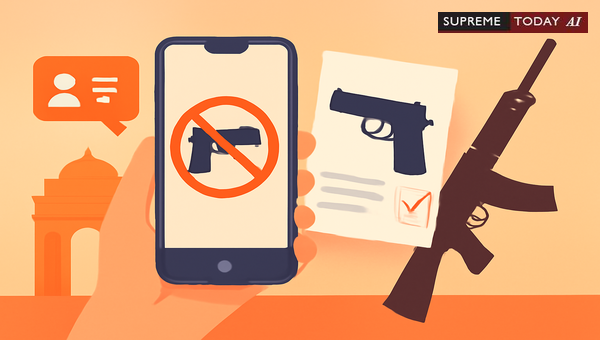
In today's digital age, social media platforms are treasure troves of evidence in criminal investigations. A viral video showing someone flaunting arms or firing guns often leads to swift police action under the . But is a mere video of arms on social media sufficient to establish a violation under the Arms Act? This question, Video of Arms in Social Media Not Sufficient to Establish Arms Act, highlights a critical evidentiary challenge in Indian courts.
While social media posts can raise red flags, courts typically require more than digital glimpses to secure convictions. This blog post delves into the legal framework, judicial precedents, and practical hurdles, drawing from key case law and legislative insights. Note: This is general information and not specific legal advice; consult a qualified lawyer for your situation.
The has repeatedly flagged the dangers of unlicensed firearms, linking them to grave crimes like murder under . In proceedings, the Court noted the widespread use of unlicensed firearms in criminal activities and stressed that India, unlike the U.S., does not recognize a fundamental right to bear arms 2024 0 Supreme(SC) 1063. Directions were issued to governments for affidavits on case numbers and enforcement steps 2024 0 Supreme(SC) 1063.
This context underscores why social media videos spark investigations—but also why they fall short alone.
The , read with , regulates firearms strictly. It categorizes arms into groups, with prohibited categories (III and IV) like smuggled or unlicensed ones posing major risks 2024 0 Supreme(SC) 1063.
Key provisions include:- Penalties: The 2019 Amendment introduced life imprisonment for illegal manufacture, sale, or possession 2018 0 Supreme(Pat) 250.- Trafficking and Use: Criminalizes illicit trade, organized crime, and , mandating electronic licensing and traceability 2018 0 Supreme(Pat) 250.- Enforcement: States handle primary duties, with central support from agencies like 2018 0 Supreme(Pat) 250.
To prove violations like (possession) or 27 (use), prosecution must show —physical or constructive (power/control) 2021 0 Supreme(Gau) 723. Mere visibility on social media doesn't equate to this.
Indian courts accept , including social media videos, photos, and posts, but with caveats. Admissibility requires:- Authentication: and forensic verification to rule out tampering.- Corroboration: Must pair with physical recovery, eyewitnesses, or 2024 0 Supreme(SC) 1063.
The Supreme Court in laid principles for , extended to digital formats. Social media can prove intent or conspiracy if authenticated 2024 0 Supreme(SC) 1063.
Several cases illustrate that videos alone aren't enough.
In , social media posts showing firearm use were admitted but supported conviction with other evidence. Similarly, hypothetical probes used chats for trafficking links, but physical traces sealed cases 2024 0 Supreme(SC) 1063.
From : Petitioners faced charges after a video circulated in social media, in which, the petitioners along with others were shown firing in a party
. arguments noted valid licenses, but court observed apparent air-firing, yet emphasized investigation beyond video.
In : A case under Sections 25, 27 Arms Act involved social media, but tied to broader atrocities 2024 Supreme(Online)(CG) 1834. Courts acquitted where proof fell short: If two views are possible... view favorable to accused is to be accepted 2021 0 Supreme(Gau) 723.
restricted undertrials from social media communication in arms-related cases, signaling its evidentiary weight but not standalone proof
.
Challenges include:- Authenticity: Tampering risks.- Privacy: Proper seizure needed.- Expertise: Forensic gaps 2018 0 Supreme(SC) 961.
Courts advocate surveillance: State shall take steps to establish sufficient number of forensic labs to verify the authenticity of social media content 2018 0 Supreme(SC) 961. Post-2019, digital tools bolster Arms Act enforcement, but require protocols.
Recommendations:- Standardize social media evidence protocols.- Train on digital .- Balance privacy with probes.
In sum, while social media arms videos aren't enough standalone, they remain pivotal when backed properly. Stay informed, post responsibly, and seek legal counsel for specifics.
References:- Supreme Court orders on unlicensed firearms 2024 0 Supreme(SC) 1063.- Arms Act amendments 2018 0 Supreme(Pat) 250.- High Court cases on social media evidence
2024 Supreme(Online)(CG) 1834 2021 0 Supreme(Gau) 723 2018 0 Supreme(SC) 961. #ArmsActIndia, #SocialMediaEvidence, #FirearmsLaw


The investigation agency has not collected the alleged video and without collecting the video which is base for the alleged commission of offence the respondent police have filed final report. More over the alleged sword is not a prohibited arm as per Section2(i) of Arms Act. ... Infact the Arms Act would not attract and the petitione....

The investigation agency has not collected the alleged video and without collecting the video which is base for the alleged commission of offence the respondent police have filed final report. More over the alleged sword is not a prohibited arm as per Section2(i) of Arms Act. ... Infact the Arms Act would not attract and the petitione....

i.e. print media, electronic media, etc. ... including social media. ... The undertrial shall not try to establish communication with co-accused or any other person Bombay Police Act and Sections 16, 18, 20 & 23 of 135 of the Bombay Police Act and Sections 16, 18, p style="position:absolute;white-space:pre;margin:0;padding:0;top

But the CCIA’s social media requirement does not bear upon the aspects of social media that are new. While social media writ large may have no historical analogue, social media handles do. ... The CCIA does not permit a licensing officer to see . . . restricted social-media accounts.....
But the CCIA’s social media requirement does not bear upon the aspects of social media that are new. While social media writ large may have no historical analogue, social media handles do. ... The CCIA does not permit a licensing officer to see . . . restricted social-media accounts.....
But the CCIA’s social media requirement does not bear upon the aspects of social media that are new. While social media writ large may have no historical analogue, social media handles do. ... The CCIA does not permit a licensing officer to see . . . restricted social-media accoun....

was circulated in social media and in which, the petitioners along with others were shown as firing. ... circulated in social media, in which, the petitioners along with others were shown firing in a party. ... It is submitted that the petitioners have got bonafide and valid Learned counsel appearing for the State has opposed the prayer for bail and has It appears that the petitioners had made firing in the Air ....

and 27 of Arms Act and Sections 147 , 148 and 149 of Indian Penal Code , 1860. ... On the basis of the report the concerning police has registered the FIR for the offence section 25, 27 of Arms Act and 147,148,149 of IPC against the applicant and after investigation the charge-sheet has been filed before the trial Court. ... Let the applicant - Karan Chauhan, involved in Crime No. 366/2024 registered at Police Station : ....

Act, Sections 25, 27 of the Arms Act and 3(2) (XII) of S.C. / S.T. ... media. ... Act, Sections 25, 27 of the Arms Act and 3(2) (XII) of S.C. / S.T. (Prevention of Atrocities) Act, 1989. ... Thereafter, the present applicant by threatening her committed sexual intercourse with the victim and made video and send the video#HL_....

The prosecution has not produced any other evidence to establish that the article falls under the definition of a prohibited arm. 5.4 Section 2(1)(i) of the Arms Act, 1959 defines prohibited arms. ... There are provisions for other categories of arms defined under the Arms Act, for which punishment may be imposed under Section 3 of the Act#HL....

In support of his submission, the learned counsel relies upon the following authorities: (1) Adhiraj Singh Yadav vs. State, W.P (Crl) No. 754/2020, dated 31.12.2020 7. The learned counsel submits that in order to establish a case under the Arms Act, mere possession of the arms and ammunition is not sufficient and that the possession has to be conscious possession which may either be physical possession or constructive possession i.e. having power and control over the arms and ammunit....

Almost all media houses used the word "committed suicide", when it should be "died by suicide". The petitioner contends that implementation of the objectives of the Mental Health Act, 2017 is lacking in totality, when it recognizes suicide as a mental illness. 6. Use photographs, video footage or social media links." (b).

After that, the video is uploaded in social media with the heading "Body Art and Politics." This video was shot by the petitioner and uploaded in social media. According to the petitioner, she is teaching sex education to her children by uploading the video! I make this observation only for the purpose of deciding this Bail Application. I can understand if the mother is doing these activities inside the four walls of her house. Prima facie, I am of the opini....

Even otherwise, provisions of Arms Act specially Section 17 of Arms Act give sufficient discretion to the authority in respect of revocation of arms licence. Subjective satisfaction of the authority cannot be looked into writ jurisdiction. Therefore, contentions raised by the petitioner are misplaced. Even otherwise, if the dispute between the parties has resolved through settlement then also it appears that petitioner does not have any apprehension of retaliation from the ot....

State shall take steps to establish sufficient number of forensic labs to verify the authenticity of social media content and audio/video content which may be in issue in such cases.


An indispensable Tool for Legal Professionals, Endorsed by Various High Court and Judicial Officers
Please visit our Training & Support
Center or Contact Us for assistance

Scan Me!
India’s Legal research and Law Firm App, Download now!


For Daily Legal Updates, Join us on :



 Back to top


