




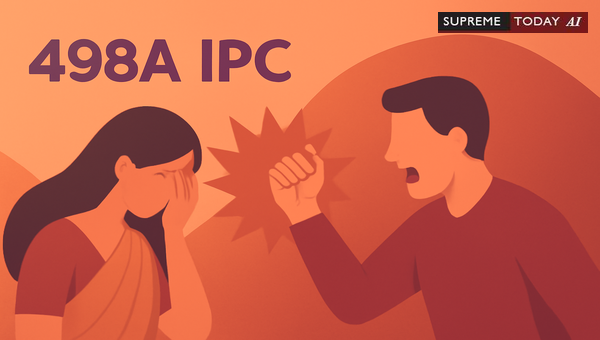
Single Act Not Cruelty Under : Key Insights
In the realm of Indian , (IPC) is a powerful provision aimed at protecting women from . However, not every disagreement or isolated event crosses the threshold into criminal territory. A common question arises: Does a solitary incident or act amount to cruelty making the accused liable for punishment under Section 498A of IPC? The answer, as established through , is generally no. This blog delves into the nuances of cruelty under Section 498A, emphasizing the need for conduct over isolated acts.
Understanding this distinction is crucial for anyone navigating family disputes, legal proceedings, or simply seeking clarity on spousal rights and obligations. While this post provides general insights based on case law, it is not a substitute for professional legal advice—consult a qualified lawyer for your specific situation.
Defining Cruelty Under
addresses cruelty by a husband or his relatives towards a married woman. The legal definition of cruelty is explicitly outlined in the section:
- (a) Any likely to drive a woman to commit suicide or to cause grave injury or danger to her life, limb, or health (mental or physical).2020 0 Supreme(AP) 286
- (b) Harassment to coerce her or her relatives into meeting unlawful demands for property or valuable security, or on failure to meet such demands.1999 0 Supreme(Guj) 343
Courts have clarified that cruelty need not be physical; or abnormal behavior may suffice. As noted in one judgment, The aforesaid explanation also clarifies that the cruelty for the purposes of constituting the offence under need not be physical and even or may amount...2012 0 Supreme(Pat) 420
However, the bar is high. A one-off argument, taunt, or incident rarely meets this standard without more.
Key Legal Principles: Why Solitary Incidents Fall Short
1. Requirement of Conduct
A cornerstone principle is that cruelty under Section 498A demands , , and . Isolated acts do not suffice. The prosecution must prove a pattern driving the woman to desperation.2020 0 Supreme(AP) 286 1991 0 Supreme(AP) 335
For instance, routine taunts without escalation do not qualify: In the usual routine it appears that accused 2 and 3 taunted the deceased to insist upon her father to keep up the promise. The said conduct does not amount to an offence of cruelty under Section 498-A of the IPC.2006 0 Supreme(Kar) 120
2. Evidence of Prior Conduct Essential
Courts consistently rule that a single act, absent prior similar behavior, fails to establish the offense. Prosecutors need concrete evidence of a behavioral pattern.1999 0 Supreme(Guj) 343 2014 0 Supreme(HP) 1288
In acquittal appeals, doubts arise when evidence lacks depth: All these points alongwith many other grounds raised by the ... creates a doubt on the prosecution's evidence. Ms. Havewala submitted that what would amount to an offence under Section 498 (A) has been discussed in catena of judgments and the cruelty must be of such a degree that it must be willful conduct of such a nature as is likely to drive the woman to commit suicide...2021 0 Supreme(Bom) 1021
3. Nexus Between Cruelty and Severe Outcomes
There must be a between the cruelty and outcomes like suicide. The conduct must reasonably push the woman to such extremes.2016 0 Supreme(HP) 492 2014 0 Supreme(HP) 1010
Mere taunts due to infirmity, without extreme pressure, may not cross the line, though mental cruelty is recognized: She might have been taunted due to her physical infirmity being handicapped. Cruelty, as defined under Section 498-A IPC does not amount only to physical cruelty but it also attracts mental cruelty.2011 0 Supreme(P&H) 208
Contrastingly, repeated failures, like not facilitating a visa despite promises, can form a pattern: Therefore this Court finds that the appellant/first accused had committed of not taking effective steps to get visa... which resulted in P.W.1 loosing her mental and physical health. This ... amounts to cruelty as defined under section 498-A IPC...2020 0 Supreme(Mad) 371
Landmark Case Law Illustrations
reinforce these principles:
- : Not every harassment qualifies. Prosecution must prove intent to force suicide or illegal demands.2020 0 Supreme(AP) 286
- : Sections 498A and 306 () are distinct; a single act does not establish 498A guilt.2021 0 Supreme(Bom) 176
In acquittal-upholding cases, courts stress the : The court acquitted the accused of offences punishable under and ... based on the prosecution's failure to prove the case... The court emphasized the need for substantial and compelling reasons to disturb the 's acquittal...2021 0 Supreme(Bom) 1021
Another example highlights for lack of essentials: The court partially quashed summons, noting essential elements like marriage, cruelty, and relative involvement must be met, interpreting illicit relationship claims skeptically.2012 0 Supreme(Pat) 420
In dowry-related matters, absent soon-before-death harassment, convictions shift: The court found that the death was not a as the essential elements of cruelty and harassment in connection with the demand of dowry soon before death were not satisfied.2011 0 Supreme(P&H) 208
Practical Implications and Prosecution Challenges
For prosecutions to succeed:- Gather Pattern Evidence: Medical records, witness testimonies spanning time, communications showing repetition.- Contextualize Timing: Link acts to victim's mental state deterioration.- Avoid Overreach: False or exaggerated solitary claims risk backlash, as courts guard against misuse of 498A.
Defendants benefit by highlighting isolation: No prior complaints, mental health factors of the complainant, or lack of nexus.2021 0 Supreme(Bom) 1021
Conclusion and Key Takeaways
A solitary incident or act does not typically amount to cruelty under , liable for punishment. Courts demand proof of , with a clear nexus to harm.2020 0 Supreme(AP) 286 1999 0 Supreme(Guj) 343
Key Takeaways:- Focus on patterns, not isolates, for viable claims.- Mental and physical cruelty both count, but must be willful and severe.2012 0 Supreme(Pat) 420- Judicial scrutiny upholds acquittals without compelling evidence.2021 0 Supreme(Bom) 1021- In disputes, prioritize evidence and context to assess viability.
This framework promotes justice while curbing misuse. For personalized guidance, seek expert legal counsel. Stay informed, stay protected.
References: 2020 0 Supreme(AP) 286 1999 0 Supreme(Guj) 343 1991 0 Supreme(AP) 335 2014 0 Supreme(HP) 1288 2016 0 Supreme(HP) 492 2014 0 Supreme(HP) 1010 2021 0 Supreme(Bom) 176 2021 0 Supreme(Bom) 1021 2020 0 Supreme(Mad) 371 2012 0 Supreme(Pat) 420 2011 0 Supreme(P&H) 208 2006 0 Supreme(Kar) 120
#Section498A #IPCCruelty #MatrimonialLaw












