




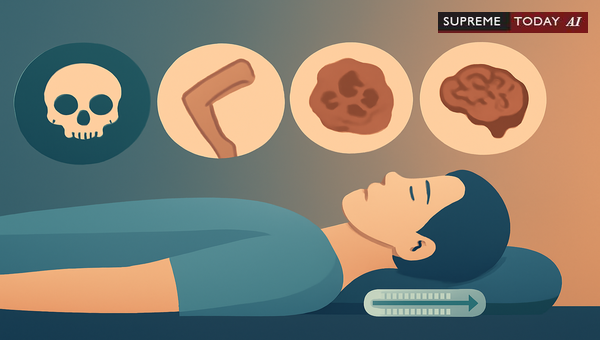
Symptoms of : Key Medical-Legal Signs
In , accurately determining death is crucial for criminal cases, insurance claims, and disability assessments. One common question arises: What are the symptoms of ? Understanding these signs helps professionals distinguish between life and death, preventing errors like premature declarations. This post explores the definition, primary indicators, and post-mortem changes associated with , drawing from medical-legal sources. Note: This is general information, not specific legal or medical advice—consult qualified experts for individual cases.
Defining
refers to the complete and irreversible cessation of the body's vital functions, often called the tripod of life: circulation, respiration, and brain activity. According to detailed medical-legal descriptions, is defined as the complete and irreversible stoppage of the circulation, respiration and brain functions 2014 0 Supreme(P&H) 1480. This marks the immediate halt of organ functions, distinguishing it from , where cellular functions cease after 3-4 hours 2017 0 Supreme(P&H) 2609.
In legal contexts, such as murder trials or insurance disputes, confirming relies on both immediate signs and subsequent changes. For instance, courts emphasize that estimation of time of death based on these signs is a broad estimation influenced by factors like age, health, climate, and body preservation conditions 2017 0 Supreme(P&H) 2609.
Primary Symptoms of
The core symptoms signal the stoppage of life's essential processes:
- Complete cessation of circulation: The heart stops beating, leading to no pulse.
- Cessation of respiration: No breathing occurs, observable through absent chest movement.
- Loss of brain functions: , confirmed by lack of reflexes and activity.
These are the foundational indicators, as death determined solely by the cessation of circulation and respiration is generally accepted 2014 0 Supreme(P&H) 1480. However, professionals advise corroborative evidence to avoid mistakes, especially in ambiguous scenarios like potential resuscitation.
Post-Mortem Changes: Confirmatory Signs
While primary symptoms are immediate, post-mortem changes provide objective evidence over time. These are critical in forensic pathology:
- (muscle stiffening): Begins 1-2 hours post-death, peaks around 12 hours, and fades after 24-36 hours. Its timing varies with temperature and cause of death, such as faster onset in violent cases with 2014 0 Supreme(P&H) 1480.
- (body cooling): The body cools to ambient temperature at about 1-1.5°F per hour initially.
- (): Blood pools in lower body parts due to gravity, appearing 30 minutes to 2 hours after death, fixed after 8-12 hours 2014 0 Supreme(P&H) 1480.
These signs are sufficient indicators of death, although they should not be relied upon solely without corroborative evidence 2014 0 Supreme(P&H) 1480. In practice, multiple changes are examined collectively.
Distinguishing Symptoms from Signs in Legal Contexts
Legal cases often hinge on differentiating subjective symptoms (patient-reported, like pain) from objective signs (observable, like lividity). A key insurance dispute clarified: A ‘symptom’ is a subjective evidence of disease, while a ‘sign’ is an objective evidence of disease 2020 Supreme(Online)(NCDRC) 741
Branch Manager, Bajaj Allianz Life Insurance Co. Ltd. VS Dalbir Kaur
. The insurer failed to link a symptom (blood in vomitus) to the cause of death, leading to claim approval since mere symptoms do not equate to a pre-existing disease; the insurer must establish a clear link between the symptom and the cause of death 2020 Supreme(Online)(NCDRC) 741.This distinction matters in repudiation cases under the , where unsubstantiated non-disclosure claims were dismissed, emphasizing the burden on insurers to prove nexus 2020 Supreme(Online)(NCDRC) 741.
in Criminal and Disability Cases
In homicide investigations, post-mortem signs help estimate time and manner of death. For example, symptoms of strangulation (e.g., specific neck marks) versus hanging were detailed, with witnesses noting no suicide indicators 2010 0 Supreme(Chh) 44 2010 Supreme(Online)(Chh) 116. Courts rely on such signs, but note they can simulate if inflicted between somatic and 2014 0 Supreme(Kar) 832.
Disability pensions consider service-aggravated death, decided by examining symptoms like psychiatric disorders post-family death
. In unnatural death probes, absent symptoms proving cause lead to acquittals, as cause of death has not been proved by placing any evidence
.
Moreover, clenched tongue or open eyes may suggest unnatural death like throttling, though debated in appeals 2021 0 Supreme(Bom) 1071. Time estimation remains approximate: Estimation regarding time of death on basis of medical science cannot be said to be accurate to every minute and hour 2017 0 Supreme(P&H) 2609.
Somatic vs. : A Timeline
precedes :
| Stage | Description | Timing ||-------|-------------|--------|| | Stoppage of heart, lungs, brain 2017 0 Supreme(P&H) 2609 | Immediate || | Cessation of all cellular functions 2017 0 Supreme(P&H) 2609 | 3-4 hours later |
Injuries post-somatic but pre-molecular may mimic ante-mortem wounds, creating investigative challenges 2014 0 Supreme(Kar) 832.
Key Takeaways for Medico-Legal Practice
- No single sign confirms death; use the triad plus post-mortem changes.
- Environmental factors affect sign timing—always consider context.
- In insurance, prove symptom-disease nexus for valid repudiations.
- Forensic exams demand comprehensive evidence to avoid doubt.
Conclusion
Symptoms of —cessation of circulation, respiration, brain function, plus , cooling, and lividity—form the bedrock of death certification in legal settings 2014 0 Supreme(P&H) 1480. Cases from insurance repudiations to murder trials underscore collective evaluation for reliability. While these provide broad guidance, determinations vary by circumstances. For precise application, engage forensic experts or legal counsel. Stay informed on evolving medico-legal standards to navigate complex scenarios effectively.
References:- 2014 0 Supreme(P&H) 1480: Core source on signs.- 2020 Supreme(Online)(NCDRC) 741,
Branch Manager, Bajaj Allianz Life Insurance Co. Ltd. VS Dalbir Kaur
,BRANCH MANAGER, BAJAJ ALLIANZ LIFE INSURANCE CO. LTD. & 2 ORS. vs DALBIR KAUR
: Symptom vs. sign in insurance.- 2017 0 Supreme(P&H) 2609, 2014 0 Supreme(Kar) 832: Somatic vs. .- Other cases:,
, 2010 0 Supreme(Chh) 44, 2021 0 Supreme(Bom) 1071. #SomaticDeath, #SignsOfDeath, #ForensicMedicine















