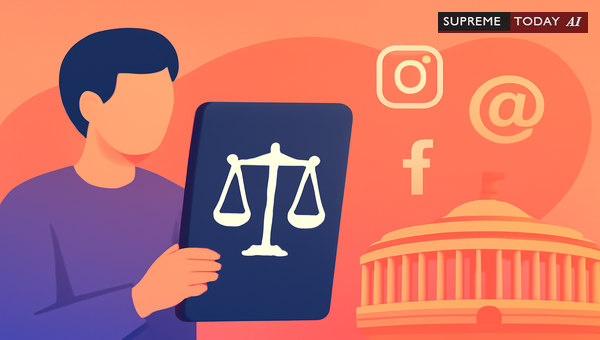
Can States Regulate Social Media Under Public Order Entry?
In today's digital age, social media platforms have become central to public discourse, activism, and even potential threats to societal harmony. A pressing legal question arises: Can Public Order Entry in State List Authorise the State to Enact Law on Social Media Regulation? This issue pits state legislative powers against fundamental rights to free speech under Article 19(1)(a) of the Indian Constitution.
As social media usage surges, states are increasingly eyeing regulations to curb misinformation, hate speech, and incitement. But does Entry 1 of List II (State List) in the Seventh Schedule—covering 'public order'—grant them this authority? This blog post delves into the constitutional framework, judicial interpretations, and limitations, drawing from key precedents. Note: This is general information, not legal advice. Consult a qualified lawyer for specific cases.
Main Legal Finding
The public order entry (Entry 1, List II) primarily authorizes states to enact laws aimed at maintaining public peace and tranquility, limited to sovereign functions directly related to public order, safety, and morality. However, comprehensive regulation of social media—which involves content moderation, online speech, and expression—overlaps with fundamental rights under Articles 19(1)(a), 19(2), and 19(6). Judicial pronouncements indicate that states' authority does not explicitly extend to broad social media oversight unless restrictions are reasonable, proportionate, and necessary. In Re : Ramlila Maidan Incident Dt. 4/5. 06. 2011 VS Home Secretary, Union Of India - 2012 2 Supreme 36Zameer Ahmed Latifur Rehman Sheikh VS State of Maharashtra - 2010 3 Supreme 494
Public order is a State subject under Entry 1, List II of the Seventh Schedule to the Constitution of India. The power to legislate on aspects of public order vests with the States. Maintenance of public order is the sovereign function of the State. S T. Peter's and St. Paul's Syrian Orthodox Church VS State Of Kerala, Represented by the Additional Chief Secretary to the Government, Home (Ssa) Department) - 2024 Supreme(Ker) 423 - 2024 0 Supreme(Ker) 423
Scope of Public Order Under Entry 1, List II
Entry 1 empowers states to legislate on matters affecting peace within their territory. Legal documents clarify that this encompasses maintaining peace, safety, and morality, but stays within sovereign domains. The Ajmer case explicitly held that laws under Entry 1 must primarily target peace and tranquility, not expansive social regulation. State Of Rajasthan VS G. Chawla - 1958 0 Supreme(SC) 175
However, 'public order' has a defined scope. Howsoever wide a meaning is assigned to the Entry 'Public Order', the present day problem of terrorism cannot be brought under the same by any stretch of imagination. Moreover, the entry 'Public Order' in the State List only empowers the States to enact a legislation relating to public order or security insofar as it affects or relates to a particular State. Pragyasingh Chandrapalsingh Thakur VS State of Maharashtra Through Additional Chief Secretary, Home Department - 2013 Supreme(Bom) 2067 - 2013 0 Supreme(Bom) 2067Peoples Union For Civil Libertiespetitioners VS Union Of India - 2003 8 Supreme 756 - 2003 8 Supreme 756
This limitation suggests social media laws must have a direct nexus to state-specific public order threats, not general platform governance.
Judicial Interpretation of Public Order
The Supreme Court views public order broadly yet precisely, tied to peace and safety. Restrictions on rights are allowed only if reasonable and proportionate. In Re : Ramlila Maidan Incident Dt. 4/5. 06. 2011 VS Home Secretary, Union Of India - 2012 2 Supreme 36Mallela Venkata Rao VS State Of A. P. - 2000 0 Supreme(AP) 844K. B. Saha And Sons Industries Pvt. Ltd. VS State of Orissa - 2019 0 Supreme(Ori) 16
In contexts like online content, courts stress that free speech curbs must protect public order without overreach. States can target incitement to violence, but not impose blanket censorship.
Social Media Regulation and Fundamental Rights
Social media extends Article 19(1)(a) protections. Regulations must pass tests of reasonableness and necessity. A. Kamala VS State, Rep. by Secretary to Government, Home, Prohibition and Excise Department - 2024 0 Supreme(Mad) 1211
Restrictions on social media or online speech are permissible only if they are justified within the framework of public order and fundamental rights. While states hold authority under Entry 1, incidental impacts on other entries are tolerable if the law's 'pith and substance' aligns with public order. Play Games 24x7 Private Limited, A Company Incorporated Under The Companies Act 1956, Represented By Its Authorized Representative Mr. Sameer Chugh vs State of Tamil Nadu, Through Chief Secretary, Secretariat - MadrasKERALA FILM EXHIBITORS FEDERATION VS STATE OF KERALA - Kerala
US precedents offer comparative insight: official social media activity may qualify as state action if involving state law, resources, or staff. Lindke v. Freed - Supreme Court of the United States Applying this, Indian states could regulate official accounts threatening order, but private platforms demand careful balancing.
Overlap, Limitations, and Counterarguments
States may regulate content inciting violence or disharmony under public order, but comprehensive ecosystem control exceeds scope. S T. Peters VS State Of Kerala Represented By The Additional Chief Secretary To The Government, Home (Ssa) Department) - 2024 0 Supreme(Ker) 496
Counterarguments note Entry 1's breadth could include digital threats to tranquility, akin to other regulations. Yet, precedents like those on taxation entries show powers are entry-specific. If we compare Entry 8 in List II with Entry 51 it is clear that when Entry 51 authorises the State legislature to levy tax and duties on alcoholic liquors falling in Entry 51, Entry 8 confers authority on the State legislature to enact laws for regulation. STATE OF ORISSA VS UTKAL DISTILLERIES LTD. - 2022 3 Supreme 355 - 2022 3 Supreme 355STATE OF ORISSA vs M/S UTKAL DISTILLERIES LTD. - Supreme Court
Social security entries similarly limit burdens. Kerala Film Exhibitors Federation vs State of Kerala - 2025 Supreme(Online)(Ker) 21302 - 2025 Supreme(Online)(Ker) 21302
Exceptions Where Regulation is Permissible
Targeted measures are viable:- Reasonable, non-arbitrary restrictions protecting order, morality, or health. In Re : Ramlila Maidan Incident Dt. 4/5. 06. 2011 VS Home Secretary, Union Of India - 2012 2 Supreme 36Zameer Ahmed Latifur Rehman Sheikh VS State of Maharashtra - 2010 3 Supreme 494- Content inciting hatred or violence. S T. Peters VS State Of Kerala Represented By The Additional Chief Secretary To The Government, Home (Ssa) Department) - 2024 0 Supreme(Ker) 496- Subject to Article 19 judicial review. All India Gaming Federation VS State of Tamil Nadu Through Chief Secretary, Chennai - MadrasPlay Games 24x7 Private Limited, A Company Incorporated Under The Companies Act 1956, Represented By Its Authorized Representative Mr. Sameer Chugh vs State of Tamil Nadu, Through Chief Secretary, Secretariat - Madras
Public Order - 'Public order' is a State subject under Entry 1 of List II... This power cannot be delegated and encompasses laws related to public peace, safety, and tranquility. S T. Peters VS State Of Kerala Represented By The Additional Chief Secretary To The Government, Home (Ssa) Department) - 2024 0 Supreme(Ker) 496S T.PETER'S AND ST.PAUL'S SYRIAN ORTHODOX CHURCH vs STATE OF KERALA - Kerala
Recommendations for States and Stakeholders
- Draft targeted laws defining social media scopes tied to public order.
- Ensure direct nexus to peace preservation for constitutional validity.
- Anticipate judicial review; prioritize proportionality.
Businesses and users should monitor state laws but challenge overreaches via courts.
Conclusion and Key Takeaways
While Entry 1 grants states robust public order powers, it does not inherently authorize sweeping social media regulation. Laws must be narrowly tailored to sovereign functions, respecting free speech. Content regulation must be targeted and proportionate, respecting constitutional protections. S T. Peters VS State Of Kerala Represented By The Additional Chief Secretary To The Government, Home (Ssa) Department) - 2024 0 Supreme(Ker) 496
Key Takeaways:- States can act on social media threats to peace but not broadly censor.- Fundamental rights demand reasonableness.- Judicial precedents guide limits. In Re : Ramlila Maidan Incident Dt. 4/5. 06. 2011 VS Home Secretary, Union Of India - 2012 2 Supreme 36Mallela Venkata Rao VS State Of A. P. - 2000 0 Supreme(AP) 844
Stay informed as digital laws evolve. For tailored advice, seek professional counsel.
References
- In Re : Ramlila Maidan Incident Dt. 4/5. 06. 2011 VS Home Secretary, Union Of India - 2012 2 Supreme 36: Scope of public order as State subject.
- Zameer Ahmed Latifur Rehman Sheikh VS State of Maharashtra - 2010 3 Supreme 494: Sovereign functions under Entry 1.
- Mallela Venkata Rao VS State Of A. P. - 2000 0 Supreme(AP) 844: Reasonable restrictions on speech.
- A. Kamala VS State, Rep. by Secretary to Government, Home, Prohibition and Excise Department - 2024 0 Supreme(Mad) 1211: Social media and rights framework.
- S T. Peters VS State Of Kerala Represented By The Additional Chief Secretary To The Government, Home (Ssa) Department) - 2024 0 Supreme(Ker) 496: Targeted content regulation.
- Pragyasingh Chandrapalsingh Thakur VS State of Maharashtra Through Additional Chief Secretary, Home Department - 2013 Supreme(Bom) 2067 - 2013 0 Supreme(Bom) 2067: Limits of 'public order' entry.
- Others as cited.
#PublicOrderIndia, #SocialMediaLaw, #StateLegislation