


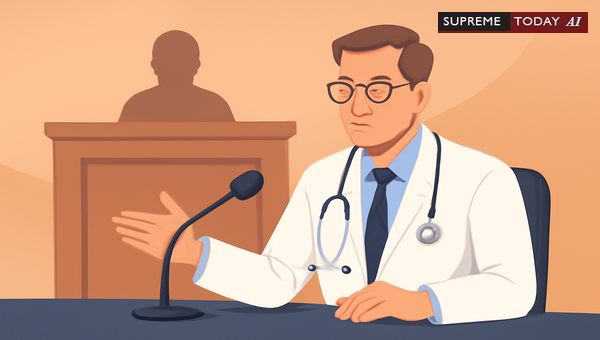
Supreme Court Ruling: Doctors Need Not Appear in Court to Testify – A Step to Save Lives
In a landmark decision, the has addressed a critical issue in the judiciary: the burden on busy doctors forced to testify in court. The question at hand is clear – Commission Which Says Doctors Need Not Come to Court to Testify Instead can Save Lives Ruling Supreme Court. This ruling recognizes that pulling doctors away from their life-saving duties for lengthy court appearances not only wastes valuable time but can endanger lives. Instead, the Court advocates for efficient alternatives like recording testimony on commission, prioritizing doctors' schedules to ensure they remain focused on patient care. 2010 0 Supreme(SC) 991
This progressive stance aims to modernize legal proceedings while protecting medical professionals from unnecessary harassment. In this blog post, we'll dive into the key findings, counterarguments, supporting case law, and practical recommendations, drawing from authoritative sources.
Understanding the Supreme Court's Key Findings
The Supreme Court has explicitly acknowledged the real-world challenges doctors face when summoned to court. Doctors are often reluctant to appear due to packed schedules, low priority in court listings, and fears of providing unfavorable evidence. 2010 0 Supreme(SC) 991
Core Recommendations from the Ruling:
- Prioritizing Doctors' Time: Courts must value doctors' busy schedules. The Court emphasizes the need to accommodate doctors' busy schedules and recognize the value of their time. 2010 0 Supreme(SC) 991
- Testimony via Commission: Evidence from treating doctors can be recorded on commission at their convenient timings, avoiding the need for physical court presence. 2010 0 Supreme(SC) 991
- Efficient Recording Processes: Testimony should be taken promptly without making doctors wait endlessly. 2010 0 Supreme(SC) 991
- Specific Time Slots: Allocate precise slots for court appearances rather than vague 'arrive by 10 AM' instructions. 2010 0 Supreme(SC) 991
- Consent-Based Evidence: Uncontested medical certificates can be marked by consent, bypassing oral testimony altogether. 2010 0 Supreme(SC) 991
These measures ensure justice is served without compromising healthcare delivery. The Court warns not to arrest or harass doctors unless facts fit parameters from the Jacob Mathew case, emphasizing protection from . We further warn the officials not to arrest or harass doctors unless the facts clearly come within the parameters laid down in Jacob Mathew case. 2025 0 Supreme(Kar) 324
Potential Counterarguments and Fairness Concerns
While the ruling promotes efficiency, some voices raise valid concerns:- Complex Legal Issues: Direct examination may be essential for intricate cases, even if time-consuming. 2002 5 Supreme 337- Rights: Parties might argue that fairness demands in-person of doctors. 2002 5 Supreme 337
These points highlight the need for balance. Courts must weigh efficiency against procedural justice, potentially using video conferencing as a middle ground. Sources note that procedures like are admissible in certain circumstances, supporting flexible testimony methods. 2024 Supreme(US)(ca4) 21
Protection of Doctors: Insights from Landmark Cases
The Supreme Court's approach builds on a strong legacy of safeguarding medical professionals. The Jacob Mathew v. State of Punjab () case is pivotal, laying down guidelines for . It stipulates that liability arises only for or lack of requisite skill, not mere . The Supreme Court realising that doctors have to be protected from of , has laid down certain rules in this connection. 2025 0 Supreme(Kar) 324 2024 0 Supreme(Mad) 2412
Further, the Court stresses shielding doctors from unjust punishment to prevent a 'play-it-safe' mentality that could harm patients. Such treatment of medical professionals may discourage them from taking necessary risk to save lives, instead adopting a 'play-it-safe' approach, ultimately harming patient care.
Jenbagalakshmi VS State of Tamil Nadu - Crimes ()
In , the Supreme Court held that should not face unnecessary harassment. Simple lack of care, error of judgment, or an accident is not proof of negligence. 2021 0 Supreme(Chh) 252
Recent observations reinforce this: The Supreme Court emphasised the need to protect doctors from frivolous and unjust prosecutions. Investigating officers must obtain independent medical opinions before proceeding. 2007 0 Supreme(Bom) 1580 2007 0 Supreme(Bom) 643
These protections extend to testimony, allowing affidavits or to minimize disruption. Doctors' Testimony & Court Proceedings - The Supreme Court emphasized that doctors need not be compelled to appear in court as witnesses; instead, they can provide testimony through affidavits or . 2025 0 Supreme(Kar) 324 2024 Supreme(US)(ca4) 159
Procedural Innovations and Global Parallels
The ruling aligns with evolving court procedures. For non-retained expert witnesses like treating doctors, less burdensome disclosures suffice, reducing paperwork. 2023 Supreme(US)(ca11) 199
In consumer disputes, courts have ruled against attributing negligence without clear evidence, relying on Supreme Court precedents. It is not feasible to attribute negligence / deficiency on the and the doctor therein. 2025 Supreme(Online)(SCDRC) 22682 2025 Supreme(Online)(SCDRC) 23067
must defer to Supreme Court rulings in conflicts, ensuring uniformity. If any ruling of a High Court is in conflict with any ruling of the Supreme Court, the ruling of the Supreme Court is always binding. 2005 0 Supreme(Jhk) 799
Practical Recommendations for Courts and Litigants
To implement this ruling effectively:- Adopt Doctor-Friendly Procedures: Schedule specific times and use commissions for testimony. 2010 0 Supreme(SC) 991- Leverage Technology: Explore video conferencing or for expert evidence.- Obtain Expert Opinions Early: Investigating agencies should secure independent medical views before action. 2007 0 Supreme(Bom) 643- Balance Efficiency and Fairness: Ensure alternatives maintain rights where needed. 2002 5 Supreme 337
Litigants should consent to certificates when uncontested, speeding up cases. During crises like pandemics, doctors risk everything to save lives – legal systems must reciprocate. Thousands of doctors across the country are working tirelessly for hours together to save lives. 2020 0 Supreme(Guj) 944
Note: This article provides general information based on public rulings and is not legal advice. Consult a qualified attorney for specific cases.
Conclusion and Key Takeaways
The Supreme Court's ruling marks a vital shift towards a doctor-friendly judiciary, allowing testimony via commission to free doctors for life-saving work. Anchored in Jacob Mathew and reinforced by multiple precedents, it protects against frivolous actions while upholding justice. 2010 0 Supreme(SC) 991 2025 0 Supreme(Kar) 324
Jenbagalakshmi VS State of Tamil Nadu - Crimes ()
Key Takeaways:- Doctors' time is precious – use commissions and slots wisely.- standard applies; errors aren't negligence.- Technology and consent streamline proceedings.- Courts must balance speed with fairness.
By embracing these changes, India's judiciary can enhance efficiency, protect healers, and ultimately save more lives. Stay informed on evolving legal protections for medical professionals.
#SupremeCourtIndia, #DoctorsRights, #MedicalTestimony















